
China’s 15th Five-Year Plan: EV Charging Infrastructure Moves Toward a National, High-Power Network
China is entering a new phase of electric-vehicle charging infrastructure development under the 15th Five-Year Plan (2026–2030). The policy focus is shifting from simply increasing charger numbers toward building a more integrated network that supports urban mobility, intercity travel, rural adoption and commercial transport.
The National Development and Reform Commission (NDRC) and National Energy Administration (NEA) issued the “15th Five-Year Plan for the Development of the New Power System” (《新型电力系统建设“十五五”规划》) in July 2026. The plan sets a new framework for charging infrastructure through 2030. The State Council’s policy interpretation, published in August, highlights the expected changes in EV charging provision over the next five years.
Executive summary
- China is moving toward a nationally integrated charging network covering cities, highways and rural areas.
- The infrastructure target is more than 40 million charging facilities by 2030, supporting more than 110 million electric vehicles.
- High-power charging is becoming a larger part of the infrastructure mix.
- Rural and county-level charging coverage will expand significantly.
- Highway charging networks and dedicated charging for heavy trucks are receiving greater attention.
- Residential charging is moving toward more coordinated construction and service models.
- The policy creates opportunities across charging equipment, energy management, digital platforms, infrastructure operations and related services.
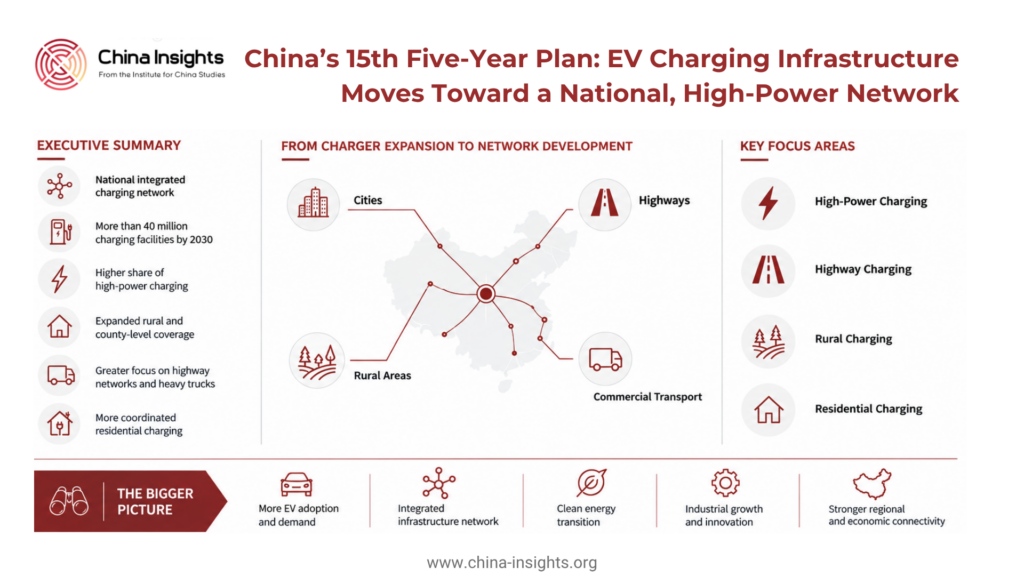
From charger expansion to network development
The key change is the move from a primarily quantitative approach to a network-based model. The new policy framework calls for differentiated infrastructure layouts: area-based coverage in cities, linear networks along roads and point-based coverage in rural areas.
This reflects the changing maturity of China’s EV market. The initial challenge was to establish sufficient charging capacity. The next challenge is to ensure that charging infrastructure is available where vehicles travel and where demand is concentrated.
For businesses, this changes the investment logic. Location, utilization rates, grid access, operating efficiency and integration with other energy services will become increasingly important alongside the number of chargers installed.
High-power charging becomes a strategic priority
The new plan places greater emphasis on fast and high-power charging. Around 300,000 high-power charging facilities are expected by 2030. The policy calls for an increased share of fast-charging infrastructure and the orderly development of higher-power facilities.
This is commercially significant because charging speed is becoming a more important factor as battery capacity and vehicle range increase. Higher-power charging can also reduce the land and time requirements associated with charging large numbers of vehicles.
The shift will increase demand for higher-capacity charging equipment, grid connections, power-management systems and technologies capable of managing peak loads. Equipment suppliers may therefore need to compete increasingly on charging performance, reliability and system integration rather than basic hardware cost.
Highway charging moves toward an intercity network
The policy gives specific attention to charging facilities at expressway service areas. Existing facilities are to be upgraded, with the objective of creating an intercity charging network capable of supporting longer-distance travel.
This addresses one of the remaining infrastructure gaps in the EV ecosystem. Urban charging has developed relatively rapidly, but long-distance travel requires a more predictable network with adequate capacity and operational reliability.
For charging operators, highway locations may offer a different commercial model from urban charging. Traffic volumes, peak travel periods, grid capacity and service-area economics will become important factors in determining investment returns.
Rural charging becomes part of national coverage
The policy also expands the role of charging infrastructure in rural and county-level markets. The stated objective is to achieve public charging coverage across rural areas, with exceptions for islands and high-altitude or extremely cold regions.
This is closely linked to China’s wider effort to expand NEV adoption in lower-tier markets. The government has increasingly combined vehicle promotion with charging infrastructure development. More comprehensive rural coverage should reduce one of the barriers to wider NEV adoption outside major urban centres.
For businesses, this creates a geographically broader market. However, rural charging economics will differ from those in dense cities. Operators will need to manage lower utilization rates, dispersed demand and potentially higher infrastructure costs.
Heavy-truck charging becomes a separate market
A notable development is the explicit focus on high-power charging for electric heavy trucks. Infrastructure is to be developed along major national freight corridors.
This creates a distinct commercial opportunity. Heavy commercial vehicles have different charging requirements from passenger cars. Charging capacity, operating hours, grid connections and station design will need to reflect freight patterns and vehicle utilization.
The development of freight-oriented charging networks could therefore support a new segment for charging equipment manufacturers, energy companies, fleet operators and infrastructure investors.
Residential charging moves toward coordinated services
The policy also addresses a persistent bottleneck in urban charging: residential installation. Authorities intend to improve the process for connecting residential charging facilities to the electricity grid and promote pilot projects based on a centralized construction and service model.
This could change the market structure for residential charging. Instead of individual vehicle owners arranging equipment and grid connections independently, property managers, charging operators, utilities and other service providers could play a larger role.
The commercial opportunity therefore extends beyond charger manufacturing. Installation, operation, maintenance, billing and property-level energy management may become more integrated services.
Service quality becomes more important
The next stage of development also places greater emphasis on the quality of charging services. Authorities want to improve station environments, information on pricing and charging services, equipment maintenance and the overall user experience.
This indicates a shift from infrastructure availability toward operational performance. As the network becomes larger, unreliable equipment, unclear pricing and poor maintenance can become more significant constraints.
For operators, asset utilization and customer experience will increasingly influence competitiveness. Digital monitoring and predictive maintenance can become important tools for managing larger networks efficiently.
Charging becomes part of the new power system
The wider significance is that EV charging is increasingly being treated as part of China’s electricity-system transformation. The 15th Five-Year Plan for the Development of the New Power System links charging infrastructure with the broader development of a more flexible and intelligent power system.
This creates opportunities at the intersection of transport and energy. Charging networks can become not only electricity consumers but also managed assets within the power system. Load management, smart charging and other forms of electricity-demand optimization are likely to become increasingly important.
What this means for business
- Move beyond hardware: Growth opportunities will increasingly involve network operation, software, energy management and maintenance.
- Priorities high-power technology: Fast and high-power charging will become more important across passenger and commercial vehicles.
- Assess rural economics carefully: Expanded coverage creates opportunities but requires business models suited to dispersed demand.
- Develop freight-specific solutions: Heavy-truck charging is emerging as a distinct infrastructure market.
- Explore integrated residential services: Centralized construction and operation could create new roles for utilities, charging operators and property-service companies.
- Treat charging as an energy asset: Smart charging and grid integration will become increasingly important as the EV fleet expands.
Sources
- https://www.gov.cn/zhengce/202608/content_7077537.htm
- https://sousuo.www.gov.cn/zcwjk/policyDocumentLibrary?q=%E6%96%B0%E8%83%BD%E6%BA%90
- https://www.hunan.gov.cn/zqt/zcjd/mtjd/202608/t20260810_34042657.html
- https://www.dxzzzx.gov.cn/dxx/zfxxgk/zc/zcjd/zyzcjd/art/2026/art_f181ad0b57ea4837b86762d5a6709b38.html
Author
Dr. Richard van Ostende

Related Articles