
State Council Reviews Digital China Implementation: Focus Remains on Execution and Industrial Digitalization
China has reaffirmed digital transformation as a central element of its economic modernization strategy during the 15th Five-Year Plan (2026–2030). At a recent State Council Executive Meeting, the government reviewed progress in implementing the Digital China strategy and identified priorities for the next phase. The meeting did not introduce new policy measures but reinforced implementation of existing national strategies, including the Overall Layout Plan for the Construction of Digital China and the objectives of the 15th Five-Year Plan.
Executive Summary
- The State Council reaffirmed digital transformation as a national strategic priority.
- Continued investment is expected in digital infrastructure and data resources.
- Authorities called for faster integration of digital technologies with the real economy.
- Innovation, policy coordination and governance remain key implementation priorities.
- Policy support is expected to continue for AI, cloud computing, industrial digitalization and digital public services.
- Businesses should anticipate ongoing regulatory developments alongside continued investment.
Policy Background
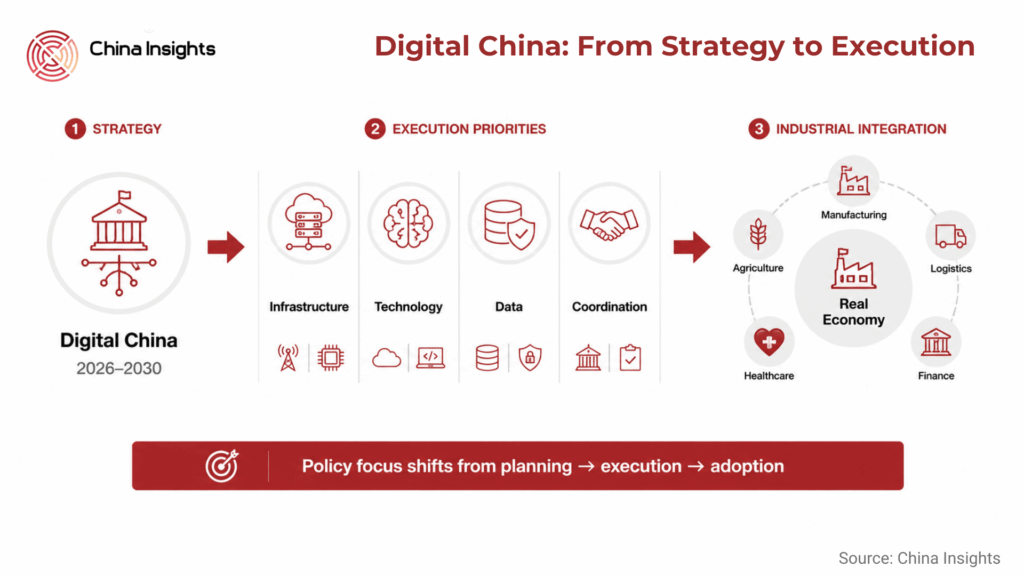
Digital China has become a comprehensive national strategy that extends beyond technology development to include industrial modernization, public services and government governance. During the meeting, the State Council reviewed implementation progress and discussed priorities for the next phase. As with many State Council Executive Meetings, the emphasis was on coordinating implementation across government agencies rather than announcing new legislation.
Implementation Progress
The State Council noted continued progress in expanding digital infrastructure, developing the digital economy and increasing the application of digital technologies across manufacturing, public administration and social services. At the same time, authorities acknowledged that implementation remains uneven across industries and regions, requiring stronger coordination and more efficient deployment of digital resources.
Accelerating Digital Industrialization
The meeting reiterated the importance of advancing both digital industrialization and the digital transformation of traditional industries. Digital industrialization focuses on expanding sectors such as software, artificial intelligence, cloud computing, integrated circuits and data services. Industrial digitalization aims to improve productivity through wider adoption of digital technologies across traditional industries.
Strengthening Digital Infrastructure
The State Council reaffirmed that digital infrastructure remains the foundation of Digital China. Future investment will continue to support computing capacity, communications networks, data infrastructure and related facilities that enable artificial intelligence, industrial internet applications, cloud computing and smart manufacturing.
Improving Data Utilization
Data continues to be treated as a strategic production factor. Authorities called for improved development, circulation and utilization of data resources while strengthening governance frameworks that support secure and efficient data use. This remains aligned with China’s broader efforts to balance innovation with cybersecurity, data security and personal information protection.
Enhancing Coordination
The meeting highlighted the need for stronger coordination across government agencies and industries to improve implementation of Digital China initiatives. Authorities also emphasized improving governance capabilities while encouraging practical application of digital technologies, reflecting China’s integrated approach to industrial policy, digital governance and regulatory oversight.
Supporting the Real Economy
A key message was the continued integration of digital technologies with the real economy. The government expects wider adoption of technologies such as artificial intelligence, cloud computing, industrial internet platforms and intelligent manufacturing to improve productivity across manufacturing, logistics, finance, healthcare, education and agriculture.
Long-Term Direction
The meeting confirms that Digital China remains a long-term national strategy focused on implementation rather than new policy announcements. Current efforts are directed toward accelerating execution, improving coordination and advancing existing strategic objectives established under earlier policy frameworks.
What this means for business
The State Council’s review indicates continued policy support for digital transformation throughout the 15th Five-Year Plan.
Companies operating in cloud computing, artificial intelligence, software, cybersecurity, telecommunications, industrial internet platforms and data infrastructure are expected to benefit from sustained government investment.
Businesses across traditional industries should also prepare for continued digital transformation initiatives and evolving requirements relating to data governance, cybersecurity and digital regulation.
Overall, the meeting reinforces the government’s long-term commitment to Digital China and provides further clarity on implementation priorities rather than introducing new policy measures.
Source
https://www.gov.cn/zhengce/202607/content_7075100.htm
Author
Dr. Richard van Ostende

Related Articles