
China Signals Trillion-Yuan Automotive Aftermarket Expansion: Policy Direction and Industry Implications
China is reinforcing policy support for the automotive aftermarket as a strategic growth segment within the broader automotive consumption ecosystem. The Ministry of Commerce (MOFCOM) highlighted that the automotive post-purchase service market represents a trillion-yuan-scale industry with significant growth potential.
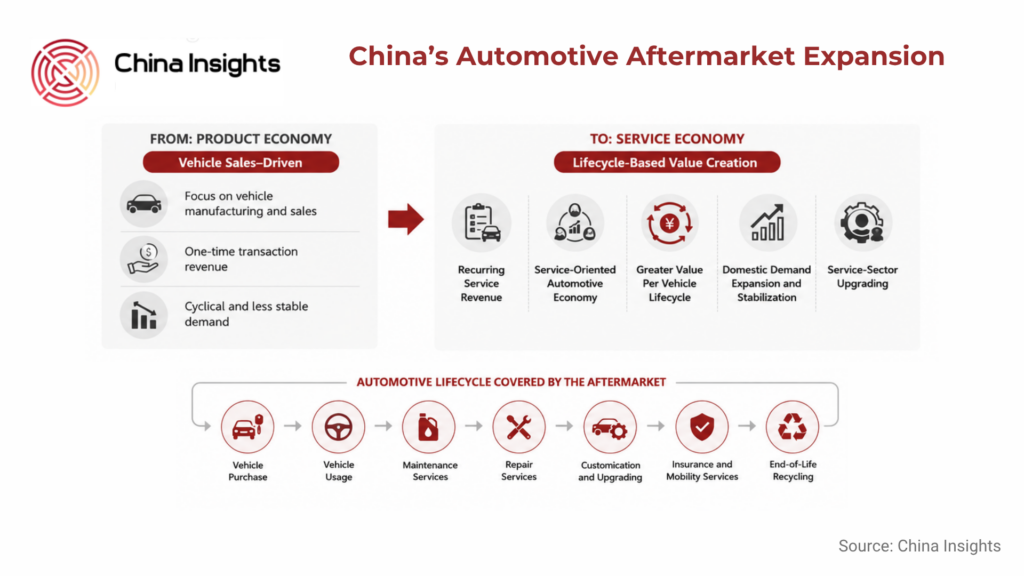
The policy direction reflects a structural shift in China’s automotive strategy from vehicle sales-driven growth toward lifecycle-based value creation, covering usage, maintenance, services, and end-of-life recycling.
Executive Summary
- The Ministry of Commerce (MOFCOM) identifies the automotive aftermarket as a trillion-yuan-scale industry.
- Policy focus is shifting from vehicle sales to full lifecycle automotive consumption.
- Key segments include maintenance, repair, customization, recycling, and mobility services.
- The aftermarket is positioned as a major driver of domestic demand expansion and service-sector upgrading.
- Regulatory direction supports standardization, digitalization, and structured market development.
Policy Context and Official Positioning
The Ministry of Commerce (MOFCOM) emphasizes that the automotive aftermarket has become a critical component of China’s consumption system. The statement reflects a broader policy consensus that automotive consumption is no longer limited to vehicle acquisition but extends across the full lifecycle of vehicle usage. The policy framing positions the aftermarket as a structural pillar of consumption upgrading and service sector expansion.
Market Structure of the Automotive Aftermarket
The automotive aftermarket covers economic activities generated after vehicle purchase. This includes maintenance services, repair operations, spare parts supply, vehicle modification, insurance services, and end-of-life recycling.
The sector is characterized by high fragmentation, regional variation, and uneven service standards. The policy direction aims to improve standardization and integration across these segments. The expansion of vehicle ownership in China has created a large installed base of cars, which directly supports long-term demand for aftermarket services. The Ministry of Commerce highlights that this structural base provides the foundation for sustained trillion-yuan-scale market activity.
Shift Toward Lifecycle-Based Consumption
A key policy direction is the transition from transaction-based automotive consumption to lifecycle-based consumption. Traditional automotive markets are dominated by vehicle sales. The current policy framework expands the economic focus to include usage, maintenance, upgrading, and disposal stages. This shift increases the total economic value generated per vehicle over its lifecycle. It also increases the importance of service networks, data systems, and long-term customer engagement models. The policy reflects a structural adjustment in China’s consumption strategy toward service-oriented growth.
Role of Standardization and Market Regulation
The automotive aftermarket is undergoing increased regulatory standardization. The policy direction emphasizes improving service quality, pricing transparency, and operational compliance across fragmented service providers. Standardization is particularly relevant in repair services, parts distribution, and vehicle modification sectors, where inconsistent practices have historically affected market efficiency. Regulatory authorities aim to reduce information asymmetry between service providers and consumers. This includes strengthening certification systems and improving oversight of service quality standards. The policy also supports improved coordination between local regulatory bodies to ensure consistent enforcement.
Digitalization and Platform Integration
Digital transformation is a key structural driver in the automotive aftermarket. The policy direction supports the development of digital platforms for maintenance tracking, service booking, parts supply chain integration, and vehicle history records. Data integration is expected to improve market efficiency and reduce transaction costs. It also enables better pricing transparency and service traceability. Platform-based service models are increasingly becoming central to aftermarket organization. These platforms integrate multiple service providers and create standardized service ecosystems. The policy supports the use of digital tools to enhance market transparency and operational efficiency.
Expansion of Service-Oriented Automotive Economy
The Ministry of Commerce highlights the automotive aftermarket as part of China’s broader service economy expansion strategy. Service-oriented automotive activities include maintenance contracts, insurance services, leasing arrangements, and customization services. These segments typically generate recurring revenue streams compared to one-time vehicle sales. The expansion of these services increases the economic resilience of the automotive sector by reducing reliance on cyclical vehicle demand. It also creates opportunities for value-added service providers across the automotive value chain.
Industrial Linkages and Supply Chain Development
The automotive aftermarket is closely linked to upstream manufacturing and downstream service industries. Spare parts production, logistics, recycling, and digital service platforms are all integrated into the broader ecosystem. The policy direction encourages better coordination between manufacturing and service sectors. This includes improving supply chain efficiency for spare parts and strengthening reverse logistics systems for recycling. The development of a structured aftermarket ecosystem is expected to support both industrial upgrading and consumption expansion objectives.
Sustainability and Circular Economy Integration
The automotive aftermarket also plays a role in China’s circular economy strategy. Vehicle recycling, remanufacturing, and parts reuse are increasingly integrated into policy frameworks. The expansion of structured recycling systems supports resource efficiency and environmental objectives. It also creates new industrial value streams within the automotive lifecycle. The policy direction encourages formalization of end-of-life vehicle management systems to improve environmental compliance and resource recovery rates.
Economic Significance and Demand Stabilization
The trillion-yuan-scale valuation of the automotive aftermarket reflects its importance as a stabilizer of domestic consumption demand. Unlike vehicle sales, which are cyclical, aftermarket services generate more stable and recurring revenue. This contributes to consumption resilience in the broader economy. The policy also supports domestic demand expansion by increasing per-vehicle consumption over time, rather than relying solely on new vehicle purchases. This aligns with China’s broader macroeconomic strategy of strengthening internal demand drivers.
What this means for business
The recognition of the automotive aftermarket as a trillion-yuan industry signals a structural shift in China’s automotive economy toward service-based value creation.
- For automakers, this increases the importance of building integrated service ecosystems, including maintenance networks, digital platforms, and lifecycle service offerings.
- For aftermarket service providers, the policy supports market expansion but also increases expectations for standardization, digital integration, and compliance.
- For investors and technology providers, opportunities are expanding in automotive platforms, spare parts logistics, data-driven service systems, and vehicle lifecycle management solutions.
Overall, the policy direction reinforces a long-term transition toward a structured, digitally enabled, and service-intensive automotive ecosystem in China.
Source
https://www.gov.cn/zhengce/202606/content_7073143.htm
Author
Dr. Richard van Ostende

Related Articles