
China Adjusts Vehicle Tax Incentives for Energy-Efficient and New Energy Vehicles
China has announced a significant adjustment to its vehicle and vessel tax incentive framework targeting energy-efficient vehicles and new energy vehicles. The policy marks a transition from broad-based tax exemptions and reductions toward a more standardized tax treatment across vehicle categories.
The “Announcement on Adjusting Vehicle and Vessel Tax Preferential Policies for Energy-Saving Vehicles and New Energy Vehicles” (《关于调整节能汽车、新能源汽车车船税优惠政策的公告》) was jointly issued by the Ministry of Finance, the State Taxation Administration, and the Ministry of Industry and Information Technology, and will take effect from 1 January 2027.
Executive Summary
- China will phase out vehicle and vessel tax incentives for key energy-saving and new energy vehicle categories from 1 January 2027.
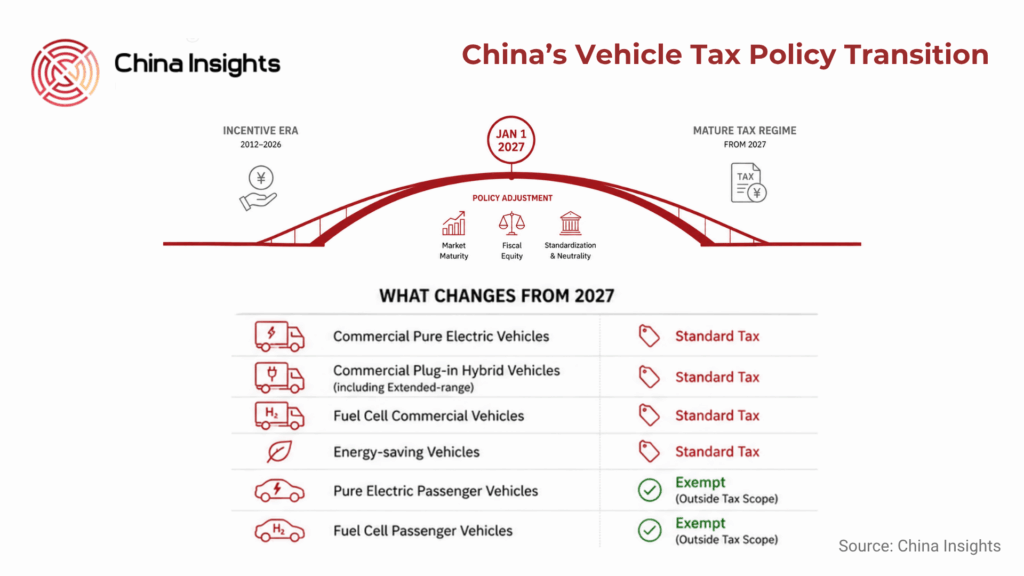
- The exemption for pure electric commercial vehicles, plug-in hybrid vehicles (including extended-range), fuel cell commercial vehicles, and energy-saving vehicles will be removed.
- The tax reduction for energy-saving passenger vehicles will also be discontinued.
- Pure electric passenger vehicles and fuel cell passenger vehicles remain outside the scope of vehicle and vessel tax.
- The policy shift is driven by market maturity of China’s new energy vehicle sector and fiscal equity considerations.
- From 2027 onward, affected vehicles will be taxed according to provincial vehicle and vessel tax schedules under the Vehicle and Vessel Tax Law.
- Tax collection will continue through insurance-linked withholding or direct taxpayer filing channels.

Policy Background and Regulatory Rationale
The vehicle and vessel tax in China is a property-based tax levied annually on vehicle and vessel owners or managers. Tax rates vary by vehicle type and engine displacement or weight classification, with provinces applying tax bands within nationally defined ranges.
Since 2012, China has implemented preferential tax policies to promote energy-saving and new energy vehicles. These policies included reduced taxation for energy-saving vehicles and full exemptions for qualifying new energy commercial vehicles, including battery electric, plug-in hybrid, and fuel cell categories, and has played a key role in supporting market expansion and industrial development of new energy vehicles over the past decade.
However, the authorities emphasize that the market has entered a new development phase. In 2025, China’s new energy vehicle sales reached 16.49 million units, accounting for more than 50 percent of domestic new car sales. This level of penetration indicates that the sector has moved beyond early-stage policy support.
The government also highlights the growing price dispersion within the sector. Some plug-in hybrid passenger vehicles have reached price levels above RMB 1 million. Policymakers therefore argue that continued tax exemptions may no longer align with principles of tax neutrality and horizontal equity.
Policy Content and Scope of Adjustment
The policy introduces a phased termination of preferential treatment starting 1 January 2027. Four main vehicle categories are affected:
- Energy-saving passenger vehicles that previously benefited from a 50 percent vehicle and vessel tax reduction will no longer receive preferential treatment.
- Pure electric commercial vehicles will no longer be exempt from vehicle and vessel tax.
- Plug-in hybrid commercial vehicles, including extended-range electric vehicles, will lose tax exemption status.
- Fuel cell commercial vehicles will also become taxable under standard rules.
Pure electric passenger vehicles and fuel cell passenger vehicles remain exempt, as they fall outside the taxable scope under China’s Vehicle and Vessel Tax Law.
The policy explicitly states that vehicles acquired before the implementation date will not retain legacy preferential treatment beyond 1 January 2027. This establishes a clear cutoff date and eliminates grandfathering effects.
Tax Calculation and Administrative Framework
From 2027 onward, affected vehicles will be taxed according to provincial implementation of the national Vehicle and Vessel Tax Law. Tax rates will continue to be determined within central government-defined bands, with provincial authorities setting specific applicable rates.
For passenger vehicles, tax is based on engine displacement categories. For commercial vehicles, taxation is based on seating capacity or vehicle weight. Tax payment mechanisms remain unchanged. Two primary channels continue to apply: insurance-based withholding, where tax is collected by insurance institutions during mandatory traffic insurance purchases, and direct taxpayer filing, which can be completed through online tax systems or in-person tax bureau services. Taxpayers are required to pay annually, with provisions for monthly calculation and lump-sum payment. Provincial governments will continue to determine specific filing deadlines.

Compliance and Administrative Location Rules
The policy maintains existing rules on tax jurisdiction. For registered vehicles, tax is paid in the vehicle registration location if filed directly by taxpayers. If tax is withheld by insurance institutions, payment is made in the jurisdiction of the insurance provider. For non-registered vehicles, tax liability is determined based on the location of the owner or managing entity. This structure preserves administrative continuity and minimizes changes to compliance procedures despite the policy shift.
Policy Interpretation and Industrial Implications
The adjustment reflects a transition in China’s industrial policy stance toward new energy vehicles. Early-stage fiscal incentives are being gradually replaced with market-based regulation. The policy signals that the new energy vehicle sector is entering a consolidation phase. Growth is no longer primarily driven by subsidies or tax exemptions but by cost competitiveness, technological maturity, and supply chain integration. At the same time, the policy reinforces fiscal standardization. By removing differentiated tax treatment for high-priced or commercially mature vehicle categories, authorities aim to improve tax neutrality across comparable asset classes. The continued exemption of pure electric passenger vehicles suggests that the government still differentiates between commercial and consumer segments in its taxation framework.
What this means for business
Automotive manufacturers will need to adjust pricing strategies for plug-in hybrid, extended-range, and commercial new energy vehicle segments in anticipation of reduced tax advantages. The removal of exemptions may affect total cost of ownership calculations and demand elasticity in certain commercial fleet markets.
Fleet operators, logistics companies, and public transport providers using new energy commercial vehicles will face higher operating costs from 2027. Procurement planning cycles may shift forward to optimize tax treatment before the policy takes effect. Insurance companies and tax collection intermediaries will maintain their central role in compliance enforcement, but administrative complexity is not expected to increase significantly. Overall, the policy marks a structural transition from incentive-driven expansion to a mature taxation regime for China’s new energy vehicle sector.
Source
https://www.gov.cn/zhengce/202607/content_7074227.htm
Author
Dr. Richard van Ostende

Related Articles