
China's 15th Five-Year Plan Reinforces Strategic Support for the Low-Altitude Economy
China is further elevating the role of the low-altitude economy as part of its industrial modernization strategy during the 15th Five-Year Plan period (2026–2030). Building on several years of policy support, the sector has evolved from an emerging industry into what policymakers increasingly describe as a new pillar of economic growth.
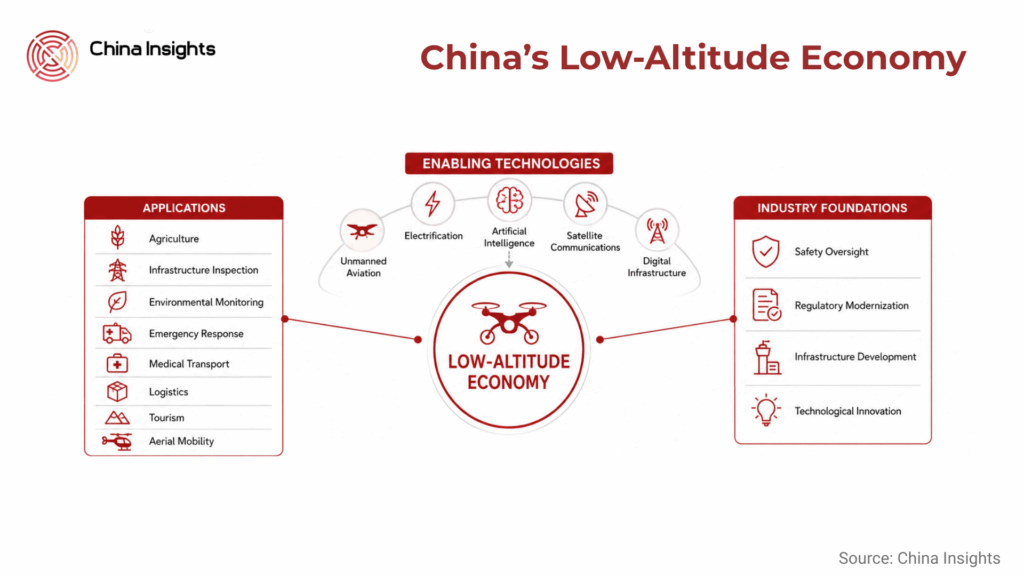
The low-altitude economy encompasses a broad range of activities involving drones, electric vertical take-off and landing aircraft (eVTOLs), general aviation, aerial logistics, emergency services, agricultural applications, infrastructure inspection, tourism, and other low-altitude aviation services. Advances in unmanned aviation, electrification, artificial intelligence, and digital infrastructure are creating new opportunities for commercial deployment and industrial development.
Recent guidance from the Civil Aviation Administration of China (CAAC) indicates that the next phase of development will focus on balancing rapid industry expansion with safety oversight, infrastructure development, regulatory modernization, and technological innovation.
Executive Summary
- China’s 15th Five-Year Plan (2026–2030) identifies the low-altitude economy as a strategic emerging pillar industry.
- Authorities are prioritizing the development of a comprehensive regulatory and safety management framework.
- The sector is experiencing rapid growth in drone registrations, flight activity, and commercial applications.
- Infrastructure development, including vertiports, flight service networks, communication systems, and navigation facilities, is expected to accelerate.
- Regulatory reforms will focus on airworthiness certification, operational standards, market access, and safety supervision.
- The government aims to support innovation while maintaining strict oversight of low-altitude operations.
- Opportunities are emerging across manufacturing, aviation services, digital platforms, infrastructure development, logistics, and advanced mobility solutions.
Low-Altitude Economy Gains Strategic Importance
The low-altitude economy has become an increasingly important component of China’s industrial and technology policies. Since 2023, the sector has been incorporated into a series of national policy initiatives aimed at fostering new growth engines and supporting the development of strategic emerging industries.
Successive government policy documents have highlighted the role of low-altitude aviation in driving innovation, stimulating domestic demand, strengthening industrial supply chains, and supporting regional economic development. The inclusion of the sector among China’s emerging pillar industries reflects growing confidence in its long-term economic potential.
Beyond its direct economic contribution, the sector is viewed as an important platform for advancing next-generation technologies, including autonomous systems, advanced batteries, artificial intelligence, satellite communications, and smart mobility solutions.
Expanding Commercial and Public-Service Applications
A key driver behind the sector’s growth is the expanding range of practical applications. Low-altitude aviation technologies are increasingly being deployed in agriculture, energy infrastructure inspection, environmental monitoring, emergency response, disaster relief, medical transport, and logistics operations.
These applications address tangible operational challenges while creating new business opportunities for technology providers, operators, and service companies. In agriculture, drones have become an important tool for crop monitoring and precision spraying. In the energy sector, unmanned aircraft are improving the efficiency of power line inspections and maintenance activities. Emergency response agencies are also increasingly utilizing drones for disaster assessment and rescue operations.
At the same time, authorities are encouraging the development of consumer-oriented applications such as low-altitude tourism, recreational aviation, and aerial mobility services, creating additional demand drivers for the industry.
Strong Growth Across the Industry
China’s low-altitude economy has expanded rapidly over the past several years. By March 2026, more than 3.8 million drones had been registered nationwide, while the number of licensed operators exceeded 430,000.
Flight activity has also increased significantly. During 2025, drone operations accumulated approximately 45.3 million flight hours, representing annual growth of nearly 70 percent. The manufacturing ecosystem continues to expand, with around 1,200 medium- and large-sized drone manufacturers and more than 40,000 operating enterprises active across the country.
These figures highlight the transition of the low-altitude economy from a niche sector into a rapidly developing industrial ecosystem with increasing commercial significance.
Source
Author
Dr. Richard van Ostende

Related Articles