
Analyzing the March 2026 CAAC Meeting
On March 3, 2026, Song Zhiyong, Administrator of the Civil Aviation Administration of China (CAAC), met with John Lee, Chief Executive of the Hong Kong Special Administrative Region (SAR), and his delegation in Beijing. The meeting centred on deepening cooperation in the civil aviation field and on integrating Hong Kong’s civil aviation more closely into China’s national development strategy. Liang Nan, Deputy Administrator of CAAC, and department heads from the Hong Kong and Macao Work Office of the CPC Central Committee were also in attendance.
The meeting took place nine days before the National People’s Congress formally approved the 15th Five-Year Plan for Economic and Social Development of the People’s Republic of China (15th FYP) on March 12, 2026. A timing that provides important context for how to interpret the exchanges that took place.
For businesses operating in or through Hong Kong, the meeting signals sustained political support for the SAR’s international aviation hub role, while the absence of a published CAAC sector sub-plan and the imminent entry into force of a revised Civil Aviation Law mean the regulatory landscape for 2026–2030 is still taking shape.
Executive Summary
On March 3, 2026, CAAC Administrator Song Zhiyong met with Hong Kong Chief Executive John Lee in Beijing to discuss civil aviation cooperation and Hong Kong’s alignment with national development strategy.
Both sides explicitly referenced the 15th Five-Year Plan (2026–2030), which was formally approved by the National People’s Congress on March 12, 2026, nine days after this meeting.
No CAAC-specific civil aviation sector sub-plan under the 15th FYP has been publicly released to date; sector-level plans typically follow the overarching FYP by months or years.
The meeting signals Hong Kong’s active engagement in ensuring its aviation interests are reflected in the forthcoming implementation framework.
The broader legislative context includes a revision of China’s Civil Aviation Law, adopted December 27, 2025, effective July 1, 2026, which updates the statutory foundation for the sector.
For businesses operating in or through Hong Kong’s aviation market, the meeting confirms political commitment at the highest administrative level to maintaining and enhancing Hong Kong’s hub status, though specific policy measures remain to be defined.
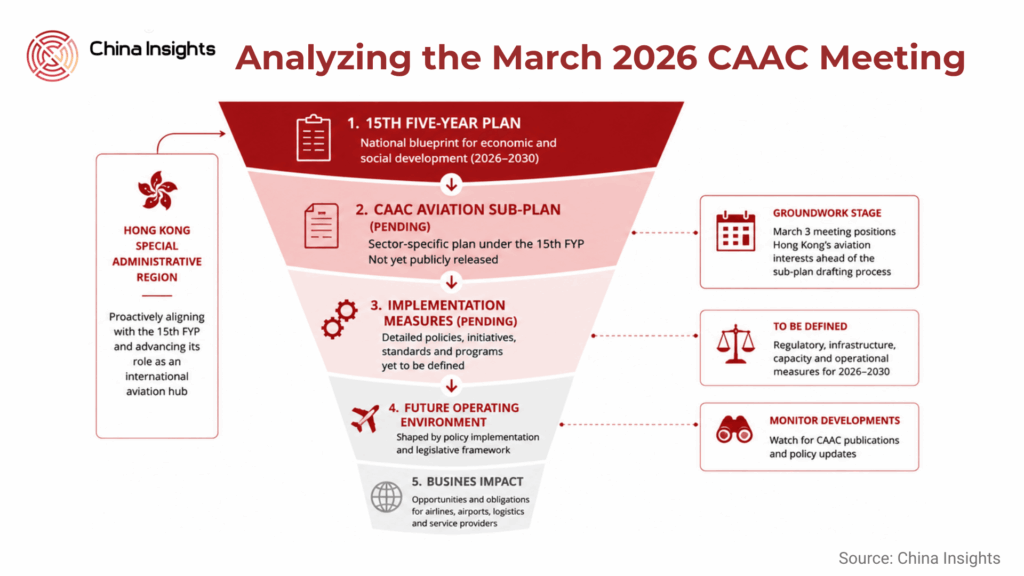
Commitments and Their Scope
The CAAC identifies two distinct but complementary sets of commitments. On Hong Kong’s side, John Lee stated the SAR would proactively align with the 15th FYP, seek new opportunities, and work to enhance Hong Kong’s competitiveness as an international aviation hub. On the mainland side, Song Zhiyong committed CAAC to continuing support for Hong Kong in consolidating and enhancing its hub status, deepening technical and professional exchanges, and leveraging Hong Kong’s position as a connector between domestic and international markets.
Notably, the framing on both sides emphasises Hong Kong’s role within the national system rather than as an independent actor. Song’s reference to Hong Kong’s “unique advantages in connecting the domestic and international markets” is consistent with the longstanding policy characterisation of Hong Kong as a connector, a role that gains renewed relevance as China pursues high-quality internationalisation of its civil aviation sector under the 15th FYP period.
The language of the meeting stops short of announcing specific agreements, new route arrangements, capacity targets, or regulatory harmonisation measures. The commitments are directional and political in nature, establishing intent rather than operational detail.
The Missing Layer: No CAAC Sector Sub-Plan Yet
A structural feature of China’s planning system is that the national FYP sits at the top of a hierarchy that cascades downward through sector-specific and regional sub-plans. Under the 14th FYP (2021–2025), CAAC published dedicated sub-plans covering areas including aviation logistics, green development, and general aviation.
As of the date of this article, no equivalent CAAC civil aviation sub-plan for the 15th FYP period has been publicly released. This is not unusual as sector plans regularly follow the overarching FYP by a period of months as ministries and agencies work through the detail of implementation. However, it does mean that the specific policy environment governing civil aviation for 2026–2030, including any provisions relating to Hong Kong, remains to be defined.
The March 3rd meeting should therefore be read in part as groundwork: an exchange that positions Hong Kong’s interests ahead of the drafting process for those forthcoming sector-level documents.
Revised Civil Aviation Law
Alongside the planning dimension, there is a relevant legislative development. On December 27, 2025, the National People’s Congress Standing Committee adopted a revision to China’s Civil Aviation Law, which enters into force on July 1, 2026. The update renews the statutory framework within which CAAC operates and under which sector-level policy will be formulated during the 15th FYP period. Businesses with operations touching the mainland civil aviation system should note the effective date.
Read more about the Revised Civil Aviation Law.
What This Means for Business
For airlines, airports, logistics operators, and aviation service providers with interests in or through Hong Kong, this meeting carries several practical implications.
Political commitment is confirmed, but detail is pending. CAAC’s support for Hong Kong’s hub status signals that the SAR’s aviation interests are being actively considered at the national planning level. However, the specific regulatory, infrastructure, and capacity framework for 2026–2030 remains to be defined. Businesses should monitor CAAC publications closely for sector-specific plans that will translate political commitment into operational policy.
The revised Civil Aviation Law requires immediate attention. The revision to China’s Civil Aviation Law, adopted December 27, 2025, enters into force on July 1, 2026. Companies subject to Chinese civil aviation regulation should review the revised statute for changes affecting compliance obligations, operational standards, or licensing requirements ahead of that date.
Governance context matters for strategic planning. The participation of the Hong Kong and Macao Work Office of the CPC Central Committee in the meeting is a reminder that Hong Kong’s aviation policy operates within a broader governance framework. Developments in this space will continue to reflect both commercial logic and national strategic priorities, and business planning should account for both dimensions.
Sources
https://www.caac.gov.cn/English/News/TPXW/202603/t20260311_230246.html
https://npcobserver.com/2026/02/24/china-npc-2026-five-year-development-plan-procedure-law/
Author
Dr. Richard van Ostende

Related Articles