
China Releases Third Round of Consumer Trade-In Subsidies to Support Domestic Demand
China continues to rely on targeted consumption stimulus measures as part of its broader strategy to support domestic demand and economic growth. One of the most visible policy tools has been the large-scale consumer goods trade-in program, which encourages households to replace older products with newer, more efficient alternatives through government subsidies.
On 31 July 2025, the National Development and Reform Commission (NDRC) announced the allocation of the third batch of funding supporting the program. The initiative forms part of China’s broader “Two New” (两新) policy framework, which promotes large-scale equipment renewal and consumer goods replacement.
The latest funding allocation signals the government’s continued commitment to stimulating consumption while simultaneously supporting industrial upgrading, energy efficiency improvements, and technological modernization.
Executive Summary
China has launched the third round of central government subsidies under its consumer goods trade-in program, reinforcing efforts to stimulate domestic consumption and support economic growth.
Key takeaways:
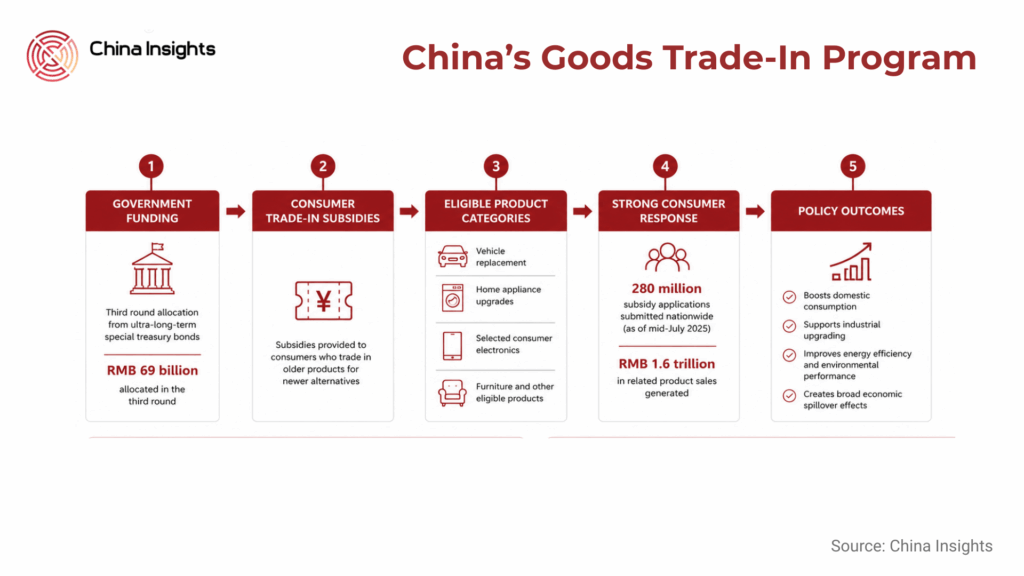
- The National Development and Reform Commission (NDRC) and the Ministry of Finance have allocated a third batch of funding worth RMB 69 billion from ultra-long-term special treasury bonds.
- The funding supports China’s ongoing consumer goods trade-in program, commonly referred to as the “national subsidy” or “国补” program.
- As of mid-July 2025, approximately 280 million applications for subsidies had been submitted nationwide.
- The program has generated more than RMB 1.6 trillion in related product sales.
- Subsidies continue to support vehicle replacement, home appliance upgrades, and selected consumer electronics purchases.
- Authorities intend to strengthen oversight to prevent abuse, ensure fair pricing practices, and maximize the economic impact of the program.
Policy Background
The consumer goods trade-in program was initially introduced as a key component of China’s efforts to boost domestic demand amid a challenging economic environment. The policy combines fiscal support with industrial policy objectives by encouraging consumers to purchase newer products while supporting manufacturers, retailers, and supply chains.
The program is funded through ultra-long-term special treasury bonds and is administered through cooperation between the National Development and Reform Commission, the Ministry of Finance, the Ministry of Commerce, and local governments.
Unlike broad-based consumption vouchers, the trade-in program targets specific categories of goods that are expected to generate significant economic multiplier effects while contributing to energy efficiency and technology adoption goals.
Third Round Funding Allocation
According to the National Development and Reform Commission, the third batch of funding amounts to RMB 69 billion. The funds have been distributed to local governments to continue implementation of the subsidy program across the country.
The allocation follows earlier rounds of funding and forms part of a planned multi-stage financing structure. Authorities have indicated that additional funding allocations will continue according to schedule to ensure that subsidy programs remain operational throughout the year.
The latest funding demonstrates the central government’s confidence in the effectiveness of the program as a policy tool for supporting consumption and maintaining economic momentum.
Strong Consumer Response
Official data released by the National Development and Reform Commission indicates that consumer participation has been substantial.
By 16 July 2025, approximately 280 million subsidy applications had been submitted nationwide. The program generated more than RMB 1.6 trillion in related sales, highlighting its significant impact on consumer spending and retail activity.
The data suggests that subsidy programs have successfully encouraged households to accelerate purchasing decisions, particularly for durable consumer goods that might otherwise have been postponed.
The scale of participation also indicates that consumers remain highly responsive to targeted financial incentives when purchasing higher-value products.
Impact on Key Consumer Sectors
Several consumer sectors have experienced particularly strong growth as a result of the subsidy program.
According to official statistics, retail sales of household appliances and audiovisual equipment, cultural and office supplies, communication devices, and furniture recorded strong year-on-year growth during the implementation period. Passenger vehicle sales also benefited from replacement incentives.
The program has been especially effective in supporting products that combine consumer demand with broader policy objectives such as energy efficiency, digitalization, and technological upgrading.
For manufacturers, the subsidies have helped stimulate demand in sectors facing slower market growth, while retailers have benefited from increased store traffic and higher transaction volumes.
Economic Policy Objectives
The subsidy program serves several policy objectives simultaneously.
First, it provides a direct boost to domestic consumption, which has become an increasingly important driver of China’s economic growth model.
Second, it supports industrial upgrading by encouraging consumers to replace older products with newer technologies.
Third, many eligible products offer improved energy efficiency and environmental performance, aligning the policy with China’s sustainability objectives.
Finally, the program supports employment and business activity across manufacturing, logistics, retail, and after-sales service sectors, creating broader economic spillover effects. This multi-dimensional policy design explains why authorities continue to allocate substantial financial resources to the initiative.
Strengthening Oversight and Implementation
While the program has delivered positive results, policymakers are also focused on ensuring effective implementation.
The National Development and Reform Commission has stated that it will continue working with the Ministry of Finance, the Ministry of Commerce, and other agencies to strengthen supervision of subsidy programs.
Particular attention will be paid to product quality, pricing practices, and compliance among participating businesses.
Authorities have specifically highlighted the need to prevent practices such as artificial price increases before subsidies are applied and fraudulent subsidy claims. These measures are intended to maintain public confidence in the program while ensuring that fiscal resources are used efficiently and transparently.
Looking Ahead
The third round of funding suggests that consumer subsidies will remain an important component of China’s economic policy toolkit. As policymakers seek to balance economic growth, industrial upgrading, and consumption expansion, targeted subsidy programs provide a relatively flexible mechanism for influencing consumer behavior and supporting priority industries.
Future adjustments may focus on refining eligibility criteria, expanding coverage to additional product categories, or increasing support for emerging technologies and smart consumer products.
The continuation of the program also reflects the growing importance of domestic consumption as a stabilizing force within China’s broader economic development strategy.
What This Means for Business
The release of the third batch of national consumer subsidies signals continued government support for consumption-led growth.
For manufacturers of automobiles, household appliances, consumer electronics, furniture, and smart devices, the policy creates ongoing opportunities to stimulate sales and accelerate product replacement cycles. Companies that offer energy-efficient, technologically advanced, and subsidy-eligible products are likely to remain among the primary beneficiaries.
Retailers and e-commerce platforms can expect continued demand support, particularly in product categories covered by subsidy programs. Businesses should ensure compliance with pricing and reporting requirements as regulatory oversight intensifies.
Foreign companies operating in China’s consumer market should closely monitor future subsidy allocations and eligibility requirements. While the program primarily targets domestic consumption, international brands with local manufacturing, distribution networks, or retail operations may also benefit from increased consumer spending.
More broadly, the continuation of the subsidy program demonstrates that consumption support remains a key pillar of China’s economic strategy, creating opportunities for businesses positioned within targeted consumer sectors.
Sources
https://www.gov.cn/zhengce/202606/content_7072647.htm
Author
Dr. Richard van Ostende

Related Articles