
China Launches New Action Plan to Strengthen Collaboration in the Platform Economy
Executive Summary
China has introduced a new policy framework aimed at strengthening collaboration between large enterprises, small and medium-sized enterprises (SMEs), and platform operators within the country’s digital economy.
Key takeaways:
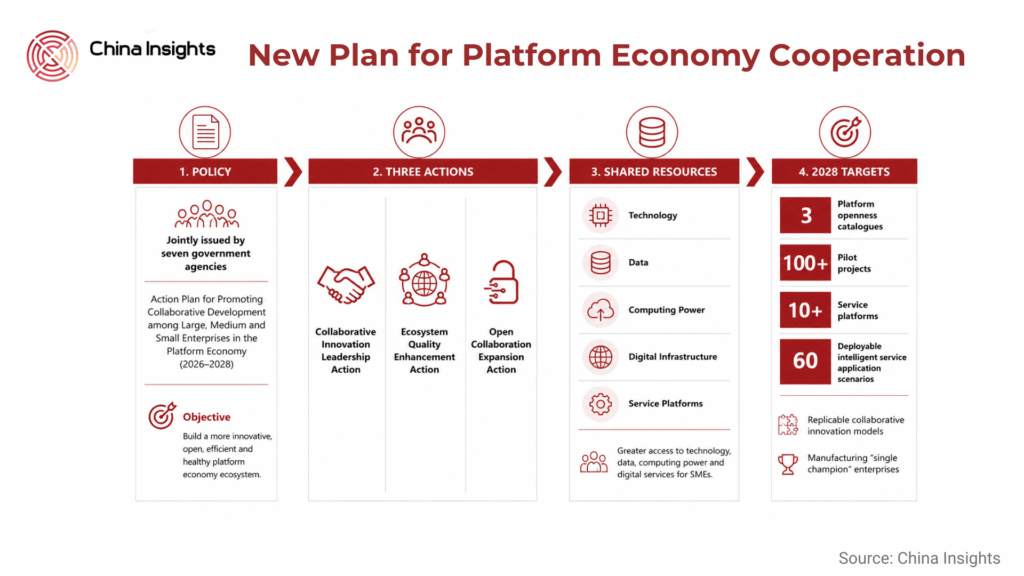
- Seven government agencies jointly issued the Action Plan for Promoting Collaborative Development among Large, Medium and Small Enterprises in the Platform Economy (2026–2028).
- The policy seeks to build a more innovative, open, efficient, and healthy platform economy ecosystem.
- By 2028, China aims to establish a number of replicable collaborative innovation models and cultivate a group of manufacturing champions within the platform economy.
- Authorities plan to release three batches of platform openness catalogues and support at least 100 pilot projects focused on sharing platform resources.
- The action plan promotes greater access to technology, data, computing power, and digital services for SMEs.
- The initiative reflects China’s broader strategy to deepen integration between the digital economy and the real economy while supporting industrial modernization and innovation.
China Signals a New Phase for Platform Economy Development
On 18 June 2026, the Ministry of Industry and Information Technology (MIIT), together with the Cyberspace Administration of China (CAC), the National Development and Reform Commission (NDRC), the Ministry of Science and Technology (MOST), the Ministry of Commerce (MOFCOM), the State Administration for Market Regulation (SAMR), and the National Data Administration (NDA), jointly released the Action Plan for Promoting Collaborative Development among Large, Medium and Small Enterprises in the Platform Economy (2026–2028) (《促进平台经济大中小企业协同发展行动方案(2026—2028年)》).
The action plan represents the latest step in China’s evolving approach to platform economy governance. After several years focused on strengthening regulatory oversight and market order, policymakers are increasingly emphasizing innovation, ecosystem development, and the role of platform enterprises in supporting broader economic growth.
The new policy aims to create stronger linkages between large enterprises, platform operators, and SMEs, while ensuring that technological resources and market opportunities are more widely shared throughout the economy.
Platform Economy Remains a Strategic Priority
According to the policy interpretation published by MIIT, the platform economy has become an important driver of entrepreneurship, industrial upgrading, technological innovation, and economic transformation.
Chinese policymakers view digital platforms not merely as commercial marketplaces but as key infrastructure supporting economic modernization. Platforms increasingly connect manufacturers, service providers, technology developers, logistics providers, consumers, and financial institutions within integrated digital ecosystems.
The action plan aligns with priorities outlined in recent Party and government policy documents, including the decisions of the Third and Fourth Plenary Sessions of the 20th Central Committee and the objectives contained within China’s 15th Five-Year Plan framework.
Against the backdrop of rapid technological change, artificial intelligence development, and industrial digitalization, authorities consider closer cooperation between enterprises of different sizes essential to sustaining long-term economic competitiveness.
Building a Collaborative Innovation Ecosystem
The central objective of the action plan is to strengthen innovation collaboration across the platform economy.
Authorities will implement a “Collaborative Innovation Leadership Action” designed to encourage cooperation between large enterprises, SMEs, research institutions, and innovation platforms. The policy seeks to accelerate the development of diverse innovation entities while improving the ability of businesses to jointly develop technologies, products, and services.
The emphasis on collaboration reflects the reality that many SMEs possess specialized expertise and innovative capabilities but often lack access to the resources, markets, and data controlled by larger enterprises and platform operators. By improving connectivity within digital ecosystems, policymakers hope to increase the efficiency of innovation and accelerate commercialization.
The policy also highlights the importance of strengthening institutional support mechanisms that can sustain long-term innovation development across platform-based industries.
Enhancing Industrial and Business Ecosystems
Beyond innovation, the action plan focuses on improving the overall quality of platform economy ecosystems.
Under the “Ecosystem Quality Enhancement Action,” authorities will support SMEs in areas such as quality improvement, brand development, and market expansion. Particular attention is being given to helping Chinese enterprises expand internationally through platform-enabled channels.
The policy encourages collaboration between enterprises in overseas market development, creating opportunities for smaller firms to leverage the resources, experience, and networks of larger companies.
At the same time, regulators continue to emphasize the importance of compliant platform operations. The action plan promotes the creation of healthy and sustainable business ecosystems through stronger compliance management, shared industrial resources, collaborative service networks, and coordinated international expansion strategies.
This balanced approach reflects China’s broader policy objective of combining economic growth with effective governance and market regulation.
Expanding Access to Technology, Data and Computing Resources
One of the most significant aspects of the action plan is its focus on resource sharing and platform openness.
Authorities plan to launch an “Open Collaboration Expansion Action” that will encourage platform enterprises to share key resources with SMEs. These resources include technology capabilities, datasets, computing power, digital infrastructure, and service platforms.
To facilitate this process, the government intends to publish three batches of platform openness catalogues during the implementation period. These catalogues will identify resources and services that platform enterprises are encouraged to make available to smaller businesses.
The action plan also includes the selection of at least 100 pilot projects demonstrating practical applications of platform resource sharing.
This initiative reflects growing recognition that access to data, cloud infrastructure, artificial intelligence tools, and digital technologies has become a critical determinant of competitiveness in the modern economy. Improving access for SMEs could help reduce barriers to innovation and market participation.
New Targets for Platform Economy Development
The action plan establishes several measurable objectives to be achieved by 2028.
Authorities aim to significantly improve collaborative development across the platform economy and create a number of scalable and replicable innovation models. The policy also seeks to cultivate a group of manufacturing “single champion” enterprises operating within platform-based ecosystems.
The degree of openness and sharing of technology, data, and other production factors is expected to increase substantially. At least 100 pilot projects involving open platform resources will be implemented, while platform-enabled innovation is expected to generate new technologies, applications, business models, and service formats.
In addition, policymakers aim to establish no fewer than ten service platforms and sixty deployable intelligent service application scenarios.
These targets indicate that authorities are seeking not only greater platform participation but also tangible industrial and technological outcomes that contribute to China’s broader modernization agenda.
Implementation and Policy Coordination
The Ministry of Industry and Information Technology has indicated that implementation will require close coordination among participating government agencies.
The policy includes measures to strengthen organizational coordination, improve statistical monitoring systems, and enhance assessment mechanisms to evaluate policy effectiveness.
Regional governments will also be encouraged to develop localized implementation measures tailored to their specific industrial structures and development priorities.
In addition, industry associations, think tanks, and other intermediary organizations are expected to play a role in promoting best practices and facilitating knowledge exchange among market participants.
The emphasis on monitoring and evaluation suggests that authorities intend to closely track the effectiveness of the policy and adjust implementation measures where necessary.
What This Means for Business
The new action plan signals a continued shift in China’s platform economy policy from regulatory correction toward ecosystem development and collaborative growth.
For platform companies, the policy creates expectations around greater openness, resource sharing, and support for SME development. Companies operating digital platforms may face increasing pressure to provide access to technology, data resources, computing capacity, and innovation tools.
For SMEs, the policy could improve access to resources that have historically been difficult or costly to obtain independently. Increased availability of digital infrastructure, platform services, and innovation support may create new opportunities for growth, product development, and market expansion.
For foreign businesses, particularly those active in software, cloud computing, artificial intelligence, industrial digitalization, and enterprise services, the policy highlights China’s continued commitment to digital transformation and ecosystem-based innovation. Opportunities may emerge through partnerships with Chinese platforms, technology providers, and industrial clusters seeking to strengthen collaborative capabilities.
More broadly, the action plan underscores China’s intention to leverage platform-based ecosystems as a key mechanism for promoting innovation, industrial upgrading, and deeper integration between the digital economy and the real economy during the 15th Five-Year Plan period.
Source
Author
Dr. Richard van Ostende

Related Articles