
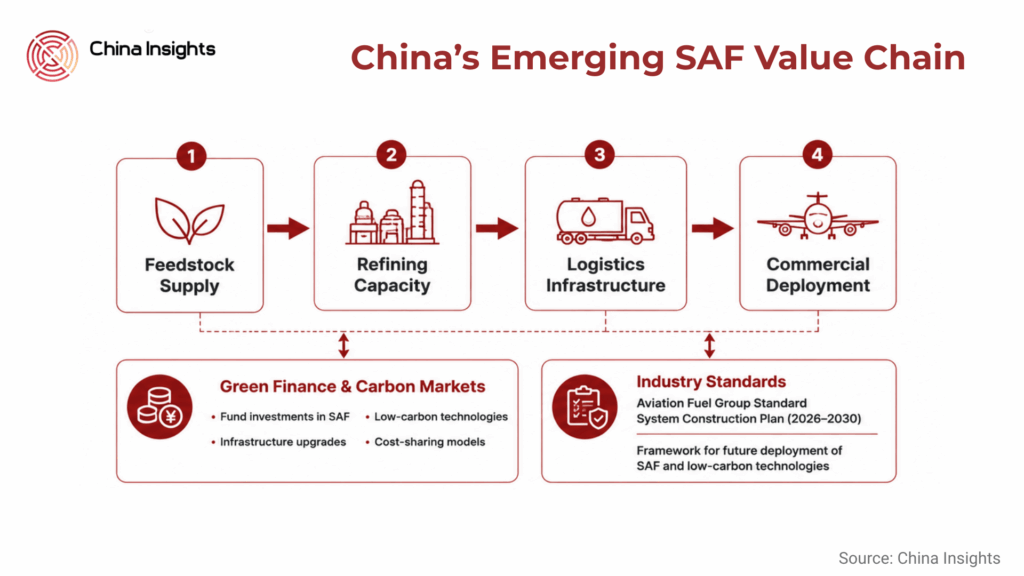
SAF Becomes the Industry’s Primary Decarbonization Pathway
A key takeaway from the conference was the growing consensus that Sustainable Aviation Fuel (SAF) will play a critical role in reducing aviation emissions.
Wang Changshun, Chairman of CATA, emphasized the need to accelerate the development of technological solutions, SAF production capacity, and cost-sharing mechanisms to support industry-wide adoption. Discussions focused on strengthening the entire SAF ecosystem, including feedstock supply, refining capacity, logistics infrastructure, and commercial deployment.
The emphasis on SAF reflects both China’s domestic carbon reduction objectives and increasing international pressure on airlines to reduce emissions.
Green Finance and Carbon Markets Gain Importance
Conference participants highlighted that technological solutions alone will not be sufficient to achieve aviation decarbonization targets.
Industry representatives called for greater innovation in green finance and carbon market mechanisms to help fund investments in SAF, infrastructure upgrades, and low-carbon technologies. Particular attention was given to developing cost-sharing models involving airlines, airports, aircraft manufacturers, and fuel suppliers.
As sustainability requirements increase globally, financing mechanisms are expected to become an increasingly important component of aviation’s transition strategy.
Hainan Strengthens Its Position in Green Aviation
The conference also highlighted Hainan’s growing role within China’s aviation development strategy.
Leveraging Free Trade Port policies, Hainan is seeking to establish itself as a regional aviation hub and a center for SAF development, aviation fuel trading, and international aviation cooperation. China National Aviation Fuel Group confirmed ongoing investments in bonded aviation fuel operations, SAF supply chains, and related trading activities in the province.
These developments reinforce Hainan’s importance as a testing ground for new aviation business models and sustainability initiatives.
Industry Standards Support Future Development
Alongside the conference, the China Air Transport Association’s Aviation Fuel Branch released the Aviation Fuel Group Standard System Construction Plan (2026-2030).
The plan aims to strengthen standardization across the aviation fuel sector and provide a framework for the future deployment of SAF and other low-carbon technologies. As the market matures, industry standards will become increasingly important for ensuring quality, safety, and interoperability.
What This Means for Business
The conference confirms that green development remains a strategic priority for China’s aviation sector.
For businesses, the strongest opportunities are likely to emerge in Sustainable Aviation Fuel production, feedstock supply, emissions management, aviation technology, and green finance.
Companies involved in carbon accounting, environmental consulting, digital aviation solutions, and low-carbon infrastructure may also benefit from growing industry demand.
The discussions in Haikou suggest that SAF development, industry standardization, and innovative financing mechanisms will be key areas of policy and investment focus during China’s 15th Five-Year Plan period. Businesses seeking exposure to China’s aviation sector should closely monitor developments in these areas.
Source
https://www.cata.org.cn/portal/content/show-content/23552/xwzx