
China Unveils New Action Plan to Accelerate “AI + Consumption” Development
Executive Summary
China has introduced a new policy framework aimed at accelerating the integration of artificial intelligence (AI) into consumer markets and everyday consumption scenarios.
Key takeaways:
- The Ministry of Commerce and seven other government agencies jointly issued the Implementation Opinions on Accelerating the Development of “Artificial Intelligence + Consumption”.
- The policy seeks to deepen the integration of AI technologies into goods consumption, services consumption, and commercial activities.
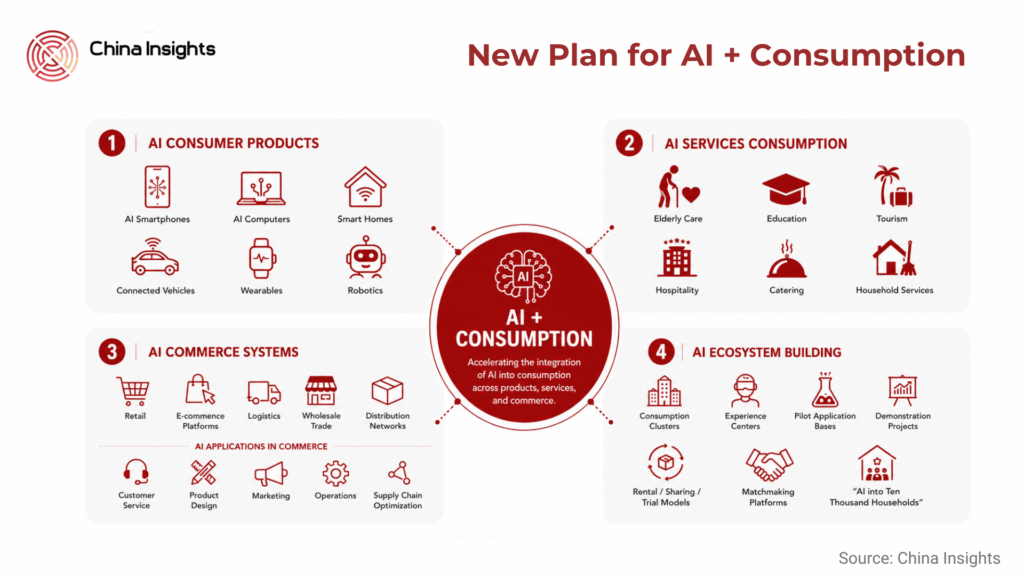
- Authorities will promote the adoption of AI-enabled smartphones, computers, smart homes, connected vehicles, wearable devices, and robotics.
- AI applications will be expanded across sectors including elderly care, tourism, hospitality, education, retail, e-commerce, and logistics.
- New AI consumption clusters, experience centers, pilot application bases, and demonstration projects will be established nationwide.
- The policy forms part of China’s broader strategy to stimulate domestic consumption, foster technological innovation, and develop new economic growth drivers during the 15th Five-Year Plan period.
China Places AI at the Center of Consumer Market Development
On 18 June 2026, the Ministry of Commerce (MOFCOM), together with seven other government departments, jointly issued the Implementation Opinions on Accelerating the Development of “Artificial Intelligence + Consumption” (《关于加快“人工智能+消费”发展的实施意见》).
The policy was accompanied by an official interpretation from the Department of Market Development of the Ministry of Commerce, outlining the rationale and implementation priorities behind the initiative.
The release highlights China’s growing emphasis on artificial intelligence as a strategic technology capable of driving consumption growth, industrial upgrading, and economic transformation.
While AI has already become a major focus of industrial policy and technological development, the new initiative specifically targets consumer-facing applications and seeks to accelerate adoption across a broad range of industries and daily life scenarios.
The policy also reflects priorities identified in China’s 15th Five-Year Plan framework, which recognizes “AI+” applications as a key area for future economic development.
AI Becomes a New Driver of Consumption Growth
Chinese policymakers increasingly view artificial intelligence not only as a technology sector in its own right, but also as an enabling technology capable of generating new consumer demand.
According to the Ministry of Commerce, rapid advances in AI technologies have already resulted in the emergence of new products, services, and business models.
The integration of AI into consumer markets is expected to create additional growth opportunities while supporting consumption upgrading and improving service quality.
The government believes that expanding AI-enabled consumption can help cultivate new sources of domestic demand at a time when consumption is expected to play an increasingly important role in supporting economic growth.
Rather than focusing solely on technology development, the policy aims to stimulate practical deployment and commercialization of AI products and services throughout the economy.
Expanding AI-Enabled Consumer Goods
One of the primary objectives of the implementation opinions is to increase the availability and adoption of AI-enabled consumer products.
Authorities intend to encourage the development and commercialization of a new generation of intelligent products, including AI-powered smartphones and computers, smart home devices, intelligent connected vehicles, wearable technologies, and robotics products.
To support market adoption, the government plans to establish platforms for product launches and exhibitions dedicated to AI-enabled consumer goods. The policy also includes initiatives such as the “AI into Ten Thousand Households” campaign, which aims to increase public awareness and encourage broader consumer adoption.
This approach suggests that policymakers view consumer hardware as an important channel for introducing AI technologies into everyday life and creating a foundation for broader ecosystem development.
Accelerating AI Integration into Services
The implementation opinions place significant emphasis on the application of AI within service industries.
Authorities aim to promote deeper integration of AI technologies into household services, elderly care, culture and tourism, hospitality, catering, and education. The objective is to improve service quality, enhance operational efficiency, and create more personalized consumer experiences.
The policy encourages the testing and iterative improvement of AI-enabled products and services in real-world environments, including homes, communities, elderly care facilities, tourist attractions, and educational settings.
China’s rapidly aging population makes AI-assisted elderly care a particularly important area of focus. Technologies capable of supporting independent living, health monitoring, and service delivery may become increasingly important components of future consumption and healthcare ecosystems.
Similarly, AI applications in tourism, hospitality, and education are expected to contribute to the modernization of traditional service industries while creating new commercial opportunities.
Driving Innovation Across Retail and Commerce
Beyond consumer products and services, the policy seeks to expand AI adoption throughout the broader commercial sector.
The implementation opinions encourage wider application of artificial intelligence in wholesale and retail trade, e-commerce platforms, logistics operations, and distribution networks.
Authorities will support the intelligent upgrading of commercial infrastructure, including the development of smart retail formats and digitally enabled commercial districts.
Particular attention is being given to the role of AI in e-commerce operations. The policy identifies opportunities for AI technologies to support customer service, product design, marketing, operational management, and supply chain optimization.
This reflects a broader trend within China’s digital economy, where businesses increasingly leverage AI tools to improve efficiency, reduce operating costs, and enhance customer engagement.
The widespread deployment of generative AI, intelligent automation, and predictive analytics is expected to further accelerate digital transformation across the commercial landscape.
Building New AI Consumption Ecosystems
A notable feature of the policy is its emphasis on creating physical and institutional environments that support AI adoption.
Authorities plan to establish a number of AI consumption clusters and experience centers where consumers can interact with and evaluate emerging technologies. New business models based on product rental, sharing, and trial usage will also be encouraged.
The government intends to publish application guidelines for AI consumption scenarios and identify exemplary use cases that can be replicated across different industries and regions.
In addition, China will establish national pilot testing bases for AI applications in the consumer sector. These facilities are expected to play an important role in validating technologies, refining business models, and accelerating commercialization.
The policy also promotes matchmaking activities between technology providers and commercial enterprises to facilitate cooperation and improve the alignment of supply and demand.
Improving the Regulatory and Market Environment
The implementation opinions recognize that sustainable growth of AI-enabled consumption requires a supportive regulatory environment.
Authorities plan to strengthen policy support mechanisms, improve consumer-related AI infrastructure, and further develop technical standards. Efforts will also focus on enhancing interoperability across industries and brands, reducing fragmentation within the AI ecosystem.
Consumer protection remains an important policy consideration. Regulators aim to establish appropriate oversight mechanisms that can support innovation while ensuring product reliability, service quality, and consumer confidence.
The emphasis on standards and interoperability is particularly significant, as it addresses one of the key challenges facing emerging AI markets: ensuring that devices, platforms, and services can function effectively within increasingly complex digital ecosystems.
What This Means for Business
The new implementation opinions provide a clear indication that AI adoption is becoming a central pillar of China’s consumption strategy.
For technology companies, the policy creates opportunities across multiple segments, including consumer electronics, smart devices, robotics, cloud services, software development, and AI infrastructure. Companies capable of delivering commercially viable AI applications may benefit from expanding market demand and government support initiatives.
For retailers, e-commerce platforms, logistics providers, hospitality groups, and service operators, the policy signals growing expectations regarding the integration of AI technologies into business operations and customer engagement strategies.
Foreign companies active in artificial intelligence, consumer technology, smart devices, industrial software, digital services, and enabling technologies may also find opportunities in China’s rapidly evolving AI ecosystem, particularly through partnerships, technology licensing, and localized solutions.
More broadly, the policy demonstrates China’s intention to move beyond AI research and development toward large-scale commercialization and practical deployment. As AI technologies become increasingly embedded in consumer markets, businesses operating in China will likely encounter both new opportunities and rising competitive pressures driven by accelerated digital transformation.
Sources
Author
Dr. Richard van Ostende

Related Articles