
China Strengthens National Unified Market Development
China’s State Council has renewed efforts to accelerate the development of a “national unified market,” reinforcing Beijing’s broader strategy to reduce regional market fragmentation, standardize regulations, and improve domestic economic circulation. For businesses, the latest policy direction signals continued regulatory harmonization, stricter enforcement against local protectionism, and deeper integration of logistics, data, technology, and industrial markets across China.
Executive Summary
- On 23 May 2026, the State Council held an executive meeting chaired by Premier Li Qiang to review measures related to the development of China’s national unified market.
- Authorities emphasized the need to remove local protectionism, market segmentation, and barriers to economic circulation.
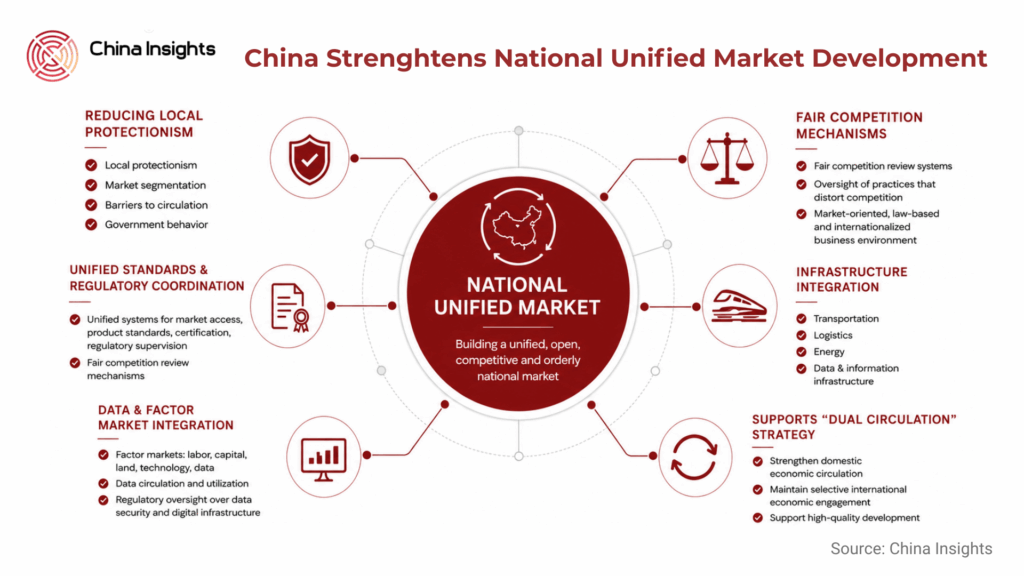
- The meeting highlighted priorities including unified market rules, standardized regulation, fair competition enforcement, and integrated infrastructure development.
- China aims to strengthen nationwide integration across logistics, data, energy, technology, and factor markets.
- The policy forms part of Beijing’s broader “dual circulation” and “high-quality development” strategy.
- For businesses, the initiative may gradually reduce regional regulatory inconsistencies while increasing compliance expectations related to competition and market practices.
State Council Renews Focus on National Market Integration
On 23 May 2026, the State Council convened an executive meeting to study and advance work related to the construction of China’s national unified market.
The concept of the “national unified market” has become a major policy priority in recent years as Beijing seeks to improve domestic economic efficiency, reduce regional barriers, and strengthen internal economic circulation amid growing external economic uncertainty.
For policymakers, market fragmentation is increasingly viewed as an obstacle to productivity growth, industrial upgrading, technological innovation, and domestic consumption expansion. The latest meeting therefore reinforces efforts to standardize market rules and improve nationwide economic coordination.
Reducing Local Protectionism and Market Fragmentation
A central objective of the policy initiative is reducing local protectionism and administrative barriers that limit cross-regional economic activity.
According to the meeting summary, authorities aim to further standardize government behavior related to investment attraction, procurement practices, industrial subsidies, and market access restrictions. Local governments are expected to avoid policies that create discriminatory treatment between regions or distort market competition.
The State Council emphasized that local protectionism and fragmented market practices increase transaction costs, reduce resource allocation efficiency, and weaken the effectiveness of the domestic market.
For businesses operating across multiple provinces, this direction could gradually improve regulatory consistency and reduce operational inefficiencies caused by varying local standards, licensing requirements, and administrative procedures.
At the same time, companies may face stricter scrutiny regarding competition practices, procurement arrangements, and regional market conduct as enforcement mechanisms become more centralized and standardized.
Read more about the new investments regulations for officials
Unified Standards and Regulatory Coordination
The latest policy discussions also place significant emphasis on unified standards and regulatory coordination.
Authorities highlighted the importance of accelerating the development of unified systems for market access, product standards, certification, regulatory supervision, and fair competition review mechanisms. This reflects Beijing’s broader effort to create a more integrated national economic framework capable of supporting large-scale industrial modernization and technological development.
In practice, the initiative may lead to greater alignment of technical standards, administrative approvals, digital governance systems, and compliance procedures across provinces and municipalities.
For domestic and foreign-invested enterprises alike, improved regulatory harmonization could help reduce compliance complexity and facilitate expansion into additional Chinese regions.
However, greater standardization may also strengthen central oversight and increase expectations regarding regulatory compliance, cybersecurity, data governance, environmental standards, and anti-monopoly enforcement.
Read more on the latest sector specific applications of these developments: Low-Altitude Economy, Telecom Technology & Navigation Satellite Systems.
Strengthening Fair Competition Mechanisms
Fair competition enforcement remains another important component of the unified market strategy. The State Council reiterated the need to improve fair competition review systems and strengthen oversight of practices that distort market competition. Authorities also emphasized the importance of creating a market-oriented, law-based, and internationalized business environment.
In recent years, China has expanded anti-monopoly enforcement and introduced stricter oversight of platform companies, local subsidy practices, and procurement systems. The national unified market initiative builds upon these broader regulatory developments by seeking to reduce regional distortions and improve competitive neutrality.
For businesses, this may result in more consistent enforcement standards nationwide, although companies operating in sectors receiving strategic state support may still encounter varying local implementation approaches.
Read More about the New Government Procurement Law.
Infrastructure Integration as an Economic Priority
Infrastructure connectivity remains central to the national unified market strategy.
The State Council meeting emphasized the need to strengthen integration across transportation, logistics, energy, data, and information infrastructure networks. Improving the efficiency of cross-regional movement of goods, services, capital, technology, and data is viewed as critical to enhancing domestic economic circulation.
Authorities are also seeking to improve nationwide logistics coordination and reduce logistical bottlenecks that increase operating costs for businesses.
This aligns closely with China’s broader infrastructure modernization agenda, including investments in smart logistics, digital infrastructure, high-speed transportation, industrial internet systems, and nationwide computing networks.
For businesses involved in manufacturing, logistics, e-commerce, supply chains, industrial technology, and infrastructure development, these initiatives may create additional commercial opportunities linked to domestic market integration.
Data and Factor Market Integration
The meeting also highlighted efforts to improve the integration of “factor markets,” including labor, capital, land, technology, and data.
Data governance has become an increasingly important component of China’s economic modernization strategy. Policymakers are seeking to create more efficient systems for data circulation and utilization while maintaining strong regulatory oversight over data security and digital infrastructure.
Authorities continue to balance market liberalization objectives with broader national security considerations. As a result, businesses should expect ongoing regulatory development related to cross-border data transfers, cybersecurity compliance, platform governance, and digital infrastructure participation. At the same time, improved integration of factor markets could enhance resource allocation efficiency and support further industrial upgrading.
Read More on Cross-border Data flow compliance.
Unified Market Supports “Dual Circulation” Strategy
The national unified market initiative forms part of China’s broader “dual circulation” strategy, which emphasizes strengthening domestic economic circulation while maintaining selective international economic engagement.
By reducing fragmentation and improving domestic market efficiency, policymakers aim to strengthen China’s internal growth drivers and reduce vulnerability to external economic disruptions.
The initiative also aligns with the broader “high-quality development” framework promoted by Chinese leadership, which prioritizes productivity improvements, innovation, industrial upgrading, and sustainable economic growth over purely expansion-driven development.
For international companies, the policy direction suggests that China will continue emphasizing domestic market integration as a strategic economic objective, particularly in response to ongoing geopolitical and global trade uncertainties.
Read more about sector-specific high-quality developments: Aviation, Human Resources & Social Security.
What This Means for Business
China’s renewed push for a national unified market signals continued efforts to reduce regional fragmentation and improve domestic economic integration.
For businesses operating across multiple Chinese provinces, greater regulatory harmonization and infrastructure integration could gradually reduce operational inefficiencies and lower administrative complexity. Companies involved in logistics, manufacturing, technology, industrial automation, infrastructure, and digital services may particularly benefit from improved nationwide connectivity and market access.
At the same time, businesses should anticipate stricter enforcement related to fair competition, procurement practices, anti-monopoly compliance, and regulatory standardization. The policy direction also reinforces the growing role of central coordination in economic governance and market supervision.
Foreign-invested enterprises should monitor how local governments implement unified market policies, as regional variations in enforcement and administrative interpretation are likely to remain during the transition period.
Overall, the initiative reflects Beijing’s broader strategy of strengthening domestic economic resilience, improving market efficiency, and supporting long-term industrial modernization through deeper national economic integration.
Source
Author
Dr. Richard van Ostende

Related Articles