
China Signals Stronger Macroeconomic Support and a Sharper Focus on Effective Investment
China is moving toward a more active use of macroeconomic policy to support growth and strengthen domestic demand. The emphasis is shifting from announcing measures to improving their implementation and economic impact.
At its meeting on 28 September 2026, the State Council Executive Meeting, chaired by Premier Li Qiang, reviewed measures to improve the effectiveness of macroeconomic policy and promote effective investment. The meeting called for stronger counter-cyclical adjustment, faster implementation of existing policies and additional targeted measures to support investment, consumption, innovation, employment and selected sectors.
Executive summary
- China is increasing the intensity of counter-cyclical macroeconomic adjustment as it seeks to sustain economic momentum.
- Policy is moving on two tracks: improving the effectiveness of existing measures while preparing additional measures.
- Fiscal and monetary tools are expected to work more closely together, including additional relending quotas for technology innovation, technological upgrading and support for agriculture and small businesses.
- Investment policy is becoming more execution-focused, with greater emphasis on project preparation, factor availability and faster approvals.
- Private investment is being given a more explicit role in supporting effective investment and domestic demand.
- Further measures to support the property market, employment and household income are being considered.
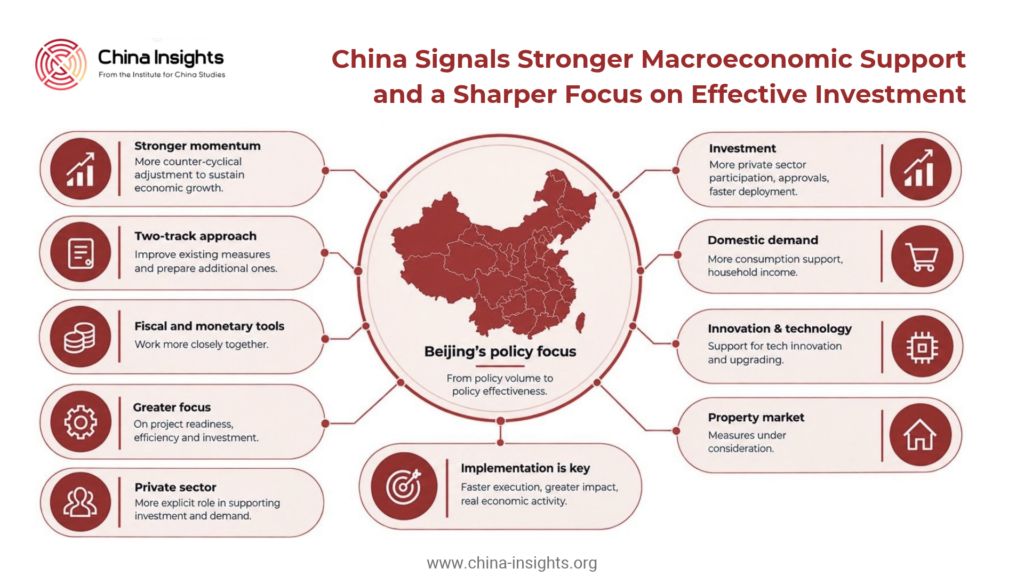
From policy volume to policy effectiveness
The most important change is the stronger emphasis on policy effectiveness. The State Council called for existing policies to be implemented with greater speed and impact, rather than relying primarily on new policy announcements.
This includes accelerating the issuance and use of various bonds, bringing forward major projects under the 15th Five-Year Plan and the “Six Networks” initiatives, upgrading ageing infrastructure, and strengthening investment and consumption interest-subsidy programs. The approach indicates that the government sees implementation speed and conversion of policy support into actual economic activity as an immediate priority.
Existing and new measures to work together
The meeting also signaled that policy support will not be limited to using existing measures more effectively. The State Council called for a number of additional, targeted policies while also optimizing fiscal expenditure arrangements and making better use of the remaining debt quota available to local governments.
On the monetary side, the government will use and adjust monetary policy tools when appropriate and increase relending quotas for technology innovation and technological transformation, as well as agriculture and small businesses. Measures to stabilize the property market and support employment and income growth are also being studied.
The combination is significant. Rather than relying on a single large stimulus measure, the policy direction points toward a broader package in which fiscal spending, credit support, investment incentives and sector-specific measures reinforce each other.
Investment becomes a stronger transmission channel
The meeting places effective investment at the center of the next phase of macroeconomic support. The State Council called for better project preparation, stronger guarantees for project inputs and resources, faster investment approvals and greater efforts to stimulate private investment.
This indicates a shift from simply increasing available funding toward improving the conversion of funding into completed projects and economic activity. The emphasis on project readiness and administrative efficiency also suggests that local governments will be expected to remove practical bottlenecks that delay investment.
For businesses, this can create opportunities in areas linked to infrastructure, industrial upgrading, technology, equipment renewal and projects aligned with national development priorities. However, access to these opportunities is likely to depend increasingly on project quality and alignment with policy priorities rather than simply on the availability of capital.
Stronger focus on domestic demand
The meeting also reinforces domestic demand as a key policy priority. The State Council called for continued preparation of measures to stimulate domestic demand and for more initiatives with strong economic spillover effects.
The focus extends beyond investment. Consumption support, employment, household income and property-market stabilization are being considered as interconnected components of the broader policy response. Local governments are also encouraged to conduct trials where conditions permit, suggesting some scope for regional experimentation in implementing demand-side measures.
The approach reflects a broader effort to strengthen the domestic economic cycle while supporting the transition toward higher-quality growth.
Implementation will determine the impact
The effectiveness of the new policy direction will depend heavily on implementation. The official interpretation accompanying the meeting stresses the need for stronger coordination between central and local authorities and closer cooperation between government departments.
This is important because many of the measures already announced require coordination across financing, project approvals, land and other production factors. Faster implementation can therefore increase the economic effect of existing policy without necessarily requiring a proportionate increase in headline fiscal support.
The policy signal is consequently less about a single stimulus package and more about improving the transmission mechanism from government policy to investment, business activity and household demand.
What this means for business
- Policy support is becoming more execution-oriented. Companies should monitor not only new measures but also how existing programs are implemented locally.
- Investment opportunities are likely to favor policy-aligned projects. Technology upgrading, infrastructure and projects linked to national development priorities are positioned for continued support.
- Financing conditions may become more supportive in selected sectors. Additional relending for innovation, technological upgrading and small businesses could improve access to credit.
- Private investment is gaining greater policy attention. Companies with investment plans should monitor local initiatives designed to attract and facilitate private-sector participation.
- Domestic demand remains a policy target. Businesses exposed to consumption, employment and household income trends may benefit from additional demand-support measures.
- Local implementation will matter. Differences in project preparation, approvals, financing and policy execution may create significant variation between regions.
Sources
https://www.gov.cn/zhengce/202609/content_7082316.htm
Author
Dr. Richard van Ostende

Related Articles