
China Expands Private Capital Access and Pushes Beidou Toward Mass Adoption
China is giving private capital a larger role in strategic investment while accelerating the commercialization of its Beidou satellite navigation system. Both developments point to a broader policy objective: mobilizing private-sector resources behind national investment and technology priorities.
At a National Development and Reform Commission (NDRC) press conference on 22 September 2026, officials provided an update on private investment and the next phase of Beidou development. The measures indicate that China is moving from general encouragement of private investment and technology adoption toward more targeted participation in priority projects and industries.
Executive summary
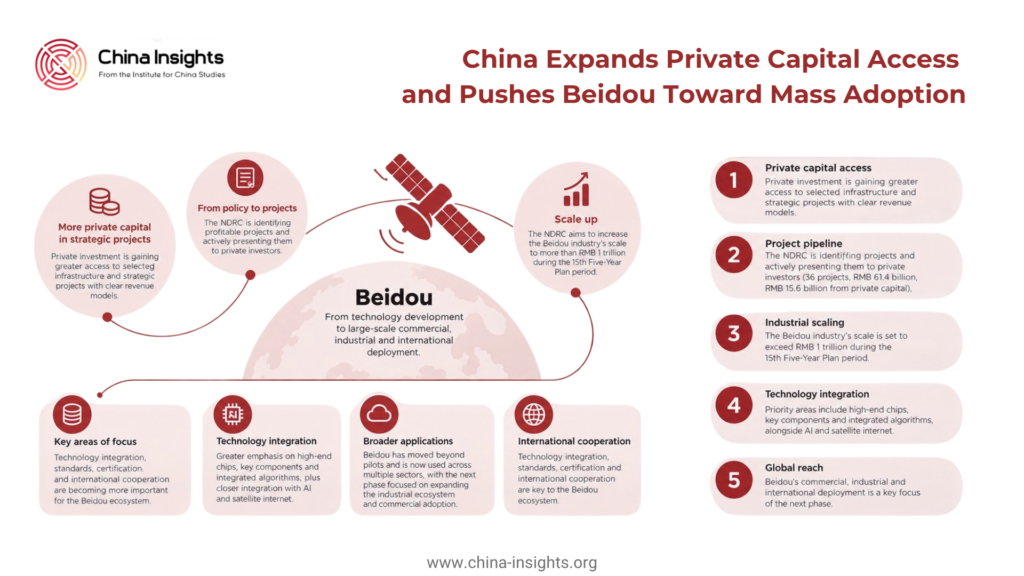
- Private capital is being given greater access to selected infrastructure and strategic projects with identifiable revenue models.
- The NDRC is actively identifying projects where private-sector participation is considered commercially viable.
- The approach strengthens the role of private investment alongside government-led infrastructure spending.
- Beidou policy is shifting from technology development and sector pilots toward large-scale commercial, industrial and international deployment.
- The NDRC aims to increase the Beidou industry’s scale to more than RMB 1 trillion during the 15th Five-Year Plan period.
- Technology integration, standards, certification and international cooperation are becoming more important to the Beidou ecosystem.
Private investment moves from access to project pipelines
The latest development builds on the General Office of the State Council’s Measures on Further Promoting the Development of Private Investment, issued on 3 November 2025. The measures require the feasibility of private-capital participation to be specifically assessed for certain profitable major projects requiring central government approval or authorization. They also encourage private participation in areas including infrastructure and energy.
The September 2026 NDRC update indicates that this framework is now moving further into implementation. Rather than simply removing market-access barriers, the government is preparing identifiable projects and actively presenting them to private investors. The latest batch covers 36 projects with expected total investment of RMB 61.4 billion, including RMB 15.6 billion intended to be raised from private capital. This creates a more direct connection between policy support and an investable project pipeline.
Greater emphasis on commercially viable projects
The change is significant because private investment policy is becoming more project-oriented. The NDRC is focusing on sectors where revenue mechanisms are relatively clear and where private companies have demonstrated an interest in participating.
This approach can help address one of the persistent constraints on private investment: access to sufficiently attractive projects. By improving project preparation, factor support and government coordination, authorities are attempting to reduce some of the practical barriers that can prevent private capital from entering infrastructure and other strategic sectors.
The direction also complements broader efforts to increase the role of private companies in areas traditionally dominated by state investment. For investors, the key issue will increasingly be the quality, structure and commercial viability of individual projects rather than simply whether a sector has formally been opened to private capital.
Beidou enters a new phase of industrial scaling
The NDRC also signaled a significant expansion of China’s Beidou strategy. According to the commission, the objective during the 15th Five-Year Plan period is to increase the Beidou industry’s scale to more than RMB 1 trillion and achieve further breakthroughs in market-oriented, industrialized and international applications.
This represents a shift in emphasis. Beidou has already moved beyond technology development and pilot applications into widespread use across multiple sectors. The next phase is focused on expanding the industrial ecosystem, increasing commercial adoption and integrating Beidou more closely with other strategic technologies.
Technology integration becomes a core priority
The NDRC is placing greater emphasis on the upstream technology base supporting Beidou. Priorities include high-end chips, key components and integrated algorithms, alongside closer integration with artificial intelligence and satellite internet.
This is important for the development of a broader domestic ecosystem. The policy direction is not limited to satellite navigation equipment. It covers technologies and services across the wider spatial-information value chain. The Ministry of Industry and Information Technology has similarly identified Beidou and spatial-information development as priorities in the Electronic Information Manufacturing Industry Development 15th Five-Year Plan, issued jointly by the MIIT and NDRC on 10 September 2026.
The result is a stronger connection between Beidou development, advanced electronics, AI, satellite communications and digital infrastructure.
Regulation and internationalization move higher on the agenda
The next phase also places greater weight on the institutional framework supporting mass adoption. The NDRC stated that China will accelerate implementation of the Satellite Navigation Regulations of the People’s Republic of China, while strengthening industry standards, testing and certification systems.
This matters because wider commercial deployment requires interoperability, reliability and recognized technical standards. Certification and standards can also reduce adoption barriers for downstream users and support the development of larger markets.
Internationalization is another explicit priority. China intends to deepen technical cooperation, joint demonstration projects and participation in global satellite-navigation governance. This suggests that Beidou’s development strategy increasingly includes overseas market expansion rather than focusing exclusively on domestic deployment.
What this means for business
- Private investment opportunities are becoming more identifiable. Companies should monitor NDRC and local-government project pipelines rather than relying solely on broad sector-opening policies.
- Commercial viability is gaining importance. Projects with clear revenue mechanisms and strong private-sector participation potential are likely to receive greater policy attention.
- Beidou is becoming a broader industrial opportunity. The expansion extends beyond navigation equipment into chips, components, algorithms, AI, satellite internet and spatial-information services.
- Standards and certification will matter more. Companies entering the Beidou ecosystem should track forthcoming regulatory and technical requirements closely.
- International opportunities are expanding. China’s push for Beidou internationalization could create opportunities in overseas infrastructure, transport, agriculture, disaster monitoring and other location-based applications.
- Foreign companies should assess the ecosystem, not just individual products. The strongest opportunities may emerge at the intersection of Beidou, AI, satellite communications and digital infrastructure.
Sources
https://www.gov.cn/zhengce/202609/content_7081801.htm
Author
Dr. Richard van Ostende

Related Articles