
China Establishes a National Roadmap for Developing New Quality Productive Forces
China has introduced a national framework to accelerate technology-driven industrial upgrading, improve productivity and reshape the relationship between innovation and commercial development. The focus is moving beyond support for individual technologies or emerging industries toward a more integrated approach combining research, industrial application, finance, regulatory reform and talent development.
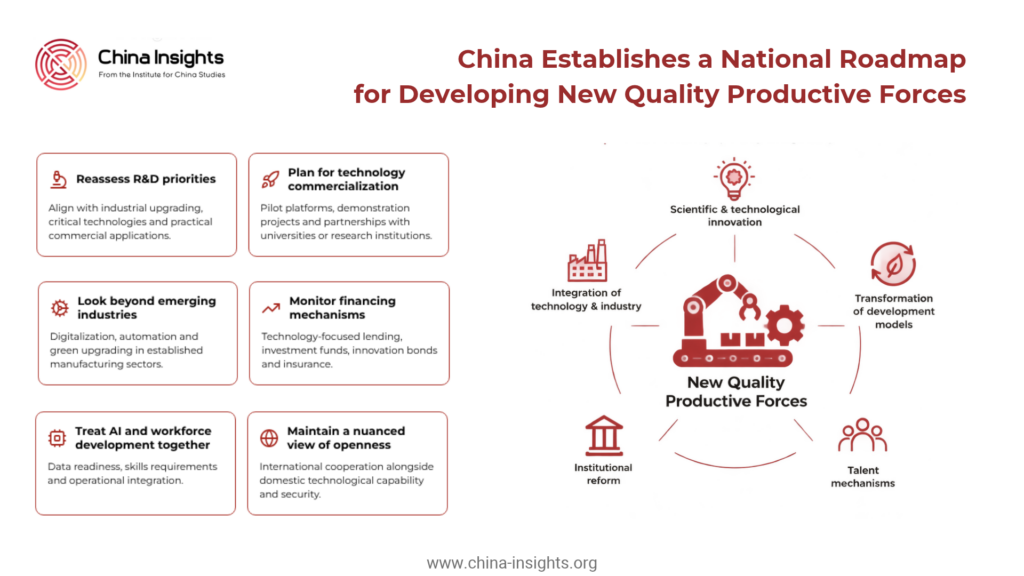
On 9 October 2026, the Communist Party of China Central Committee and the State Council issued the Opinions on Developing New Quality Productive Forces (《关于发展新质生产力的意见》). Published the same day, the document sets out 19 measures across five areas: scientific and technological innovation, integration of technology and industry, transformation of development models, institutional reform and talent mechanisms. It provides a national policy framework for the 15th Five-Year Plan period (2026–2030).
Executive summary
- China is linking research, industrialization, financing and talent policy more closely within a single national framework.
- Companies are given a stronger role in research and development, technology commercialization and major technology projects.
- Traditional industries are expected to accelerate digital and green upgrading, while strategic emerging and future industries receive targeted support.
- AI adoption is being extended across industries, supported by computing, algorithms, data and application infrastructure.
- Institutional reforms aim to improve technology transfer, access to finance, intellectual property protection and the movement of production factors.
- The policy retains an emphasis on international cooperation while strengthening domestic innovation capabilities and supply-chain resilience.
From separate initiatives to an integrated productivity agenda
The new document establishes a broader framework for developing what China terms new quality productive forces. The central objective is to improve productivity through technological breakthroughs, more efficient allocation of production factors and industrial transformation.
The change is the integration of several policy areas that have often been addressed through separate sectoral programs. Research funding, industrial upgrading, financial products, regulatory reform and workforce development are now explicitly connected within one framework. This gives businesses a clearer indication of how future industrial and innovation policies are intended to reinforce each other.
Enterprise innovation moves closer to the center
The policy strengthens the role of enterprises in the innovation process. It calls for more business-led research, increased support for corporate R&D and greater participation by capable private companies in major national technology projects. It also encourages large companies to open their supply chains to smaller firms and supports the use of technology developed by universities and research institutions.
A further priority is to accelerate commercialization. The document calls for demonstration programs involving new technologies, products and application scenarios, alongside concept-validation and pilot-scale testing platforms. Technology projects are to be assessed more closely on whether their results translate into practical applications. This could improve opportunities for companies able to bridge the gap between research and market deployment.
Industrial upgrading extends beyond emerging sectors
The framework does not limit support to new industries. It also calls for the upgrading of established manufacturing sectors through digital technologies, green technologies, advanced equipment and improved production processes. Manufacturing modernization, equipment renewal and technical transformation remain important components of the strategy.
At the same time, the document identifies strategic emerging industries—including next-generation information technology, new energy, advanced materials, intelligent connected vehicles, robotics, biomedicine, advanced equipment and aerospace—as areas for further development. Future industries are also to receive forward-looking support, with investment-growth and risk-sharing mechanisms intended to help address uncertainty.
For businesses, the implication is that opportunities may arise both from developing new technologies and from applying them to established industries. The framework also calls for stronger interregional industrial cooperation and measures to avoid excessive, duplicative competition.
AI and digitalization become economy-wide priorities
The document calls for comprehensive implementation of the “AI Plus” initiative. This includes applying AI to traditional industries, expanding its use across sectors and accelerating the deployment of intelligent products and systems. The policy also emphasizes improvements in computing capacity, algorithms and data supply, alongside monitoring and risk-response mechanisms.
This positions AI as both an industrial sector and a tool for wider productivity improvement. Companies may find opportunities in industrial automation, intelligent manufacturing, digital services and sector-specific AI applications. However, the framework’s direction does not guarantee commercial returns; adoption will depend on implementation, technical performance, business demand and the availability of suitable data and infrastructure.
Institutional reform targets commercialization and capital access
The policy recognizes that technological development depends partly on the institutional environment. It calls for reforms to the management and ownership arrangements of scientific and technological achievements, improved market-access systems, stronger intellectual property management and more effective technology markets.
Financing is another priority. The document encourages venture capital, private equity, government-guided funds, technology-focused lending, innovation bonds and insurance products covering different stages of technological development. It also supports longer-term capital for early-stage and technology-intensive companies.
These measures are intended to address barriers between research, financing and commercial scale-up. Their practical impact will depend on the detailed rules, eligibility conditions and implementation of individual programs.
Green transformation and talent reform broaden the agenda
The framework links productivity growth to green manufacturing, clean energy, resource efficiency and more developed carbon-accounting and carbon-pricing mechanisms. It also calls for expansion of the national carbon market and further development of green finance and product certification.
Workforce reform is treated as another enabling condition. Priorities include aligning university disciplines and vocational education with industrial demand, expanding practical skills training, improving lifelong learning and facilitating movement of talent between universities, research institutions and businesses. The objective is to reduce the mismatch between technological development and workforce capabilities.
What this means for business
- Reassess R&D priorities. Identify opportunities aligned with industrial upgrading, critical technologies and practical commercial applications.
- Plan for technology commercialization. Explore pilot platforms, demonstration projects and partnerships with universities or research institutions.
- Look beyond emerging industries. Digitalization, automation and green upgrading may create opportunities in established manufacturing sectors.
- Monitor financing mechanisms. Track eligibility requirements for technology-focused lending, investment funds, innovation bonds and insurance.
- Treat AI and workforce development together. Evaluate AI adoption alongside data readiness, skills requirements and operational integration.
- Maintain a nuanced view of openness. The document supports international cooperation and foreign participation in innovation, while also emphasizing domestic technological capability and security.
Sources
https://www.gov.cn/zhengce/202610/content_7082841.htm
Author
Dr. Richard van Ostende

Related Articles