
China Strengthens Lifetime Accountability for Environmental Damage
China has strengthened the accountability framework for environmental damage. On 3 August 2026, the General Office of the Communist Party of China Central Committee and General Office of the State Council issued the revised Measures for Accountability for Environmental Damage by Party and Government Leading Officials (《党政领导干部生态环境损害责任追究办法》). The revised measures were publicly released on 25 August 2026.
The revision increases the responsibility of government and Party officials for environmental outcomes. It expands the situations in which accountability can arise and strengthens coordination between environmental regulators, disciplinary authorities and personnel departments. For business, the change matters because local environmental decisions and enforcement are likely to face stronger institutional scrutiny.
Executive summary
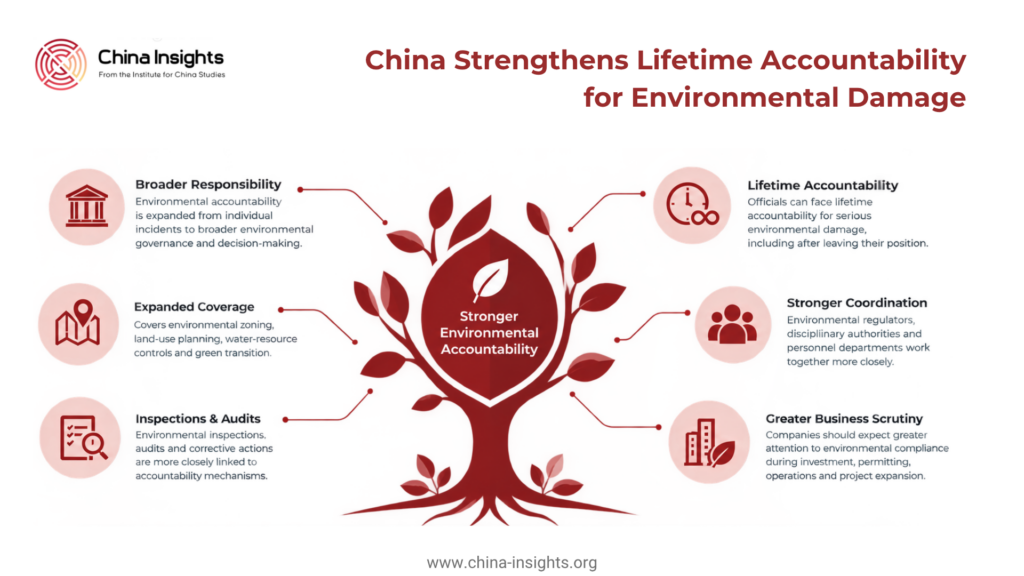
- Environmental accountability is being expanded from individual incidents toward broader responsibility for environmental governance and decision-making.
- Officials can face lifetime accountability for serious environmental damage, including after leaving their position.
- Responsibility now covers areas such as environmental zoning, land-use planning, water-resource controls and green economic transition.
- Environmental inspections, audits and corrective actions are becoming more closely connected to accountability mechanisms.
- Companies should expect greater attention to environmental compliance during investment, permitting, operations and project expansion.
Accountability is moving upstream
The revised framework places greater emphasis on the decisions and governance processes that create environmental risks. Responsibility can arise where local leaders make decisions that violate environmental policies, regulations or plans, or where decisions disregard ecological protection red lines, environmental quality limits or resource-use constraints.
This is an important change in emphasis. Environmental accountability is no longer focused only on whether pollution or ecological damage has occurred. The framework also examines whether officials properly incorporated environmental requirements into economic and development decisions.
Environmental governance becomes part of leadership performance
The revised measures specifically add responsibility for failing to implement environmental governance reforms, advance comprehensive green transformation, or properly apply territorial spatial planning, environmental zoning controls and rigid water-resource constraints.
Responsibility is also extended to ecological restoration, integrated protection of ecosystems and environmental damage compensation. The revised framework therefore links environmental performance more closely with broader economic and administrative decision-making.
For local governments, this increases the importance of demonstrating that environmental considerations were incorporated before major projects and development decisions were approved. It also strengthens the incentive to address environmental risks at an earlier stage.
Lifetime accountability is reinforced
One of the most significant changes is the explicit reinforcement of lifetime accountability. Where serious environmental damage results from distorted performance priorities or failure to follow high-quality development requirements, responsibility can still be pursued after an official has been transferred, promoted, resigned or retired.
The provision changes the incentives surrounding environmental decision-making. Officials have stronger reasons to consider long-term environmental consequences rather than short-term investment, production or growth objectives. This is particularly relevant in sectors involving significant land, water, energy or emissions impacts.
Environmental inspections gain greater weight
The revised framework also strengthens the connection between environmental accountability and existing supervisory mechanisms. Responsibility can arise where officials fail to properly rectify problems identified through environmental inspections, natural-resource inspections, audits, disciplinary recommendations or administrative public-interest litigation.
The measures require stronger communication and cooperation between disciplinary authorities, personnel departments and government departments responsible for environmental supervision. Accountability cases should also generally be made public in an appropriate manner.
This increases the importance of documented environmental compliance. Problems identified through regulatory inspections are less likely to remain isolated technical issues if they indicate broader failures in local environmental governance.
Implications for local investment decisions
The revised framework does not directly impose new environmental obligations on companies. Its immediate target is Party and government officials. However, it changes the institutional environment in which companies obtain approvals, develop projects and operate facilities.
Local authorities have stronger incentives to scrutinize projects against environmental plans and controls before making decisions. Projects that create significant environmental risks may therefore face greater examination of their location, resource requirements, emissions, environmental impact and long-term remediation implications.
Higher importance of early-stage compliance
The policy direction reinforces the importance of environmental due diligence before investment decisions are made. Companies should not rely solely on local administrative support or previous project practices when assessing a new investment.
Environmental requirements linked to land use, ecological protection, water resources and local development planning should be assessed at the project-design stage. For existing operations, environmental findings and remediation commitments should also be monitored closely because local authorities have stronger incentives to demonstrate effective follow-up.
What this means for business
- Environmental due diligence: Assess environmental constraints before selecting investment locations or committing capital.
- Permitting risk: Expect closer scrutiny of projects involving significant land, water, energy or environmental impacts.
- Local-government engagement: Government approvals should be assessed against formal environmental plans and controls rather than informal assurances alone.
- Compliance documentation: Maintain clear records of environmental assessments, permits, inspections, corrective actions and remediation.
- Project development: Integrate environmental requirements into project design and investment decisions at an early stage.
- Long-term risk: Environmental liabilities should be considered over the full operating and asset lifecycle, not only during initial approval.
Sources
https://www.gov.cn/zhengce/202609/content_7080363.htm
Author
Dr. Richard van Ostende

Related Articles