
China Elevates Historical Classic Industries into a New Industrial Policy Priority
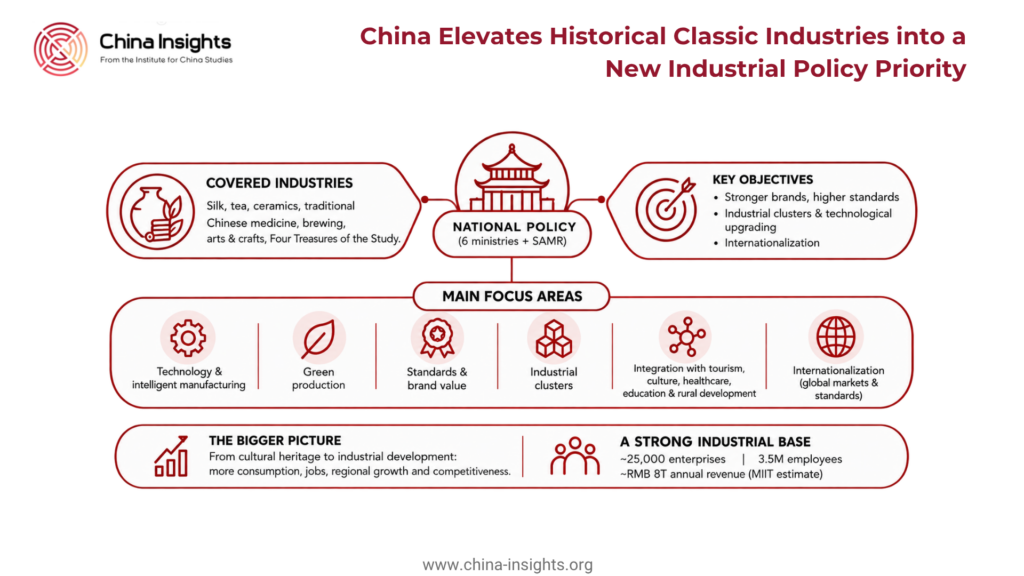
China has introduced its first national-level industrial policy specifically targeting what it calls “historical classic industries”. On 28 August 2026, the Ministry of Industry and Information Technology (MIIT), Ministry of Human Resources and Social Security, Ministry of Agriculture and Rural Affairs, Ministry of Commerce, Ministry of Culture and Tourism, and State Administration for Market Regulation jointly issued the Opinions on Promoting the High-Quality Development of Historical Classic Industries.
The policy covers industries including silk, tea, ceramics, traditional Chinese medicine, brewing, arts and crafts, and the Four Treasures of the Study. The approach is not limited to cultural preservation. It seeks to modernize these industries, build larger companies and industrial clusters, strengthen brands and standards, and move leading products toward higher-value positions in global markets.
Executive summary
- China has established a national industrial-policy framework for historical classic industries for the first time.
- The focus is shifting from preservation of traditional industries toward industrial upgrading and commercialization.
- Technology, intelligent manufacturing, green production and modern management are becoming central to the sector.
- The government is targeting stronger brands, standards and industrial clusters rather than fragmented production.
- Integration with tourism, culture, healthcare, education and rural development is expected to create new consumption channels.
- Internationalization is becoming a specific policy objective, including participation in international standards and access to high-end overseas markets.
From cultural heritage to industrial development
The new policy changes the positioning of traditional industries within China’s economic strategy. Historical classic industries are now treated not only as carriers of cultural heritage but also as contributors to domestic consumption, employment, regional development and industrial competitiveness.
MIIT estimates that representative above-designated-size enterprises in these industries number around 25,000, with almost 3.5 million employees and annual industry revenue of approximately RMB 8 trillion. The government therefore sees a substantial existing industrial base that can be upgraded rather than simply preserved.
Scale and industrial clustering become priorities
A major change is the stronger emphasis on scale. The policy targets the development of 50 large enterprises with annual revenue above RMB 10 billion, 100 Chinese consumer brands and several distinctive industrial clusters reaching RMB 1 trillion by 2028. By 2030, the objective is to establish internationally recognized companies and brands and move the industries toward the middle and upper segments of global value chains.
The policy also seeks to reduce fragmented development. Local governments are encouraged to build specialized industrial clusters, improve supporting industries and coordinate regional development. This creates a stronger basis for supply-chain integration, shared services, technology adoption and brand development.
Modernization becomes central to competitiveness
The policy places greater emphasis on combining traditional craftsmanship with modern technology. It calls for stronger scientific and technological innovation and for industries to move toward high-end, intelligent and green development.
This represents an important change for companies operating in traditionally labor-intensive segments. Modern production methods, digital technologies, quality control and green manufacturing are increasingly being positioned as tools for preserving competitiveness rather than as a departure from traditional production models.
The approach also encourages traditional enterprises to adopt modern management methods. Smaller companies with strong technical capabilities are encouraged to pursue specialized and differentiated development. This could support the emergence of more professionally managed small and medium-sized enterprises alongside larger industry leaders.
Standards and brands become strategic assets
The new framework gives greater importance to product quality, standardization and brand value. The State Administration for Market Regulation has highlighted the development of national standards and stronger quality-management systems across these industries.
The policy also encourages Chinese brands to participate in international standard-setting. According to MIIT, China has already led or participated in international standardization work covering areas such as silk, tea, ceramics and traditional Chinese medicine.
For businesses, this increases the strategic importance of intellectual property, product standards, traceability and brand management. Competition is likely to move further away from low-cost production toward recognized quality and differentiated brand value.
New links between industry and consumption
The policy also promotes deeper integration between historical classic industries and culture, tourism, healthcare, education and rural revitalization. The objective is to create new consumption scenarios and connect products more closely with cultural and experiential services.
This creates opportunities for companies that can combine manufacturing with retail, tourism, digital marketing, cultural content and consumer experiences. It also provides local governments with a framework for developing regional economic clusters around distinctive traditional industries.
Internationalization moves higher on the agenda
International market development is another clear policy priority. The government plans to support overseas promotion platforms, participation in international exhibitions and greater exposure of historical classic products to international consumers.
The objective is not simply to increase exports. The policy seeks to strengthen Chinese brands and improve their position in higher-value international markets. Participation in international standardization is part of the same strategy. This could gradually increase the competitiveness of Chinese traditional-product companies beyond their domestic markets.
What this means for business
- Industrial upgrading: Traditional manufacturers should expect stronger pressure to adopt modern technology, quality systems and management practices.
- Consolidation and clustering: Larger enterprises and specialized industrial clusters are likely to receive greater policy attention and resources.
- Brand value: Quality, trademarks, standards and international recognition will become more important competitive factors.
- Technology opportunities: Digitalization, intelligent production, green manufacturing and quality-control technologies should see increasing demand.
- Cross-sector opportunities: Companies combining traditional products with tourism, culture, healthcare, retail and digital services may benefit from new consumption models.
- International expansion: Export-oriented companies should monitor opportunities linked to overseas promotion, international standards and higher-end consumer markets.
Source
https://www.gov.cn/zhengce/202609/content_7080363.htm
Author
Dr. Richard van Ostende

Related Articles