
China's "Six Networks" Strategy: A Multi-Trillion Yuan Infrastructure Blueprint for the Next Stage of Growth
China has launched one of its most ambitious infrastructure development initiatives in recent years through the national deployment of the “Six Networks” strategy. The initiative was formally highlighted during the April 2026 meeting of the Communist Party’s Politburo and has since become a key component of the country’s infrastructure and economic development agenda.
The strategy focuses on accelerating the planning and construction of six interconnected infrastructure systems that policymakers view as essential to supporting China’s next phase of economic modernization. Unlike traditional stimulus programs centered solely on transportation and real estate, the Six Networks framework combines both conventional and new-generation infrastructure, reflecting China’s evolving development priorities.
According to the National Development and Reform Commission, the initiative is expected to mobilize trillions of yuan in investment while creating the foundation for long-term industrial competitiveness, digital transformation, energy security, and sustainable growth.
Executive Summary
China has elevated the construction of six strategic infrastructure networks to a national priority as part of its efforts to strengthen domestic demand, modernize infrastructure, and support long-term economic growth.
Key takeaways include:
- The Central Political Bureau (Politburo) first incorporated the “Six Networks” initiative into national-level economic planning during its April 2026 meeting.
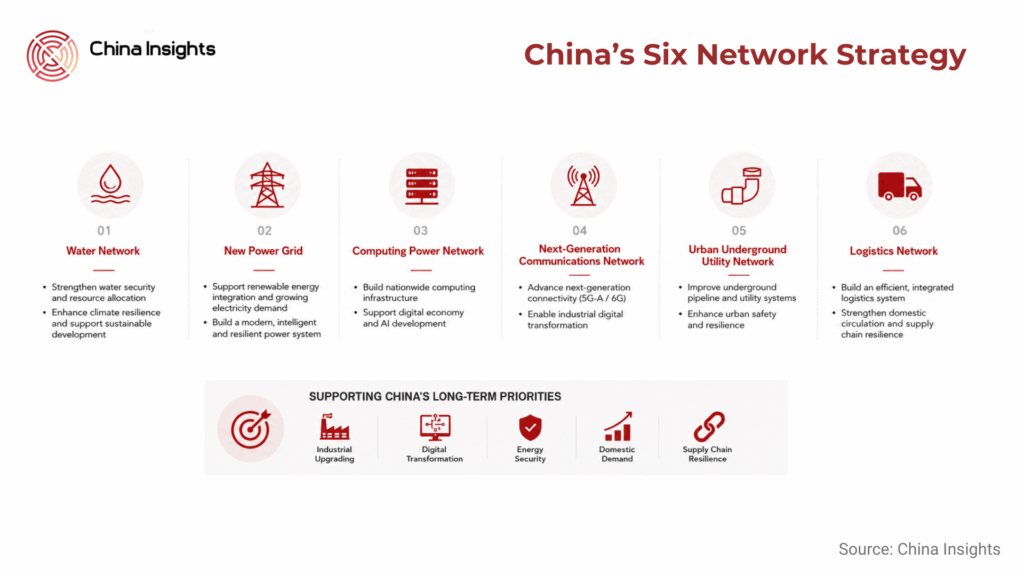
- The six networks include the water network, new power grid, computing power network, next-generation communications network, urban underground utility network, and logistics network.
- The National Development and Reform Commission (NDRC) is preparing dedicated implementation plans and sector-specific development roadmaps.
- Total investment related to the six networks and associated infrastructure sectors is expected to exceed RMB 7 trillion in 2026 alone.
- Investment in the new power grid and urban underground pipeline network is projected to reach approximately RMB 5 trillion each during the 15th Five-Year Plan period.
- The initiative is designed to stimulate investment, improve economic resilience, support industrial upgrading, and strengthen national security and supply chain capabilities.
What Are the Six Networks?
The Six Networks initiative encompasses six major infrastructure systems that collectively support economic activity and national development.
These include the national water network (水网), new power grid (新型电网), computing power network (算力网), next-generation communications network (新一代通信网), urban underground utility network (城市地下管网), and logistics network (物流网).
The composition of the initiative is notable because it combines traditional infrastructure sectors such as water management and logistics with digital infrastructure such as computing power and communications networks. This reflects China’s intention to simultaneously address physical infrastructure needs and the requirements of an increasingly digital economy.
A New Infrastructure-Led Growth Strategy
The Six Networks initiative emerges at a time when policymakers are seeking new sources of economic growth and investment.
Infrastructure investment has historically played a central role in China’s economic development model. However, traditional infrastructure categories such as highways, railways, and property development have matured significantly over the past two decades. The Six Networks strategy therefore represents a shift toward infrastructure that supports technological transformation, energy transition, and industrial upgrading.
The National Development and Reform Commission has indicated that dedicated implementation plans will be issued to define investment priorities, project timelines, and annual targets. Authorities also intend to establish a dynamic project pipeline to ensure a continuous flow of investment opportunities.
Strengthening Water Security Through the National Water Network
Water security remains a strategic priority for China due to regional imbalances in water resources, climate-related risks, and growing industrial demand.
China has already developed the world’s largest water infrastructure system, including major projects such as the South-to-North Water Diversion Project. During the 15th Five-Year Plan period, authorities intend to continue expanding the national water network and improve water resource allocation capabilities.
Modern water infrastructure is expected to play a critical role in safeguarding food security, industrial production, urban development, and environmental sustainability. As climate variability increases, resilient water systems are becoming increasingly important for long-term economic stability.
Building the Next Generation Power Grid
One of the largest investment opportunities within the Six Networks framework lies in the development of a new power grid system.
China’s electricity consumption surpassed 10 trillion kilowatt-hours for the first time in 2025, highlighting the growing demands placed on the national energy system. To support continued economic growth and renewable energy integration, authorities are accelerating the development of a modernized electricity grid that combines large-scale transmission infrastructure with intelligent distribution systems and microgrids.
Government estimates suggest that investment in the new power grid could exceed RMB 5 trillion during the 15th Five-Year Plan period, with broader economic benefits extending throughout the energy and manufacturing value chains.
Computing Power and Communications Become Strategic Infrastructure
The inclusion of the computing power network and next-generation communications network highlights the growing importance of digital infrastructure within China’s economic strategy.
As artificial intelligence adoption accelerates, computing capacity is increasingly viewed as a strategic production factor similar to electricity or transportation infrastructure. The computing power network aims to connect computing resources across regions and industries, improving efficiency and enabling broader access to advanced digital capabilities.
At the same time, China continues to expand 5G and 5G-Advanced networks while preparing for future 6G deployment. These networks will support emerging industries including autonomous vehicles, industrial internet applications, remote healthcare, smart manufacturing, and low-altitude economy initiatives.
Modernizing Cities and Logistics Infrastructure
The urban underground utility network represents another major area of investment.
Many Chinese cities continue to upgrade aging underground infrastructure, including water supply systems, drainage systems, gas pipelines, and utility tunnels. The government estimates that investment in urban underground pipeline systems could reach approximately RMB 5 trillion during the 15th Five-Year Plan period.
The logistics network component aims to strengthen supply chain efficiency, improve freight mobility, and enhance the connectivity of industrial clusters and consumer markets. Efficient logistics infrastructure remains essential to supporting domestic consumption, exports, and industrial competitiveness.
Economic and Industrial Implications
Beyond infrastructure development itself, the Six Networks initiative is expected to generate substantial economic spillover effects.
According to government estimates, investment related to the Six Networks and associated infrastructure sectors could exceed RMB 7 trillion in 2026. Such investment is expected to stimulate demand across construction, engineering, equipment manufacturing, information technology, telecommunications, energy, and industrial services sectors.
The initiative also aligns closely with China’s broader policy priorities, including technological self-reliance, industrial modernization, green transition, digital transformation, and domestic demand expansion.
By integrating physical and digital infrastructure development, policymakers aim to create a stronger foundation for productivity growth and economic resilience.
Financing and Implementation
The National Development and Reform Commission has emphasized that implementation will require coordinated use of government funding, policy finance tools, and private capital.
Authorities plan to strengthen funding support mechanisms while improving project planning and approval processes. Efforts will also focus on mobilizing private investment and ensuring adequate land, environmental, and regulatory support for major infrastructure projects.
This financing approach reflects China’s preference for combining public-sector guidance with market participation to achieve large-scale infrastructure objectives.
What This Means for Business
The Six Networks initiative represents one of China’s most significant infrastructure investment opportunities of the coming decade.
For companies operating in energy, utilities, telecommunications, data centers, cloud computing, engineering, construction, industrial automation, logistics, and environmental technologies, the initiative is expected to create substantial business opportunities as projects move from planning into implementation.
Equipment manufacturers, software providers, infrastructure developers, and engineering service companies are likely to benefit from increased demand linked to network construction and modernization projects. The emphasis on digital infrastructure also creates opportunities for firms active in artificial intelligence, data services, smart grids, and communications technologies.
For foreign companies, the initiative highlights China’s continued commitment to large-scale infrastructure development and industrial modernization. Businesses with expertise in advanced technologies, energy systems, water management, smart infrastructure, and logistics optimization may find new opportunities for cooperation with Chinese partners and project developers.
More broadly, the Six Networks strategy illustrates how China is redefining infrastructure investment for the digital era, combining traditional public works with next-generation technologies to support long-term economic transformation.
Author
Dr. Richard van Ostende

Related Articles