
China Updates Civil Aviation Engineering Standards Management Framework to Improve Infrastructure Governance
In January, 2026, the CAAC released the “Notice from the Civil Aviation Administration on Revising the Administrative Measures for Industry Standards in Civil Aviation Engineering Construction” (文号:民航发〔2026〕3号). These revised measures establish updated procedures for standard planning, development, review, implementation, maintenance, and revision.
The revision replaces the previous management framework issued in 2020 and aims to align civil aviation engineering standards with China’s broader standardization system, infrastructure development priorities, and technology advancement requirements.
The policy reflects a broader shift in China’s civil aviation sector toward stricter technical governance, higher-quality infrastructure development and more systematic regulatory management. International companies will need to adapt to increasingly sophisticated local standards, but may find opportunities where their technologies and expertise align with China’s infrastructure modernization priorities.
Executive Summary
The CAAC has revised the management system governing civil aviation engineering construction standards.
The new framework introduces a more structured lifecycle approach covering planning, drafting, review, publication, and periodic assessment.
The Airport Department of the CAAC will continue to serve as the central coordinating authority for industry construction standards.
Companies involved in airport infrastructure, engineering design, construction, equipment, and related services will need to monitor evolving technical requirements more closely.
The updated framework supports higher-quality airport development and may increase compliance expectations for future projects.
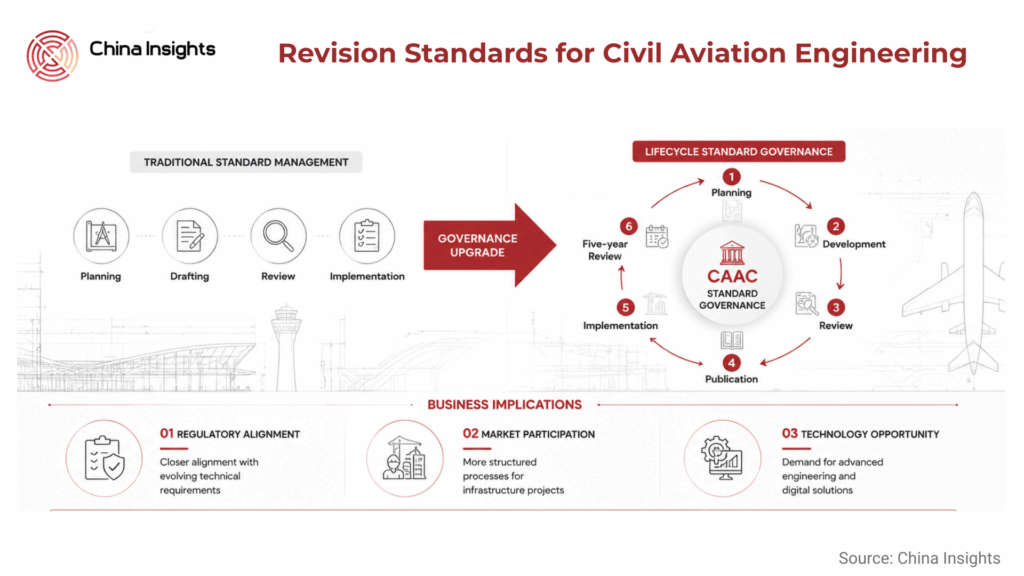

Expanded Governance Structure for Industry Standards
The revised measures clarify responsibilities among different CAAC departments and technical organizations.
The CAAC Airport Department acts as the coordinating department responsible for overall management of civil aviation engineering construction standards. Its responsibilities include developing management systems, organizing the industry standard system, coordinating standardization committees, and promoting international alignment of civil aviation standards.
Relevant CAAC departments will manage standards within their respective business areas. A technical committee for civil aviation engineering construction standards will provide technical support for standard development and management.
For businesses, the updated governance model indicates stronger institutional coordination between regulators, technical experts, and industry participants during the development of future engineering requirements.
More Structured Standard Development Process
The framework defines three types of standard actions: new development, comprehensive revision, and partial revision. Comprehensive revisions apply when existing standards no longer match industry development needs, while partial revisions address specific technical or regulatory updates.
The standard development process includes six main stages:
Project initiation
Preliminary review
Public consultation
Final review
Final technical editing
Approval and publication
For new and comprehensive revisions, the development period should generally not exceed two years from project initiation to official publication. This creates a more predictable regulatory timeline for companies participating in standard-setting activities or preparing for future compliance requirements.
Greater Industry Participation and Technical Review Requirements
The revised framework strengthens requirements for organizations involved in drafting standards. The main drafting organization must provide technical resources, establish internal review mechanisms, and coordinate participating entities. The CAAC specifies that the main drafting organization should generally be limited to one entity to improve accountability.
Drafting teams must include qualified technical personnel, and reviewers must have technical authority and broad industry representation. Review groups should generally include representatives from airport operations, design, construction, supervision, inspection, safety management, and related organizations.
The consultation process will also become more transparent. Draft standards must be publicly reviewed through CAAC channels and relevant industry platforms for no less than one month.

Stronger Focus on Safety, Quality and Technology Development
Civil aviation engineering standards are divided into mandatory and recommended standards. Mandatory standards focus on areas directly affecting construction quality, safety, ecological protection, resource conservation and public interests. Recommended standards provide technical guidance to improve efficiency, durability and sustainability.
During reviews, standards must be assessed against current laws, safety requirements, environmental policies, technical development trends, and practical industry needs.
Five-Year Review Mechanism Introduced for Existing Standards
According to the policy, civil aviation engineering construction standards must undergo review every five years. Reviews will assess whether standards remain consistent with regulations, industry development, technical progress, and international practices.
Following review, standards may remain valid, be revised, or be withdrawn. The responsible CAAC departments will determine the outcome based on review reports.
What this means for business
Overall, the policy signals that China’s civil aviation infrastructure market will continue moving toward stricter technical governance, higher quality requirements, and more systematic standard management.
Engineering contractors, airport developers, design institutes, equipment suppliers, and technology providers should strengthen internal processes for tracking upcoming standards and technical requirements.
Companies participating in airport construction projects should expect greater emphasis on compliance documentation, technical validation, and alignment with updated industry standards.
The revised framework may also create opportunities for companies with advanced engineering capabilities, digital construction solutions, energy-efficient technologies and internationally competitive technical standards.
Source
https://www.caac.gov.cn/XXGK/XXGK/ZCFB/202601/t20260114_229754.html
Author
Dr. Richard van Ostende

Related Articles