
China Shifts E-Commerce Policy from Scale Expansion to Quality-Led Competition
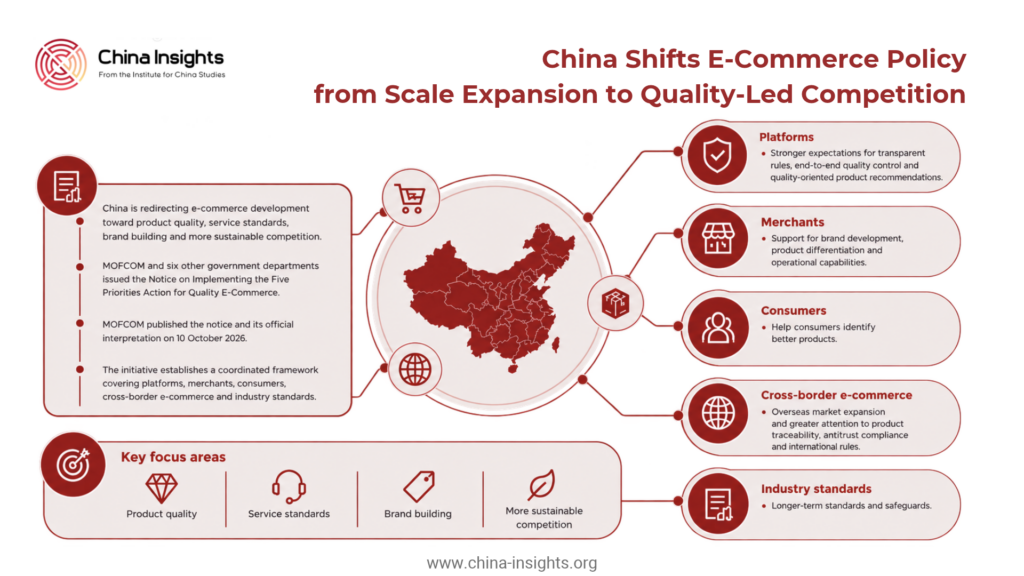
China is redirecting e-commerce development toward product quality, service standards, brand building and more sustainable competition. The policy shift aims to improve consumer experience while strengthening the position of quality-focused merchants and closer integration between digital platforms and the real economy.
On 11 September 2026, the Ministry of Commerce (MOFCOM), together with six other government departments, issued the Notice on Implementing the Five Priorities Action for Quality E-Commerce (《关于实施品质电商“五优”行动的通知》). MOFCOM published the notice and its official interpretation on 10 October 2026. The initiative establishes a coordinated framework covering platforms, merchants, consumers, cross-border e-commerce and industry standards.
Executive summary
- China is shifting e-commerce policy from market-scale expansion toward quality, service and consumer trust.
- Platforms face stronger expectations for transparent rules, end-to-end quality control and quality-oriented product recommendations.
- Merchants are being encouraged to invest in brand development, product differentiation and operational capabilities.
- Regulators are targeting practices such as automatic repricing, “lowest price across the internet” competition and manipulation of transaction metrics.
- Cross-border e-commerce policy combines overseas market expansion with greater attention to product traceability, antitrust compliance and international rules.
- Standards, certification and industry self-regulation are becoming more important to the sector’s long-term development.
From transaction growth to quality-led development
The new action addresses a structural challenge in China’s mature e-commerce market: continued expansion in online transactions does not automatically translate into better consumer experiences or sustainable merchant profitability. The government is seeking to make product quality, service reliability and consumer trust more central to competition.
The notice sets out 15 tasks across five priorities: improving platform quality, supporting merchant quality, helping consumers identify better products, strengthening the quality of cross-border e-commerce and establishing longer-term standards and safeguards. This creates a more coordinated policy framework than measures focused primarily on stimulating online consumption.
For businesses, the direction suggests that growth strategies based mainly on traffic acquisition, discounting and sales volume may become less aligned with policy priorities. Product differentiation, reliable fulfilment, service quality and brand reputation are receiving greater emphasis.
Platforms face stronger quality and governance expectations
The notice calls on e-commerce platforms to improve their internal rules and establish more comprehensive quality-control systems. Platforms are encouraged to publish quality commitments and governance reports, improve merchant verification and strengthen quality management across the transaction process.
Product presentation, recommendation and promotional mechanisms are also expected to give greater weight to product quality, service reputation and merchant credibility. The notice further encourages platforms to establish chief quality officer arrangements and improve online service-quality assessment.
This could influence how platforms assess merchants, allocate visibility and manage disputes. Platforms may need to invest more in verification, quality monitoring and governance systems. The notice establishes policy expectations, although the precise implementation and enforcement requirements will depend on subsequent measures.
Merchants are encouraged to compete through brands and differentiation
The policy places greater emphasis on improving merchant capabilities rather than treating sellers simply as participants in platform transactions. Planned support includes training in quality management, standards, compliance and brand development, particularly for small businesses and merchants operating through livestreaming and cross-border channels.
The notice also promotes closer links between e-commerce platforms and industrial clusters. Measures include connecting manufacturers and specialized small businesses with digital sales channels, developing consumer brands and helping foreign-trade companies reach China’s domestic market. AI-enabled services are identified as another area for innovation.
The commercial implication is a stronger policy focus on the connection between manufacturing capabilities and online market access. Businesses with distinctive products, original design or specialized technologies may find opportunities through platform partnerships and industry-specific programs. However, participation in these programs does not guarantee preferential placement or sales growth.
Price competition and platform practices come under closer scrutiny
One of the notice’s clearest market signals is its focus on what the authorities describe as disorderly and irrational competition. Regulators intend to address automatic repricing and “lowest price across the internet” practices, while improving the regulation of platform commissions and merchant-rating rules. The notice also calls for action against fake transactions and manipulated online reputations.
These measures respond to concerns that price-driven competition can squeeze merchants’ margins and discourage investment in product quality. More transparent platform rules could change the balance between platforms and sellers, particularly where ranking systems, commission arrangements or promotional requirements affect merchant economics.
The direction does not mean price competition will disappear. It indicates that regulators want competition to operate within a framework that gives greater weight to quality, credibility and fairer platform practices.
Cross-border e-commerce combines expansion with stronger safeguards
The notice also connects domestic quality upgrading with the internationalization of e-commerce. It calls for a stronger ecosystem for Chinese platforms and merchants operating overseas, including brand and quality screening and product-traceability systems. It also highlights antitrust compliance guidance for companies expanding abroad.
At the same time, the government intends to deepen international cooperation on e-commerce policies, digital trade processes and cross-border rules. Initiatives under the Silk Road E-Commerce framework are intended to support trade links and promote quality products across participating markets.
For businesses, this means overseas expansion is being framed not only as a sales opportunity but also as a matter of compliance, quality assurance and international coordination. Companies should distinguish between the policy’s broad direction and the specific legal requirements in each overseas market.
What this means for business
- Reassess platform strategy. Monitor changes to merchant rankings, product recommendations, quality assessments and promotional rules.
- Strengthen quality assurance. Review product traceability, supplier controls, customer-service standards and evidence supporting product claims.
- Build brands beyond price. Invest in differentiation, reputation and direct customer relationships rather than relying exclusively on discounts and platform traffic.
- Review platform economics. Track commission structures, automatic repricing and merchant-rating policies that may affect margins and market access.
- Prepare for more structured cross-border expansion. Integrate quality screening, traceability and antitrust compliance into overseas e-commerce plans.
- Monitor implementation. Track subsequent standards, local initiatives and platform-level changes before assuming that policy announcements create immediate legal obligations.
Sources
https://www.gov.cn/zhengce/202610/content_7082909.htm
Author
Dr. Richard van Ostende

Related Articles