
China’s 15th Five-Year Plan Raises the Bar for Intelligent Connected NEVs
China has released its first dedicated five-year plan for the intelligent connected new energy vehicle (NEV) industry. On 9 September 2026, the Ministry of Industry and Information Technology (MIIT), together with eight other government departments, issued the Intelligent Connected New Energy Vehicle Industry Development 15th Five-Year Plan (《智能网联新能源汽车产业发展“十五五”规划》).
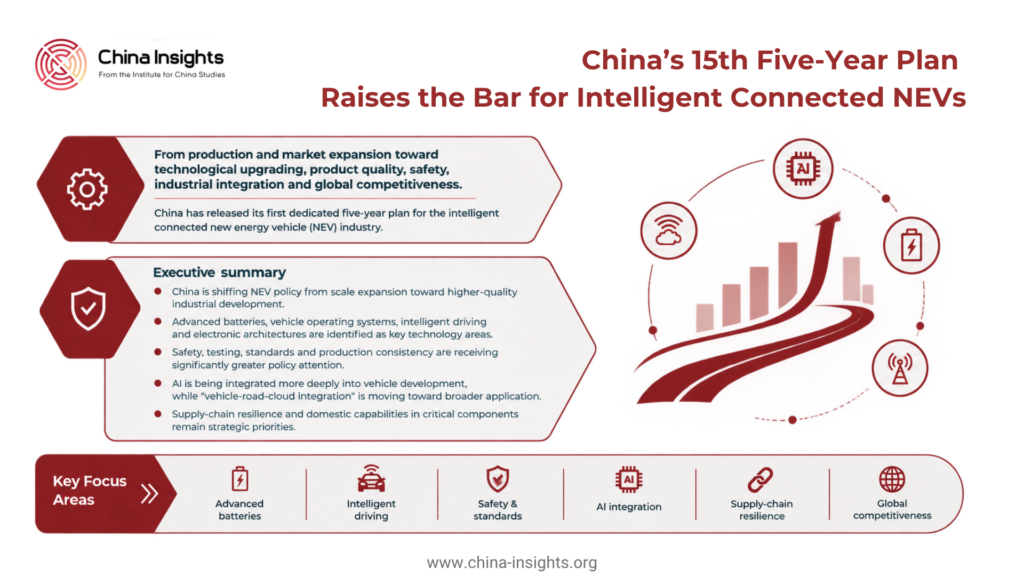
The plan signals a new phase for China’s NEV industry. The policy focus is moving beyond production and market expansion toward technological upgrading, product quality, safety, industrial integration and global competitiveness. It also places greater emphasis on correcting irrational competition and strengthening industry governance.
Executive summary
- China is shifting NEV policy from scale expansion toward higher-quality industrial development.
- Advanced batteries, vehicle operating systems, intelligent driving and electronic architectures are identified as key technology areas.
- Safety, testing, standards and production consistency are receiving significantly greater policy attention.
- AI is being integrated more deeply into vehicle development, while “vehicle-road-cloud integration” is moving toward broader application.
- Supply-chain resilience and domestic capabilities in critical components remain strategic priorities.
- Internationalization is being upgraded from vehicle exports toward broader trade, investment, technology and supply-chain cooperation.
From rapid expansion to industrial upgrading
China enters the 15th Five-Year Plan with a mature NEV manufacturing base. The challenge is changing. The authorities now identify irrational competition, premature technology deployment, product-quality problems and autonomous-driving safety as issues requiring stronger intervention.
The new plan therefore places greater emphasis on the quality of industrial development. The objective is to strengthen China’s existing advantages while addressing weaknesses that could constrain the industry’s next stage of growth.
This represents a different policy priority from the previous phase, when expanding NEV production, consumer adoption and charging infrastructure were central concerns.
Technology priorities move further upstream
The plan establishes a dedicated key technology research project covering areas including energy and power systems, intelligent chassis and intelligent connectivity. MIIT has also highlighted new-generation electronic and electrical architectures, all-solid-state batteries, automotive operating systems and intelligent driving as priority areas for technological breakthroughs.
The focus is therefore moving deeper into the technology stack. Battery performance, computing and control platforms, software and intelligent-driving systems are becoming increasingly important sources of competitive advantage.
For suppliers, this creates opportunities beyond conventional components. Software, semiconductors, sensors, computing platforms, battery technologies and testing capabilities are increasingly integrated into the strategic development of the automotive industry.
Safety becomes a central industrial requirement
The plan gives substantially greater weight to product and system safety. A dedicated intelligent connected NEV safety project will strengthen functional safety, cybersecurity and data-security management, while establishing stronger safety monitoring capabilities.
The policy also calls for stronger testing and evaluation capabilities. Product innovation will face greater scrutiny before market deployment, while production consistency supervision will be strengthened.
This changes the competitive environment for companies developing advanced vehicle functions. Speed to market will remain important, but technologies that cannot demonstrate sufficient reliability and safety are likely to face greater regulatory barriers.
AI becomes part of the vehicle industrial strategy
The plan introduces a dedicated “AI + automotive” development action. The focus includes basic capabilities, vehicle-side applications and data resources. This signals that artificial intelligence is moving from an emerging automotive application toward a broader industrial-development priority.
The implication is wider than autonomous driving. AI is increasingly relevant to vehicle software, intelligent cockpits, development processes, data management and vehicle-cloud interaction.
The policy direction also reinforces the importance of data infrastructure. Companies operating in intelligent vehicles will need to consider technology, data governance and cybersecurity as increasingly interconnected requirements.
Vehicle-road-cloud integration moves toward scale
China is also moving from individual intelligent-vehicle applications toward broader infrastructure integration. The plan supports continued development of vehicle-road-cloud integration, intelligent connected vehicle access and road-use trials, alongside wider application of new energy commercial vehicles and autonomous driving.
This creates a larger ecosystem around the vehicle itself. Road infrastructure, cloud platforms, communications, mapping, data services and local government systems become part of the automotive value chain.
For technology companies, this expands the addressable market. For vehicle manufacturers, it also increases the importance of interoperability and cooperation with infrastructure and technology providers.
Industry governance becomes more important
The plan responds directly to concerns about irrational competition and insufficient product validation. The government intends to strengthen industry governance, improve product innovation design review and testing, and strengthen production-consistency supervision.
This is part of a broader effort to improve competition in China’s manufacturing industries. The 15th Five-Year Plan calls for stronger mechanisms to address excessive and irrational competition across strategic industries.
For NEV companies, the policy direction points toward a market where price competition alone will be less sustainable. Technology, quality, safety, brand strength and operational efficiency will become more important competitive factors.
Internationalization becomes more comprehensive
The new plan also moves beyond an export-led approach. A dedicated internationalization capability project covers areas including international cooperation, Chinese automotive brands and cross-border data flows. The government also plans to strengthen international standards and regulatory coordination and improve supporting systems for cross-border logistics and investment.
This reflects the changing international position of Chinese NEV companies. China’s automotive industry is increasingly operating through a combination of exports, overseas manufacturing, investment and supply-chain partnerships.
The next phase will therefore require companies to manage not only market access but also regulatory compliance, technology cooperation, data requirements and geopolitical risks across multiple jurisdictions.
What this means for business
- Technology suppliers: Demand should increase for advanced batteries, automotive software, computing, sensors, cybersecurity and testing technologies.
- Product development: Safety validation, reliability and production consistency will become more important alongside speed of innovation.
- AI and data: Companies should assess opportunities across vehicle AI, data infrastructure, software and cloud-based automotive services.
- Industry competition: Stronger governance may reduce some forms of irrational price competition and increase the value of technology and operational efficiency.
- Automotive ecosystems: Vehicle-road-cloud integration creates opportunities beyond vehicle manufacturing, including infrastructure, communications and digital services.
- International expansion: Chinese and foreign companies should prepare for a more integrated automotive market involving exports, overseas investment, standards, data and supply-chain cooperation.
Sources
https://www.gov.cn/zhengce/202609/content_7080809.htm
Author
Dr. Richard van Ostende

Related Articles