
China Tightens Control Over New Energy Vehicle Battery Recycling
China is moving from policy-led development of new energy vehicle (NEV) battery recycling toward a more formalized, traceable and enforcement-oriented regulatory system. The shift is driven by the rapid growth of retired power batteries and the need to control environmental, safety and resource-security risks.
On 31 December 2025, the Ministry of Industry and Information Technology (MIIT), together with five other ministries and commissions, issued the Measures for the Administration of Recycling and Comprehensive Utilization of Waste Power Batteries from New Energy Vehicles (《新能源汽车废旧动力电池回收和综合利用管理暂行办法》, MIIT Order No. 73). The measures entered into force on 1 April 2026. MIIT published its official policy interpretation on 16 January 2026.
The policy marks an important change for companies operating across the NEV, battery, automotive repair, dismantling and recycling value chains. Compliance is becoming increasingly dependent on documented battery flows, defined corporate responsibilities and the use of authorized recycling channels.
Executive summary
- China is moving toward full-lifecycle traceability of NEV power batteries.
- Battery and vehicle manufacturers face clearer producer responsibility for recovery.
- Recycling and comprehensive utilization activities are subject to stronger environmental, safety and permitting requirements.
- Informal collection, unauthorized dismantling and untraceable battery transactions are becoming higher-risk activities.
- Regulatory enforcement is shifting from framework building toward joint inspections and penalties.
- The removal of the former policy concept of “cascade utilization” further tightens the market boundary for retired batteries.
From voluntary coordination to formal responsibility
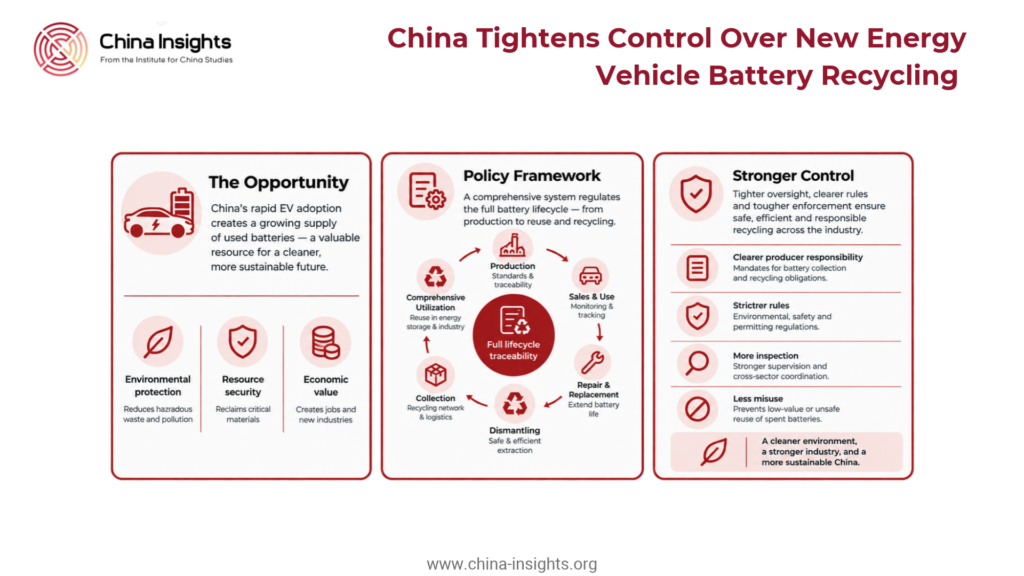
The key change is the formal allocation of responsibilities across the battery lifecycle. The new measures cover production, sales, repair, replacement, dismantling, collection and comprehensive utilization. Battery manufacturers and NEV manufacturers must establish appropriate recovery arrangements, while other participants must transfer retired batteries through compliant channels.
This reduces the scope for companies to treat retired batteries as an unregulated secondary commodity. For manufacturers, the issue is no longer limited to establishing a recycling network. They must also demonstrate that batteries leaving their operational chain are handled through compliant channels.
Traceability becomes a core compliance requirement
The new system introduces a stronger digital traceability framework. MIIT and relevant authorities are establishing a national NEV power battery traceability information platform covering the battery’s lifecycle. Battery producers and other relevant companies must provide information through the platform, while batteries must be coded and labelled in accordance with applicable standards.
The commercial impact is significant. Companies will need reliable internal processes for recording battery movements, replacements, transfers and recovery. Data quality therefore becomes part of operational compliance. The national platform launched in March 2026 and is intended to support lifecycle monitoring, corporate responsibility assessment and regulatory analysis.
Recycling is becoming a regulated industrial activity
The measures also raise the compliance threshold for companies engaged in comprehensive utilization. Activities must comply with requirements covering resource utilization, environmental protection and workplace safety, while relevant projects may require approvals and pollutant-discharge permits. The measures also prohibit the use of retired batteries in areas where such use is prohibited by laws, administrative regulations or mandatory standards.
This is likely to favor established recycling companies with adequate technical capabilities, environmental controls and formal operating licenses. At the same time, companies relying on informal collection networks or low-cost dismantling models face increasing regulatory exposure.
Enforcement is moving closer to the market
Implementation is now moving beyond the establishment of rules. In April 2026, MIIT, the Ministry of Ecology and Environment, the Ministry of Transport, the Ministry of Commerce and the State Administration for Market Regulation launched a joint enforcement campaign targeting irregular battery transactions, non-compliance with traceability requirements, illegal dismantling, production of substandard products and unlicensed operations.
This represents a meaningful change in the regulatory environment. Authorities are coordinating inspections across several stages of the value chain rather than treating battery recycling as a narrow industrial-policy issue. Companies should therefore expect compliance requirements to increasingly affect commercial transactions, supplier selection and operational procedures.
“Cascade utilization” is no longer a policy safe harbor
A further tightening occurred in July 2026. MIIT issued the Announcement on Repealing and Revising Policies and Standards Related to “Cascade Utilization” of Waste Power Batteries and Regulating Relevant Industry Activities, dated 30 July 2026. The announcement removed “cascade utilization” provisions from the 2024 industry conditions and ended the separate public listing of cascade-utilization enterprises.
The change reflects a stricter distinction between recycling retired batteries and producing new battery products. Companies cannot rely on the label “cascade utilization” to avoid applicable product-quality, safety or regulatory requirements. This is particularly relevant for businesses supplying secondary battery products into downstream applications.
What this means for business
- Manufacturers should strengthen producer-responsibility systems, including recovery networks and contractual arrangements with authorized recyclers.
- Traceability should be treated as an operational control, not simply a regulatory reporting task.
- Recycling investments require stronger compliance screening, particularly for environmental permits, safety systems and processing capabilities.
- Supply-chain due diligence will become more important as companies can face exposure through non-compliant collection or disposal partners.
- Secondary-use business models need reassessment, particularly where retired batteries are repackaged or reused in applications subject to specific safety standards.
- Market consolidation is likely to continue, favoring technically capable and compliant recycling companies over informal operators.
Sources
https://www.gov.cn/zhengce/202608/content_7079239.htm
https://www.miit.gov.cn/zwgk/zcjd/art/2026/art_34b7d0c460e54151a81fc981ae12fd98.html
https://www.miit.gov.cn/gyhxxhb/jgsj/cyzcyfgs/bmgz/jdcjxl/art/2026/art_392462fdc40c415ea4a4129cac3028c2.html
https://www.miit.gov.cn/jgsj/jns/zhlyh/art/2026/art_b3fc173935c54c45aed141149b064878.html
https://www.miit.gov.cn/jgsj/jns/zhlyh/art/2026/art_a8abaaf4ce1d4f8f9d37c2d3aa5f4f0c.html
https://wap.miit.gov.cn/jgsj/jns/zhlyh/art/2026/art_68252019ef6648f886b2c070ef8ced02.html
Author
Dr. Richard van Ostende

Related Articles