
China Repositions Emerging Industries as New Pillars of Industrial Growth
China is entering the implementation phase of its 15th Five-Year Plan (2026–2030) with a clearer industrial policy focus on sectors expected to generate future growth. The Ministry of Industry and Information Technology (MIIT) has signaled that emerging industries will move beyond targeted development programs and become a more important part of the country’s industrial structure.
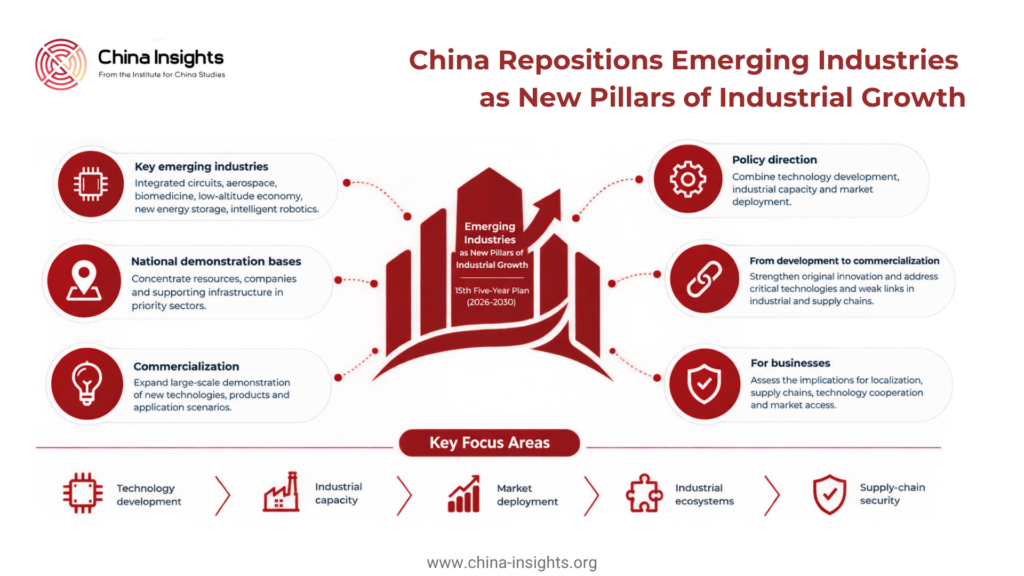
At a State Council Information Office press conference on 26 August 2026, MIIT outlined its priorities for implementing the 15th Five-Year Plan and advancing new industrialization. The ministry identified integrated circuits, aerospace, biomedicine, low-altitude economy, new energy storage and intelligent robotics as emerging pillar industries. Quantum technology, biomanufacturing, hydrogen and nuclear fusion, brain-computer interfaces, embodied intelligence and 6G were identified as future industries.
Executive summary
- China is shifting emerging industries from development priorities toward new pillars of industrial growth.
- Industrial policy will increasingly combine technology development, industrial capacity and market deployment.
- New national demonstration bases are expected to concentrate resources, companies and supporting infrastructure in priority sectors.
- Large-scale application of new technologies and products will become an important mechanism for commercialization.
- Foreign companies should assess the implications for localization, supply chains, technology cooperation and market access.
- Competition is likely to intensify as policy support attracts additional capital and industrial capacity into selected sectors.
Emerging industries receive a higher strategic status
The most important change is the positioning of selected emerging industries as future pillars of the manufacturing economy. This represents a progression from supporting individual technologies or applications toward developing complete industrial ecosystems.
The policy direction is consistent with the 15th Five-Year Plan Outline, which calls for accelerated development of strategic emerging industries, including information technology, new energy, new materials, intelligent connected NEVs, robotics, biomedicine, high-end equipment and aerospace. It also calls for the development of new technology, product and application scenarios at scale.
For businesses, this changes the relevance of industrial policy. Government support is increasingly likely to target not only R&D but also industrialization, supply-chain development, infrastructure, demonstration projects and market deployment.
Policy support is moving toward industrial ecosystems
MIIT is planning to establish national emerging-industry development demonstration bases. These will focus on areas including new-generation information technology, new energy, new materials, intelligent connected vehicles, robotics, biomedicine, high-end equipment and aerospace. The objective is to create regional and corporate models that can lead broader industrial development.
This points to greater geographical concentration of industrial resources. Demonstration bases can become focal points for investment, infrastructure, research institutions, skilled labor and supply-chain development. Companies entering priority sectors should therefore assess not only national policy alignment but also the location of relevant industrial clusters.
Commercialization becomes a policy priority
Another important shift is the stronger emphasis on moving technologies from development into commercial applications. MIIT plans to expand large-scale demonstration of new technologies, products and application scenarios, including “5G+”, “AI+”, “robotics+”, industrial internet and BeiDou applications. The approach is intended to allow technologies to be tested, validated and iterated in real operating environments before broader deployment.
This is commercially relevant because access to application scenarios can become a competitive advantage. Companies able to participate in demonstration projects may gain earlier access to customers, operational data and industrial partners. At the same time, companies operating in priority sectors should expect government procurement, state-owned enterprises and industrial parks to play a greater role in market formation.
Technology development remains linked to supply-chain security
The emerging-industry strategy is not limited to demand-side support. MIIT also intends to strengthen original innovation and address critical technologies and weak links in industrial and supply chains. The ministry has highlighted major technology-equipment projects, industrial foundation rebuilding and targeted breakthroughs in strategic areas.
This creates opportunities for suppliers of advanced equipment, components, materials, industrial software and specialized technologies. It also signals continued pressure on companies to strengthen the resilience and domestic depth of strategically important supply chains. Foreign suppliers should therefore distinguish between areas where China seeks complementary international technology and areas where domestic substitution is likely to remain a policy objective.
The boundary between emerging and future industries is becoming clearer
The latest positioning also creates a clearer distinction between technologies that are moving toward industrial scale and those still being developed as future growth engines. Intelligent robotics, aerospace and new energy storage are being treated as emerging pillars, while embodied intelligence, brain-computer interfaces, quantum technology and 6G remain future-oriented areas.
For investors, this distinction matters. Emerging pillar industries are more likely to see near-term industrial investment and application support. Future industries may offer longer-term opportunities but involve higher technology, regulatory and commercialization risks. Capital allocation and market-entry strategies should therefore reflect different development timelines.
What this means for business
- Priority sectors will attract more resources: Companies active in designated emerging industries should monitor national and local funding, demonstration programs and industrial-base initiatives.
- Location will matter more: Industrial clusters and demonstration bases may become increasingly important for market access, partnerships and supply-chain integration.
- Commercial deployment is critical: Technology companies should assess opportunities to participate in government-supported application and demonstration projects.
- Supply-chain localization will continue: Suppliers in strategic technologies should evaluate both partnership opportunities and potential substitution risks.
- Competition will intensify: Stronger policy support is likely to accelerate investment and capacity expansion in priority sectors.
- Market-entry strategies should differentiate sectors: Emerging pillar industries offer nearer-term commercial opportunities, while future industries require a longer investment horizon and higher risk tolerance.
Sources
https://www.gov.cn/zhengce/202608/content_7079236.htm
Author
Dr. Richard van Ostende

Related Articles