
China Steps Up Efforts to End Corporate Payment Arrears
China is strengthening its response to payment arrears owed to businesses. The latest measures indicate a shift from periodic campaigns to a more permanent framework for preventing and resolving overdue corporate payments. The focus is increasingly on large companies that delay payments to small and medium-sized enterprises (SMEs), while also addressing the mechanisms that allow payment chains to become blocked.
The State Council Executive Meeting, chaired by Premier Li Qiang on 21 August 2026, deployed further measures to clear outstanding corporate accounts. The meeting called for stronger accountability, greater use of financial and fiscal instruments, sector-specific payment rules, closer supervision of large-company payment practices and stricter controls on non-cash payment instruments. The State Council’s policy interpretation was published on 22 August 2026.
Executive summary
- China is moving from campaign-based arrears clearance toward regularized governance of corporate payments.
- Large companies face greater scrutiny over delayed payments to SMEs.
- Payment terms and conditions are expected to become more sector-specific and transparent.
- Authorities will target practices that effectively extend payment periods through non-cash instruments.
- Fiscal and financial tools will be used to address interconnected or “chain” arrears.
- Companies should expect stronger pressure to improve cash-flow discipline, payment processes and contractual compliance.
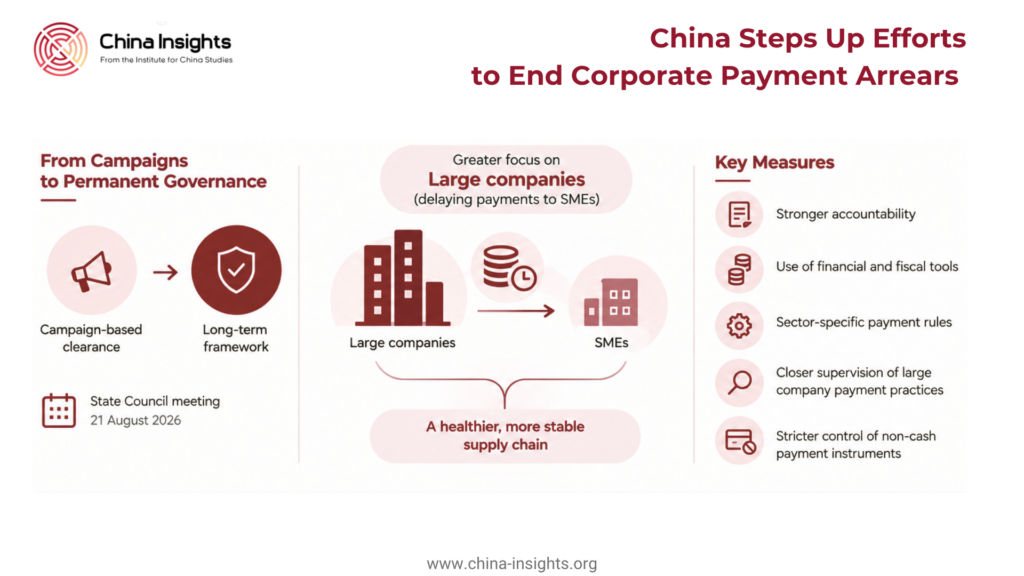
From campaign-based clearance to permanent governance
The most important change is the policy objective. The July 2026 Politburo meeting called for the normalization of resolving corporate payment arrears. The August State Council meeting translates this direction into more specific mechanisms for implementation. The emphasis is therefore shifting from resolving accumulated arrears toward preventing new arrears from emerging.
This matters because persistent payment delays affect more than individual suppliers. Delayed payments can weaken SME liquidity, increase financing requirements and create secondary arrears elsewhere in the supply chain. The new approach recognizes payment discipline as part of broader market stability and business confidence.
Greater pressure on large companies
A key new focus is the treatment of arrears owed by large companies to SMEs. The State Council called for stronger action against large enterprises that delay payments, alongside enhanced supervision of their payment behavior and enforcement against unfair competition.
This increases the compliance exposure of large buyers. Payment practices are no longer solely an internal financial-management issue. Contract terms, approval processes and actual payment behavior are becoming relevant to regulatory oversight. Large companies should therefore expect greater scrutiny of practices that use market power to shift financing burdens onto smaller suppliers.
Payment terms will become more explicit
The State Council called for improved industry-level payment rules, with reasonable payment periods and payment conditions to be defined according to individual sectors. It also called for more detailed criteria for identifying enterprises that default on payment obligations.
This could reduce ambiguity around what constitutes an unreasonable payment period. For companies, the commercial implication is that payment terms may become less flexible where they conflict with sector-specific expectations. Procurement and finance departments will need to review whether standard contractual arrangements remain appropriate.
Non-cash payment practices face tighter scrutiny
Another significant change concerns the use of non-cash payment instruments. The State Council called for their standardized management and stronger disclosure of payment information. This follows longstanding concerns that bills, supply-chain instruments and other mechanisms can be used to defer the economic settlement of an invoice even where the formal payment process has been completed.
The issue is particularly relevant to SMEs because delayed conversion of non-cash instruments into usable funds can create additional financing costs. Companies that rely heavily on such instruments should therefore assess both contractual compliance and the actual liquidity impact on suppliers.
“Chain clearance” becomes a policy priority
The State Council also called for authorities to break the chain of interconnected arrears. Fiscal and financial instruments, including special-purpose local government bonds and special relending facilities, are expected to support this effort where appropriate.
The focus on interconnected arrears is important. A company may delay payment because it itself has not been paid by another customer. This can create a cascading liquidity problem across multiple tiers of a supply chain. Addressing the chain rather than an individual debtor could improve the effectiveness of arrears clearance.
The direction builds on an established legal framework
The latest measures do not create the policy framework from scratch. China has already established legal and administrative mechanisms for protecting SME payment rights, including the Regulations on Ensuring Payment of Funds to Small and Medium-sized Enterprises. Earlier government measures also required large enterprises to improve accounts-payable management and prevent unreasonable payment practices.
The current development is therefore primarily one of implementation and enforcement intensity. Businesses should not interpret the latest announcement simply as another temporary clearance campaign. The policy direction points toward stronger institutional controls over payment behavior.
What this means for business
- Large buyers should review payment practices: Procurement and finance processes should be assessed against applicable payment rules and contractual obligations.
- SME suppliers may gain stronger protection: More formal payment rules could improve cash-flow predictability and reduce dependence on customer financing.
- Payment terms require greater attention: Sector-specific standards may reduce the scope for excessively long or commercially unbalanced payment periods.
- Non-cash settlement needs review: Companies should assess whether payment instruments create effective delays or additional financing costs.
- Supply-chain liquidity will matter more: Companies should monitor upstream and downstream receivables and payables rather than treating arrears as isolated transactions.
- Compliance risk is increasing: Payment behavior is becoming more visible to regulators and may increasingly affect corporate reputation and market relationships.
Sources
- https://www.gov.cn/zhengce/202608/content_7078874.htm
- https://www.beijing.gov.cn/ywdt/zyldhd/202608/t20260825_4836105.html
- https://wap.sasac.gov.cn/n2588020/n2588072/n2590944/n2590946/c22526282/content.html
- https://app.www.gov.cn/govdata/gov/202112/01/478826/article.html
Author
Dr. Richard van Ostende

Related Articles