
China Pushes New Energy Vehicles and Green Smart Products Deeper into County Markets
China is strengthening its policy focus on county-level and rural consumption. The latest measures move beyond encouraging individual product categories and address the wider commercial ecosystem needed to make consumption in lower-tier markets more sustainable. New energy vehicles (NEVs), green smart products and related infrastructure are among the priority areas.
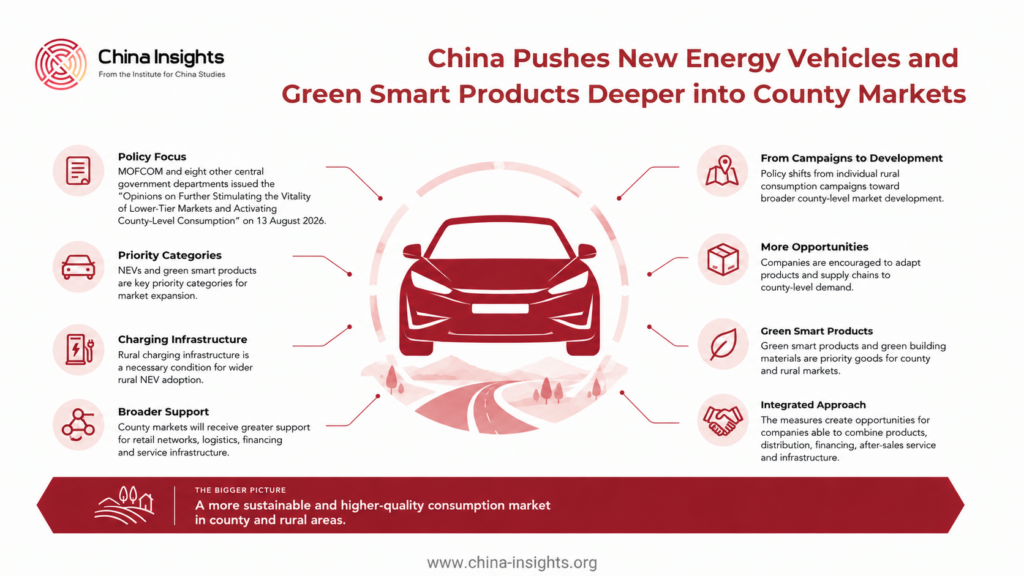
The Ministry of Commerce (MOFCOM), together with eight other central government departments, issued the “Opinions on Further Stimulating the Vitality of Lower-Tier Markets and Activating County-Level Consumption” (《关于进一步激发下沉市场活力 活跃县域消费的意见》) on 13 August 2026. The State Council’s policy interpretation subsequently highlighted the expansion of NEVs, green smart products and rural charging infrastructure as key measures.
Executive summary
- Policy is shifting from individual rural consumption campaigns toward broader county-level market development.
- NEVs and green smart products are being positioned as priority categories for market expansion.
- Charging infrastructure is being treated as a necessary condition for wider rural NEV adoption.
- County markets will receive greater support for retail networks, logistics, financing and service infrastructure.
- National and local authorities are encouraging companies to adapt products and supply chains to county-level demand.
- The measures create opportunities for companies able to combine products, distribution, financing, after-sales service and infrastructure.
County markets move higher on the consumption agenda
The key change is the treatment of lower-tier markets as a structural source of domestic consumption rather than simply an extension of urban retail. The new policy seeks to upgrade commercial facilities, improve distribution networks, attract brands and expand the range and quality of goods and services available in counties and towns.
This creates a broader market-entry framework for companies. Businesses are being encouraged to enter county markets with products suited to local consumption patterns. The policy also supports flexible supply chains based on actual demand. This reduces the emphasis on simply transferring urban retail formats into rural areas.
NEVs move from promotional campaigns toward market infrastructure
NEVs remain a clear policy priority. The new measures call for stronger support for NEVs to enter county and rural markets while also expanding the coverage of rural charging facilities. The objective is to address both product availability and the practical barriers to vehicle use.
This represents an important shift in market development. China’s NEV policy has already supported rural sales through dedicated “NEVs to the countryside” campaigns. In 2026, five central government departments launched another nationwide campaign, combining vehicle promotion with trade-in policies, charging infrastructure and related services.
The new county-consumption policy places these efforts within a wider commercial strategy. For manufacturers, the opportunity is therefore not limited to vehicle sales. Charging, maintenance, finance, insurance, used vehicles and other parts of the automotive value chain are becoming increasingly relevant to rural market penetration.
Charging infrastructure becomes a commercial enabler
Infrastructure remains one of the main constraints on rural NEV adoption. The government is therefore linking product promotion with the expansion of charging coverage. This reduces the risk that vehicle sales grow faster than the infrastructure required to support daily use.
Progress is already visible. The National Energy Administration reported that county-level charging-facility coverage had reached 98.61% by the end of June 2026. The remaining policy focus is increasingly on improving network density, service quality and the ability of infrastructure to support growing NEV usage.
For businesses, this points toward a shift from infrastructure availability to infrastructure quality and utilization. Charging operators, equipment suppliers, energy companies and digital-service providers may find opportunities as rural networks become more commercially active.
Green smart products gain a larger rural market
The policy extends beyond vehicles. Green smart products and green building materials are also identified as priority goods for county and rural markets. The objective is to improve product supply and promote more consistent access to quality goods between urban and rural consumers.
The implication for manufacturers is that rural markets should not necessarily be treated as destinations for older or lower-end product lines. The policy explicitly encourages enterprises to introduce quality products into county markets and, where conditions permit, launch new products simultaneously in county and urban markets.
This could support a broader shift toward “same quality, same products” across urban and county markets. Companies with differentiated green and smart-product portfolios may therefore have an opportunity to expand their addressable market.
Distribution and supply chains are being upgraded
The measures also address the commercial infrastructure behind consumption. Authorities are supporting upgrades to county commercial facilities, logistics networks, cold-chain infrastructure and rural delivery systems. They are also encouraging closer integration between online and offline retail.
For companies, this reduces some of the structural barriers associated with serving geographically dispersed markets. However, successful expansion will still depend on distribution economics. Flexible inventory management, local partnerships and demand forecasting will become more important as companies seek to avoid simply replicating urban distribution models.
Financing and local commercial ecosystems receive support
The policy also introduces financial and operational support for businesses expanding into county markets. Eligible consumer loans and loans to service-sector businesses may receive interest subsidies. Companies establishing qualifying chain stores in counties can also access entrepreneurship-guarantee loan support.
At the same time, authorities are encouraging national brands to move into counties while supporting local businesses and brands. This creates a more competitive environment. International and national companies will need to compete not only with established urban brands but also with local businesses that understand county-level consumer preferences.
The policy is broader than “going rural”
The significance of the latest measures lies in their broader approach. NEV and green-product sales are being integrated with commercial infrastructure, financing, logistics, digitalization and after-sales services. The government is therefore attempting to develop the market conditions needed for sustained county-level consumption rather than relying solely on temporary promotional campaigns.
For companies, this makes county markets more strategically relevant. However, the opportunity is not uniform across China. Local population trends, income levels, infrastructure, logistics costs and commercial density will continue to determine where expansion is commercially viable.
What this means for business
- Reassess county-level market potential: NEVs and green smart products now have stronger policy support as growth categories in lower-tier markets.
- Build the full service ecosystem: Product sales should be considered alongside charging, maintenance, financing, logistics and after-sales support.
- Adapt products to local demand: Companies are encouraged to use demand-driven supply chains rather than simply replicate urban product portfolios.
- Invest in distribution capabilities: County expansion will require stronger local logistics, retail partnerships and inventory management.
- Monitor financing support: Eligible businesses and consumers may benefit from interest-subsidy and guarantee programs.
- Consider local partnerships: Market entry may be more effective through cooperation with county-level retailers, service providers and local brands.
Sources
- https://www.gov.cn/zhengce/202608/content_7078604.htm
- https://www.mofcom.gov.cn/zwgk/zcfb/art/2026/art_39e326e1c5a44c16b7b18f5ec6c62baf.html
- https://interview.mofcom.gov.cn/detail/202608/ff808081a018349901a018e9e7fb0007.html
- https://wap.miit.gov.cn/xwfb/gxdt/sjdt/art/2026/art_352714e8c8024dd99957867de040e81a.html
Author
Dr. Richard van Ostende

Related Articles