
China Reshapes Healthcare Financing as Multi-Layered Medical Coverage Moves into the 15th Five-Year Plan
China is entering a new phase of healthcare insurance reform. The focus is shifting from expanding basic coverage toward building a more integrated and financially sustainable multi-layered medical security system. The change reflects demographic ageing, rising healthcare demand and rapid innovation in medical technologies and services.
On 19 August 2026, the National Healthcare Security Administration (NHSA) issued the “15th Five-Year Plan for Universal Medical Security” (《全民医疗保障“十五五”规划》). The plan sets the direction for healthcare insurance reform through 2030. It places greater emphasis on long-term care insurance, commercial medical insurance, fund sustainability, digital supervision, payment reform and closer coordination between healthcare, medical insurance and pharmaceuticals.
Executive summary
- China is moving from broad insurance coverage toward a more integrated multi-layered healthcare protection system.
- Long-term care insurance is becoming a more formal component of the national healthcare security architecture.
- Commercial medical insurance is expected to play a larger complementary role alongside basic insurance.
- Medical insurance payment, drug procurement and pricing reforms will continue to reshape provider and pharmaceutical economics.
- Digital tools and AI will be used more extensively for fund management, claims administration and fraud detection.
- Businesses across healthcare, pharmaceuticals, medical devices and insurance should expect tighter cost controls alongside new market opportunities.
From coverage expansion to system integration
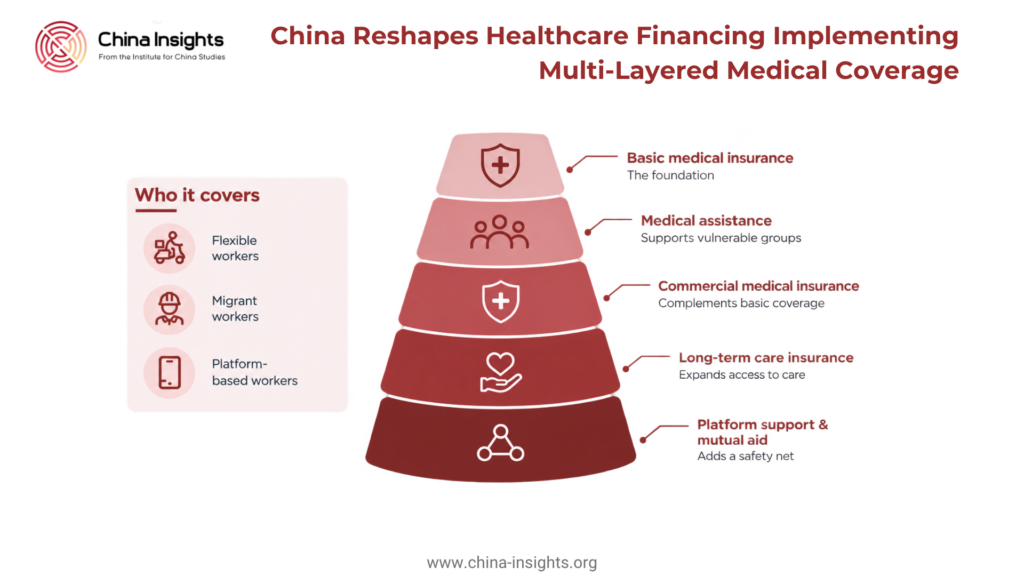
The most important change is the shift in policy emphasis. Basic medical insurance remains the foundation, but the new plan seeks to connect it more systematically with commercial insurance, medical assistance, charitable support and mutual-aid schemes. The objective is to create a system in which different financing mechanisms complement rather than duplicate each other.
This matters for the healthcare industry because future growth will not be driven solely by increases in basic insurance coverage. Market development will increasingly depend on how different payment sources interact. Providers, pharmaceutical companies and insurers will need to understand the combined reimbursement environment rather than treating public and private healthcare financing as separate markets.
Long-term care insurance moves closer to national coverage
Long-term care insurance receives significantly greater attention under the new plan. The NHSA identifies comprehensive implementation of the long-term care insurance system as a key task for the 15th Five-Year Plan and introduces the number of regions covered by the system as a formal development indicator.
This is commercially significant. Population ageing is creating sustained demand for long-term care services and related products. Broader institutional coverage could support development of professional care providers, rehabilitation services, assistive technologies and related insurance and healthcare-management services.
For companies entering this market, however, the opportunity will develop within a regulated reimbursement framework. Service standards, eligibility, payment rules and local implementation will remain important determinants of commercial viability.
Commercial medical insurance gains a clearer role
The new plan gives commercial medical insurance a more explicit role within the broader healthcare protection system. The NHSA intends to support products that complement basic medical insurance, particularly coverage for services and medicines outside the basic reimbursement framework and products that support medical innovation.
This could expand the addressable market for private insurers and healthcare companies. It also creates incentives for insurers to develop products that are differentiated from basic public coverage rather than simply duplicating it.
For pharmaceutical and medical technology companies, stronger commercial insurance could eventually provide an additional route to reimbursement for innovative products that face limitations within the basic insurance system.
Payment reform continues to reshape healthcare economics
The plan continues the reform of medical insurance payment mechanisms, medical service pricing and national drug and medical-device procurement. It also calls for dynamic adjustment of the medical insurance drug catalogue and deeper coordination between medical treatment, medical insurance and pharmaceutical reform.
The business implication is continued pressure on pricing and margins across the healthcare value chain. Companies will need to demonstrate clinical value and cost-effectiveness. Market access strategies will increasingly need to account for reimbursement policy, procurement mechanisms and payment reform from the early stages of product development.
At the same time, the policy explicitly seeks to support pharmaceutical innovation. This creates a more differentiated environment. Products offering clear clinical value may benefit from policy support, while products with limited differentiation face greater pricing pressure.
Digitalization changes insurance administration
The new plan places substantially greater emphasis on digital healthcare insurance management. Big data and artificial intelligence are expected to support more precise administration, service delivery and fund supervision. The NHSA also intends to expand data-based regulatory models covering the full process of medical insurance fund use.
This creates opportunities for companies providing healthcare IT, data analytics, AI, fraud detection and digital claims-management solutions. It also increases compliance expectations for healthcare providers and other entities receiving medical insurance payments.
The direction is toward earlier detection of irregularities rather than relying primarily on post-payment investigations. Healthcare companies will therefore need stronger data quality, documentation and internal controls.
Regional integration will accelerate
Another structural change is the continued move toward greater regional coordination. The plan targets further progress toward provincial-level pooling of basic medical insurance funds and greater standardization of benefits and administration. It also seeks to expand cross-provincial direct settlement and improve portability of insurance benefits.
For businesses, greater standardization can reduce some of the fragmentation associated with China’s regional healthcare system. However, local implementation differences will remain relevant. Companies should therefore distinguish between national policy direction and the practical reimbursement and procurement rules applied in individual markets.
What this means for business
- Healthcare providers face tighter payment discipline: Revenue models will increasingly need to reflect insurance payment reform and cost controls.
- Innovative products need stronger value evidence: Reimbursement and procurement decisions will place greater emphasis on clinical and economic value.
- Long-term care is becoming a strategic market: Broader insurance coverage could create new demand for care, rehabilitation and assistive services.
- Commercial insurance offers new opportunities: Insurers and healthcare companies can develop complementary products around gaps in basic coverage.
- Digital compliance will become more important: Providers and suppliers should strengthen data management, claims documentation and fraud-prevention controls.
- Market access strategies need to become more integrated: Product planning should consider regulation, reimbursement, procurement and insurance coverage together.
Primary source
- https://www.gov.cn/zhengce/202608/content_7078670.htm
- https://www.nhsa.gov.cn/art/2026/8/19/art_105_21829.html
- http://big5.www.gov.cn/gate/big5/www.gov.cn/yaowen/liebiao/202608/content_7078692.htm
- https://www.moe.gov.cn/jyb_xwfb/xw_zt/moe_357/2026/2026_zt03/yw/202603/t20260314_1430877.html
- https://www.mee.gov.cn/zcwj/gwywj/202607/t20260714_1161753.shtml
Author
Dr. Richard van Ostende

Related Articles