
China’s 15th Five-Year Plan: Premium Self-Drive Tourism Routes Become a New Consumption Infrastructure Priority
China is moving self-drive tourism from a primarily market-driven activity toward a more structured component of transport and tourism policy. The emphasis is shifting from individual scenic routes and local tourism roads to coordinated, long-distance networks supported by infrastructure, services, digital systems and new consumption formats.
The Ministry of Transport (MOT) issued the “Implementation Plan for Premium Self-Drive Tourism Roads” (《精品自驾旅游公路实施方案》) in August 2026. The policy is aligned with the 15th Five-Year Plan (2026–2030) and the government’s broader objective of expanding domestic demand and consumption. The State Council published its policy interpretation on 17 August 2026.
Executive summary
- China is creating a national “1+N” premium self-drive tourism road system rather than relying primarily on local tourism routes.
- The initiative links transport infrastructure with tourism resources and consumer services.
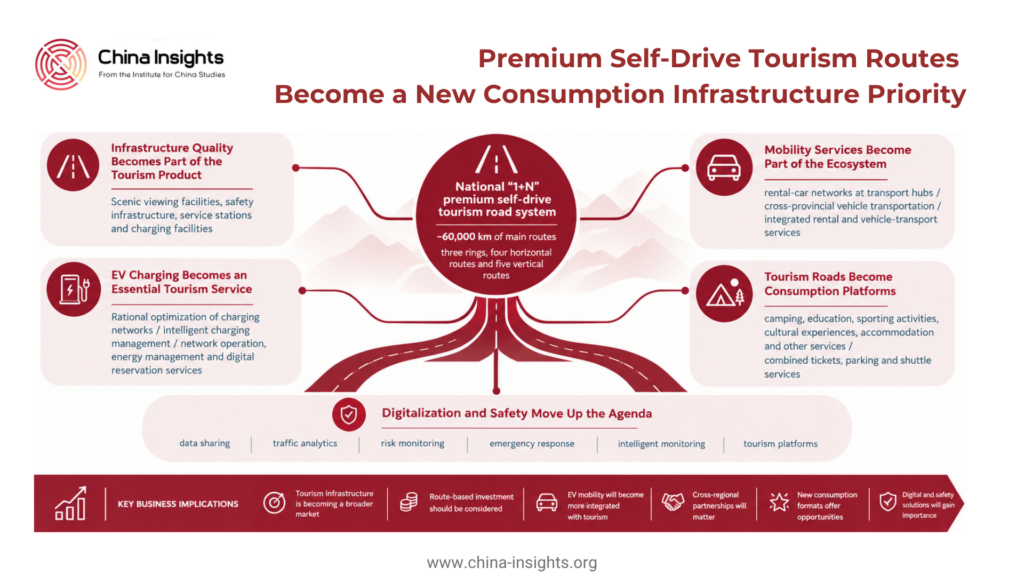
- Around 60,000 kilometers of main routes are planned around a national “three rings, four horizontal routes and five vertical routes” framework.
- Charging, vehicle rental, cross-provincial vehicle transport, maintenance and outdoor equipment services are becoming part of the planned ecosystem.
- Authorities are encouraging new consumption formats around tourism roads, including camping, cultural activities, education and sporting events.
- The policy creates opportunities across transport, tourism, mobility, energy, hospitality, retail and digital services.
From Local Tourism Roads to a National Network
The most significant change is the move toward a coordinated national framework. The new system will combine routes managed at the national level with additional routes developed by provinces and municipalities. The objective is to create a connected network rather than a collection of isolated tourism roads.
The national backbone will primarily use ordinary national highways and connect major cultural and tourism resources. This approach allows existing road infrastructure to become part of a broader tourism product while limiting the need for entirely new road construction. It also gives local governments a framework for connecting their own tourism routes to nationally promoted corridors.
For businesses, the change creates a larger and more identifiable market. Tourism-related investment can increasingly be assessed around complete routes and regional ecosystems rather than individual attractions.
Infrastructure Quality Becomes Part of the Tourism Product
The implementation plan places greater emphasis on upgrading selected road sections and improving supporting infrastructure. Scenic viewing facilities, safety infrastructure, service stations and charging facilities are included in the development framework.
This changes the commercial role of transport infrastructure. Roads are no longer viewed only as a means of reaching a destination. The route itself becomes part of the tourism experience. Infrastructure quality, accessibility and service availability can therefore influence visitor spending and destination competitiveness.
The approach also provides opportunities for companies involved in road engineering, charging infrastructure, roadside services, digital systems and facility management.
EV Charging Becomes an Essential Tourism Service
The expansion of charging infrastructure is particularly relevant to the growing domestic NEV market. The plan calls for rational optimization of charging networks along premium self-drive routes and considers intelligent charging management during periods of high demand.
This creates a more integrated relationship between mobility and tourism. EV adoption can expand the potential customer base for self-drive tourism, while tourism routes create additional demand for charging infrastructure. The commercial opportunity therefore extends beyond the sale and installation of chargers to network operation, energy management and digital reservation services.
For charging and energy companies, route selection and expected traffic volumes will become important factors in assessing the commercial viability of new infrastructure.
Mobility Services Become Part of the Ecosystem
The plan also addresses the practical needs of self-drive tourists. Authorities intend to improve rental-car networks at transport hubs and facilitate cross-provincial vehicle transportation. Models such as picking up a vehicle at one location and returning it elsewhere are being supported.
This could reduce one of the barriers to long-distance self-drive tourism. Travelers will not necessarily need to use their own vehicles for the entire journey. The development of integrated rental and vehicle-transport services could also support combined rail, air and road travel.
For mobility companies, the policy therefore expands the potential market beyond conventional local car rental toward nationally connected tourism mobility services.
Tourism Roads Become Consumption Platforms
A further change is the emphasis on “road plus” consumption formats. Authorities are encouraging the integration of tourism roads with camping, education, sporting activities, cultural experiences, accommodation and other services. They also support products such as combined tickets, parking and shuttle services.
This is important because the policy is designed to generate spending along the route, not simply increase traffic volumes. The commercial model is therefore becoming closer to a distributed tourism ecosystem, in which multiple businesses can benefit from visitor flows.
Hotels, restaurants, campsites, equipment-rental businesses, cultural operators and local retailers may therefore become part of the wider value chain.
Digitalization and Safety Move Up the Agenda
The implementation plan also calls for stronger digital and safety capabilities. Transport and tourism authorities are encouraged to share data, analyses self-drive travel patterns and improve emergency response. Digital systems will support traffic information, risk monitoring and emergency coordination.
This creates demand for integrated digital solutions rather than isolated applications. Companies providing traffic analytics, navigation, emergency-response systems, intelligent monitoring and tourism platforms could benefit as the network develops.
The emphasis on safety is also commercially relevant. As routes become longer and cross regional boundaries, consistent emergency and information systems become more important.
The 15th Five-Year Plan Links Tourism to Domestic Demand
The initiative is consistent with the broader 15th Five-Year Plan focus on expanding domestic demand and improving the quality of consumption. The Ministry of Transport had already identified premium self-drive routes as part of its 2026 program to promote transport-related consumption.
The new implementation plan turns that policy direction into a more concrete infrastructure and market-development program. By 2030, the nationally coordinated routes are expected to be substantially established. By 2035, the wider “1+N” system is expected to be fully developed.
The commercial impact will depend on local implementation. However, the direction is clear: self-drive tourism is increasingly being treated as an integrated transport, tourism and consumption sector.
What this means for business
- Tourism infrastructure is becoming a broader market: Opportunities extend from roads to charging, services, accommodation and digital systems.
- Route-based investment should be considered: Businesses can assess opportunities around complete tourism corridors rather than individual destinations.
- EV mobility will become more integrated with tourism: Charging, rental and related services are likely to expand along priority routes.
- Cross-regional partnerships will matter: National routes require cooperation between transport operators, tourism businesses and local governments.
- New consumption formats offer opportunities: Camping, outdoor recreation, cultural activities and related services are being actively incorporated into route development.
- Digital and safety solutions will gain importance: Data sharing, intelligent management and emergency systems are becoming part of the infrastructure ecosystem.
Sources
- https://www.gov.cn/zhengce/202608/content_7078394.htm
- https://www.mot.gov.cn/xinwen/jiaotongyaowen/202602/t20260213_4200264.html
- https://paper.people.com.cn/rmrb/pc/content/202608/18/content_30175612.html
- https://policy.mofcom.gov.cn/claw/policyInfo.shtml
- https://news.cnr.cn/native/gd/20260818/t20260818_527780913.shtml
Author
Dr. Richard van Ostende

Related Articles