China's Identifies New Investment Growth Areas: Where Capital Is Expected to Flow
China’s investment strategy continues to shift from property-led growth towards investment that supports industrial upgrading, technological innovation and infrastructure modernization. While overall fixed asset investment remains under pressure, Chinese policymakers increasingly emphasize the quality and strategic direction of investment rather than headline growth alone.
Recent policy interpretation by the National Bureau of Statistics (NBS) highlights that China still possesses significant investment potential despite a more challenging macroeconomic environment. The analysis identifies several sectors expected to attract continued investment during the 15th Five-Year Plan period, reflecting national priorities such as advanced manufacturing, digital infrastructure, green development and major strategic projects.
Executive Summary
- Investment policy is shifting from expanding volume towards improving investment quality and economic efficiency.
- Priority sectors include advanced manufacturing, digital infrastructure, equipment renewal, strategic infrastructure and emerging industries.
- Government investment continues to play a catalytic role through central budget funding, ultra-long special treasury bonds and local government special bonds.
- The implementation of the 15th Five-Year Plan (2026–2030) is expected to support major national projects and industrial modernization.
- Businesses aligned with China’s industrial policy priorities are likely to benefit most from future investment activity.

Policy Background
The National Bureau of Statistics has repeatedly emphasized during 2026 that China’s investment landscape is undergoing structural adjustment rather than simple contraction. Although total fixed asset investment has softened due largely to weakness in the real estate sector, investment in strategic industries continues to outperform.
Rather than stimulating broad-based investment, policymakers are directing capital towards sectors that support long-term productivity improvements and national competitiveness.
Infrastructure Remains a Strategic Investment Priority
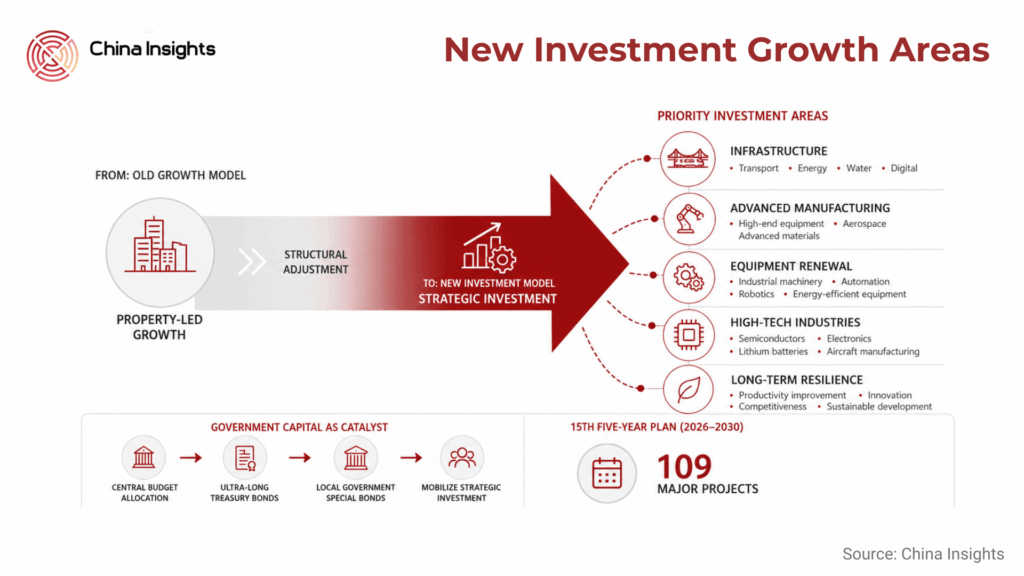
Infrastructure continues to represent one of China’s most important investment drivers. According to the National Bureau of Statistics, infrastructure investment has remained relatively resilient as construction accelerates under the country’s “Two Major Projects” initiative. These projects focus on nationally significant infrastructure and strengthening capacity in critical sectors. Investment has been supported by central government funding as well as local financing mechanisms.
Investment priorities include transport infrastructure, energy systems, water management, digital infrastructure and other projects that improve long-term economic resilience rather than short-term demand stimulation. For engineering companies, construction firms and infrastructure suppliers, these programs continue to represent an important source of market opportunities.
Advanced Manufacturing Receives Continued Policy Support
Industrial upgrading remains central to China’s investment strategy. The National Bureau of Statistics highlights that manufacturing investment increasingly reflects the country’s objective of moving towards higher-value production. Investment is concentrated in sectors that strengthen industrial competitiveness through automation, digitalization and advanced technologies.
High-end equipment manufacturing, electronics, integrated circuits, aerospace manufacturing and advanced materials continue to receive policy attention. Rather than supporting traditional manufacturing expansion, government policy increasingly favors projects that improve productivity, technological capability and supply chain resilience. This approach aligns closely with China’s broader industrial policies promoting advanced manufacturing and technological self-reliance.
Equipment Renewal Continues to Generate Investment
Large-scale equipment renewal remains another important investment driver. The National Bureau of Statistics notes that investment in equipment purchases continues to grow as national equipment renewal policies are implemented across multiple industries. Businesses are encouraged to modernize production facilities, improve energy efficiency and upgrade manufacturing technology.
The policy supports demand for industrial machinery, automation systems, robotics, energy-efficient equipment and industrial software. Companies supplying industrial technology solutions may therefore continue to benefit from policy-driven replacement demand over the coming years.

High-Technology Industries Continue to Expand
Technology-intensive sectors remain among China’s strongest investment performers. The National Bureau of Statistics reports continued investment growth in high-technology manufacturing and high-technology services despite weaker overall investment conditions. Areas showing particularly strong performance include electronic components, lithium battery manufacturing, aircraft manufacturing and integrated circuit production.
The emphasis reflects China’s long-term objective of strengthening domestic innovation capacity while reducing dependence on foreign technologies in strategically important industries. Investment incentives are therefore increasingly aligned with sectors contributing to innovation, digital transformation and industrial upgrading.
Government Capital Continues to Guide Investment
An important feature of China’s investment strategy is the continued use of public funding to mobilize private and institutional investment. According to the National Bureau of Statistics, investment implementation relies on multiple policy tools, including central government budget allocations, ultra-long special treasury bonds and local government special bonds. These instruments support implementation of the 109 major projects included within the 15th Five-Year Plan framework.
Rather than replacing private investment, these public resources are intended to catalyze investment into sectors considered strategically important for national development. This policy approach is expected to remain an important characteristic of China’s investment environment throughout the current planning period.
Investment Quality Becomes More Important Than Investment Volume
One notable message emerging from recent NBS policy interpretations is that China is placing greater emphasis on investment quality. Historically, fixed asset investment served primarily as an engine of rapid economic growth. Current policy increasingly evaluates investment according to its contribution to industrial upgrading, productivity improvements, technological innovation and sustainable development.
This shift reflects broader structural changes in China’s economy as policymakers seek to reduce dependence on property investment while strengthening new sources of economic growth.
Businesses evaluating opportunities in China should therefore consider policy alignment as an increasingly important factor when assessing investment prospects.
What this means for business
China’s investment priorities continue to evolve towards sectors closely aligned with national industrial policy.
Companies operating in advanced manufacturing, industrial automation, clean technology, semiconductors, digital infrastructure, aerospace, advanced materials and equipment manufacturing are likely to encounter stronger policy support than businesses operating in more traditional investment sectors.
Infrastructure suppliers, engineering firms and environmental technology providers may benefit from continued implementation of nationally significant infrastructure projects financed through public investment programs.
Foreign companies should also recognize that investment decisions in China are becoming increasingly influenced by industrial policy priorities rather than solely by market demand. Aligning products, technologies and investment proposals with national development objectives will become an increasingly important factor in accessing market opportunities.
Overall, the National Bureau of Statistics’ assessment suggests that China’s future investment growth will be driven less by expansion in traditional sectors and more by targeted investment supporting innovation, industrial upgrading and long-term economic resilience.
Sources
https://www.gov.cn/zhengce/202607/content_7075654.htm
Author
Dr. Richard van Ostende

Related Articles