China's First National Consumption Plan Sets the Agenda for Demand-Led Growth Through 2030
China has elevated consumption to a central pillar of its economic strategy with the approval of the 15th Five-Year Plan for Expanding Consumption (《扩大消费“十五五”规划》). Approved by the State Council in July 2026, the plan is the country’s first national-level special plan dedicated exclusively to consumption policy.
The plan reflects a strategic shift in China’s economic priorities. Rather than relying primarily on investment and exports, policymakers aim to strengthen domestic demand by improving household purchasing power, expanding service consumption and creating a more attractive consumer environment. The initiative supports China’s broader objective of building a stronger domestic economic circulation while improving living standards.
Unlike short-term stimulus measures, the plan establishes a long-term framework through 2030. It combines social policy, income growth, consumer protection and market development into a coordinated strategy designed to unlock the potential of China’s domestic market.
Executive Summary
- The plan is China’s first national-level special development plan dedicated exclusively to consumption.
- By 2030, China aims to increase the total retail sales of consumer goods to approximately RMB 60 trillion, up from more than RMB 50.1 trillion in 2025.
- Policy priorities include increasing household income, strengthening social security, expanding service consumption and improving the consumer environment.
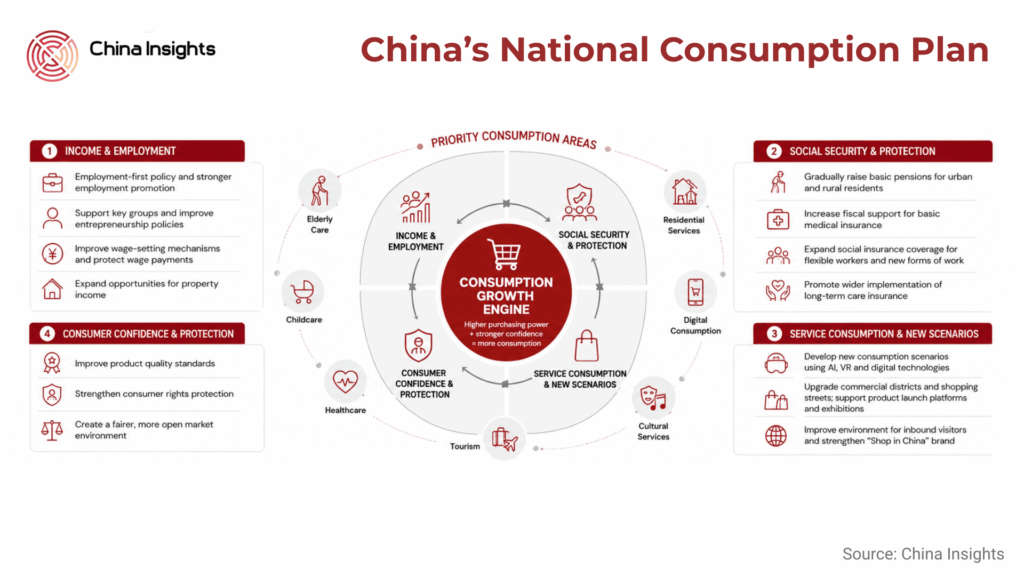
- New opportunities are expected in elderly care, childcare, healthcare, tourism, cultural services, digital consumption and residential services.
- The plan reinforces domestic demand as a long-term driver of China’s economic growth.

Policy Background
China’s leadership has consistently identified domestic demand as a key component of high-quality economic development. Although household consumption has continued to grow, policymakers believe structural constraints, including income uncertainty, demographic change and uneven access to public services, have limited the full potential of domestic consumption.
The 15th Five-Year Plan for Expanding Consumption addresses these challenges through a comprehensive policy framework. Rather than relying on temporary consumption subsidies, the government seeks to increase consumers’ willingness and ability to spend by improving employment, income growth, social protection and service availability. The plan serves as both a roadmap and implementation framework for expanding domestic demand during the 2026–2030 period.
A Clear Consumption Target for 2030
The plan establishes an ambitious but measurable objective for China’s consumer market. By 2030, policymakers aim for the total retail sales of consumer goods to reach approximately RMB 60 trillion. Since retail sales exceeded RMB 50.1 trillion in 2025, achieving this objective would represent nearly RMB 10 trillion in additional consumer spending over five years. The government also intends to increase the household consumption rate while supporting faster growth in both goods and services consumption. These targets demonstrate that expanding domestic consumption is no longer viewed solely as a social objective but increasingly as a strategic economic priority.
Improving Consumer Confidence Through Better Public Services
One of the plan’s central themes is improving consumers’ willingness to spend. Chinese policymakers argue that households consume more when future financial risks become more predictable. Consequently, many of the plan’s measures focus on strengthening public services rather than directly stimulating spending. Particular attention is given to elderly care and childcare. The plan includes programs to improve county-level elderly care services, encourage greater private sector participation in affordable elderly care and improve pricing mechanisms for inclusive childcare services.
Housing also receives considerable attention. Measures include improving the supply of affordable housing, supporting demand for upgraded housing where appropriate, regulating the rental housing market and promoting higher-quality residential construction. The government also plans to improve property management services and encourage the development of safer, greener and smarter residential buildings. In addition, the plan contains dedicated development sections covering the silver economy, childcare products and services, cultural consumption, tourism and healthcare, reflecting the government’s intention to support both basic and higher-value consumption.
Raising Household Purchasing Power
Beyond improving public services, the plan seeks to strengthen consumers’ purchasing capacity.
Employment remains the foundation of this strategy. The government will continue implementing its employment-first policy, strengthen employment promotion mechanisms and support enterprises in maintaining and expanding jobs. Special attention will be given to key employment groups while entrepreneurship policies will be further improved.
Income growth forms a second pillar of the strategy. The plan proposes improving wage-setting mechanisms, ensuring more reasonable wage growth and strengthening payment protection. Measures also seek to improve the operating environment for small businesses and individual entrepreneurs while expanding opportunities for households to generate property income. Taken together, these initiatives aim to create a more sustainable relationship between employment, income growth and consumer spending.
Expanding the Social Safety Net
The plan also recognizes that stronger social protection supports higher consumption. Several measures seek to reduce precautionary household savings by improving social security coverage. Planned initiatives include gradual increases in basic pensions for urban and rural residents, higher fiscal support for basic medical insurance and expanded participation in social insurance schemes for flexible workers, migrant workers and individuals employed through new forms of work.
The plan also promotes the wider implementation of long-term care insurance, reflecting China’s ageing population and increasing demand for elderly care services. From a policy perspective, expanding the social safety net is viewed as an economic measure as much as a social one. Greater financial security is expected to encourage households to increase discretionary spending.

Creating New Consumption Scenarios
Beyond increasing purchasing power, the government intends to make consumption more attractive through innovation. The plan encourages local governments to develop new consumption scenarios using digital technologies such as artificial intelligence and virtual reality. These technologies are expected to enhance retail, tourism, entertainment and lifestyle services while improving the overall consumer experience.
Commercial districts and shopping streets are encouraged to evolve towards more immersive and interactive consumption environments. The plan also supports the creation of launch platforms for new products and strengthens the role of exhibitions and trade fairs in introducing innovative consumer goods.
International consumption is another priority. Policymakers intend to improve the consumption environment for inbound visitors while further developing the national “Shop in China” (购在中国) brand.
Strengthening Consumer Protection
The plan places significant emphasis on consumer confidence. Authorities intend to improve product quality standards, strengthen consumer rights protection and create a fairer and more open market environment. Although many of these initiatives continue existing regulatory trends, their inclusion within the national consumption strategy highlights the government’s recognition that trust is an essential component of sustainable consumer demand. A stronger consumer protection framework is also expected to support higher-quality competition among businesses while encouraging greater household spending.
What this means for business
The 15th Five-Year Plan for Expanding Consumption provides an important indication of where future market opportunities are expected to emerge.
Businesses operating in elderly care, childcare, healthcare, tourism, cultural industries, digital services and residential services are likely to benefit from sustained policy support throughout the current planning period. Companies developing artificial intelligence applications, immersive retail technologies and digital consumer platforms may also find increasing opportunities as local governments implement new consumption scenarios.
Consumer goods manufacturers should recognize that policy support extends beyond traditional retail. The government’s strategy increasingly favors services, experience-based consumption and higher-quality products that align with changing demographic trends and rising consumer expectations.
For foreign companies, the plan reinforces the long-term importance of China’s domestic market. Success will increasingly depend on aligning products and services with evolving consumer preferences, demographic changes and government priorities related to service quality, innovation and consumer protection.
Overall, the plan signals that consumption will become an increasingly important driver of China’s economic growth through 2030. Rather than relying on short-term stimulus, policymakers are building the institutional foundations for a larger, more resilient and higher-quality consumer economy.
Source
https://www.gov.cn/zhengce/202607/content_7075642.htm
Author
Dr. Richard van Ostende

Related Articles