China's H2 2026 Economic Outlook: Policy Support and Domestic Demand Underpin Annual Growth Prospects
China’s economic performance during the first half of 2026 has reinforced the country’s transition towards a more innovation-driven growth model. While headline GDP growth moderated during the second quarter, the National Bureau of Statistics (NBS) maintains that the economy remains on track to achieve its major annual development objectives.
For businesses and investors, the briefing provides insight into the government’s current assessment of economic conditions and the policy priorities expected to shape China’s economy during the remainder of 2026.
Executive Summary
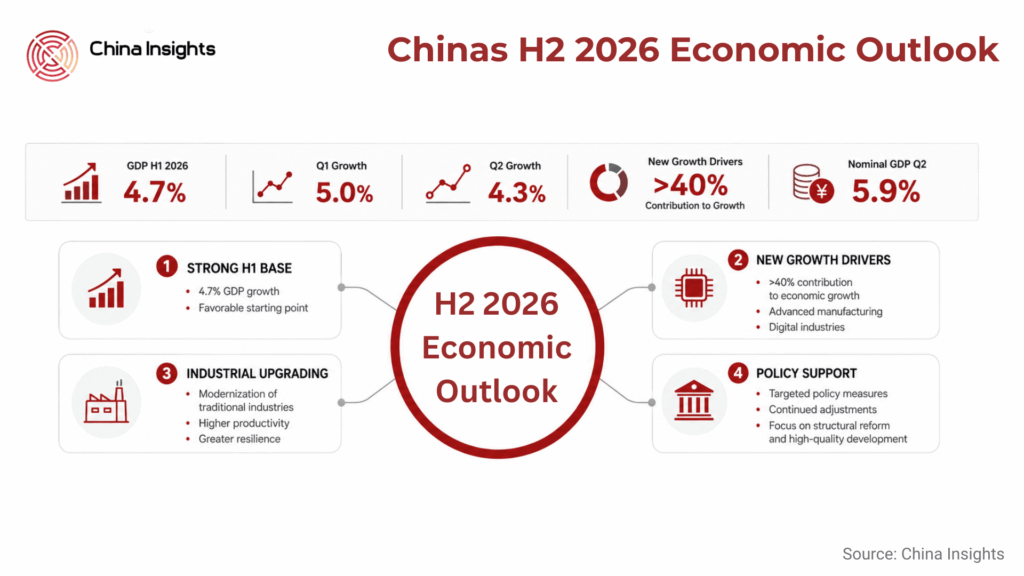
- China’s GDP grew 4.7% during the first half of 2026, with growth moderating from 5.0% in the first quarter to 4.3% in the second quarter.
- The NBS believes there are “solid conditions and support” for achieving the government’s major economic targets for 2026.
- Officials identified four key supporting factors: a strong first-half performance, rapid expansion of new growth drivers, continued upgrading of traditional industries and the ongoing impact of macroeconomic policy measures.
- The government expects additional targeted policy adjustments as economic conditions evolve.
- Innovation, advanced manufacturing and domestic structural upgrading remain central to China’s growth strategy.

Policy Background
The economic outlook was presented during the State Council Information Office press conference following publication of China’s first-half economic statistics by the National Bureau of Statistics on 15 July 2026.
According to the NBS, China’s economy continued to operate “within an appropriate range” despite a more complex international environment and continued domestic structural adjustment. GDP reached RMB 69.57 trillion during the first half of the year, representing year-on-year growth of 4.7% at constant prices. Employment remained generally stable, prices increased moderately, foreign trade maintained positive momentum and new growth drivers continued to strengthen.
While second-quarter growth slowed compared with the first quarter, the NBS argues that the moderation should be viewed within the broader context of structural economic transformation rather than as a deterioration of underlying economic fundamentals.
Understanding the Second-Quarter Slowdown
One of the main questions addressed during the press conference concerned the decline in second-quarter GDP growth from 5.0% to 4.3%.
According to Deputy Commissioner Mao Shengyong, several temporary factors contributed to slower growth, including external influences affecting petrochemical industries and short-term domestic factors influencing coal production. Importantly, the NBS stated that these factors were sector-specific rather than economy-wide and did not alter the overall trajectory of stable and higher-quality economic development.
The NBS also noted that, when measured in current prices rather than constant prices, economic activity actually accelerated during the second quarter. Nominal GDP increased by 5.9%, exceeding first-quarter nominal growth, while the absolute increase in economic output was larger than both the previous quarter and the same period last year. This distinction illustrates the government’s emphasis on assessing economic performance through multiple indicators rather than relying solely on headline real GDP growth.
New Growth Drivers Continue to Strengthen
A central theme throughout the NBS assessment is the growing contribution of China’s emerging industries. According to the NBS, new growth drivers contributed more than 40% of overall economic growth during the first half of 2026, and this contribution is expected to remain strong during the second half of the year.
Several sectors demonstrated particularly strong momentum. Equipment manufacturing expanded by 9.7% during the second quarter, accelerating compared with the first quarter. High-technology manufacturing increased by 14%, while computer, communication and electronic equipment manufacturing grew 14.8% during the first half, with further acceleration during the second quarter.
These figures reinforce China’s ongoing shift from investment-led expansion towards innovation-driven industrial development. Advanced manufacturing, digital technologies and high-value production continue to become increasingly important sources of economic growth.
Traditional Industries Are Also Improving
While considerable attention is focused on emerging industries, the NBS also highlighted gradual improvement within traditional sectors.
Officials indicated that temporary weaknesses affecting certain industries during the second quarter are expected to ease over time. Industrial upgrading, technological modernization and stronger domestic production capabilities are expected to support recovery across more conventional sectors of the economy.
This reflects China’s broader industrial policy objective of simultaneously developing new industries while improving the competitiveness of existing manufacturing sectors.

Policy Support Will Continue
The National Bureau of Statistics also emphasized the continuing role of macroeconomic policy. According to the briefing, previously introduced policy measures are expected to generate stronger economic effects during the second half of the year. At the same time, authorities indicated that additional targeted measures may be introduced in response to changing economic conditions. Rather than broad stimulus, policymakers continue to favor precise and targeted interventions designed to support stable growth while advancing structural reform.
This approach is consistent with China’s recent macroeconomic strategy, which prioritizes high-quality development, industrial upgrading and technological innovation over large-scale demand stimulus.
Domestic Consumption Remains an Area of Attention
The NBS also addressed questions regarding consumer demand following weaker retail sales data during May. Officials noted that monthly retail sales should be interpreted carefully because the traditional retail sales indicator excludes a large proportion of China’s expanding service economy. When both goods and services are considered together, overall market sales remained positive during the first five months of the year. Retail sales returned to positive year-on-year growth in June, suggesting some improvement in consumer activity.
Although domestic consumption remains weaker than many policymakers would prefer, the government continues to view services consumption as an increasingly important component of long-term economic growth.
Outlook for the Remainder of 2026
Looking ahead, the National Bureau of Statistics identified four reasons for maintaining confidence in the economic outlook.
- First-half GDP growth has created a favorable starting point for achieving the government’s annual growth objective.
- Rapidly expanding new growth drivers continue to strengthen the economy and are expected to remain an important source of growth.
- Industrial upgrading is improving the resilience of traditional sectors while reducing the impact of temporary disruptions.
- Macroeconomic policy measures already introduced are expected to deliver stronger results during the remainder of the year, supported where necessary by additional targeted policy adjustments.
Taken together, the NBS concluded that China possesses “solid conditions and support” for achieving its principal economic objectives during 2026.
What this means for business
The NBS assessment suggests that China’s policy direction remains broadly unchanged despite slower second-quarter growth.
Businesses should expect continued policy support for advanced manufacturing, digital industries, artificial intelligence, high-technology manufacturing and industrial modernization. Companies aligned with these strategic sectors are likely to benefit from sustained investment and supportive industrial policies.
At the same time, traditional industries should expect continued pressure to upgrade production processes, improve productivity and adopt more advanced technologies. Environmental performance, digital transformation and automation will remain important competitive factors.
Foreign companies should also recognize that China’s economic management is increasingly focused on structural quality rather than short-term growth acceleration. Market opportunities are therefore likely to be strongest in sectors that support productivity improvements, technological innovation and industrial upgrading.
Although domestic demand remains relatively subdued, the government’s confidence in meeting its annual targets indicates that targeted policy support will continue to underpin economic activity during the second half of 2026.
Sources
https://www.gov.cn/zhengce/202607/content_7075653.htm
https://www.stats.gov.cn/sj/zxfbhjd/202607/t20260715_1964134.html
Author
Dr. Richard van Ostende

Related Articles