China's 15th Five-Year Plan for Soil, Groundwater and Rural Environmental Protection
China is strengthening environmental governance through a more integrated approach to soil, groundwater and rural ecological protection. On 17 July 2026, the Ministry of Ecology and Environment (MEE), together with five other central government departments, jointly issued the 15th Five-Year Plan for Soil, Groundwater and Agricultural and Rural Ecological Environmental Protection (《土壤、地下水和农业农村生态环境保护“十五五”规划》).
The plan supports China’s broader environmental and food security objectives during the 2026–2030 period. It focuses on preventing new pollution, reducing existing contamination, controlling environmental risks and protecting public health. The measures build on the progress made under the 14th Five-Year Plan while introducing more integrated environmental management across industrial land, agricultural land, groundwater and rural pollution sources.
Executive Summary
The plan prioritizes prevention of new soil pollution, remediation of historical contamination and stronger environmental risk management.
- New measures target contaminated construction land, agricultural heavy metal pollution, groundwater protection and agricultural non-point source pollution.
- Environmental supervision of industrial enterprises, particularly chemical manufacturers and other high-risk sectors, will become stricter.
- Local governments will receive clearer implementation targets, supported by monitoring, digital technologies and enhanced enforcement.
- The plan creates new compliance requirements for companies involved in industrial production, land redevelopment, environmental services and agriculture.

Policy Background
China has significantly strengthened environmental protection over the past decade. While previous policies concentrated on reducing air and water pollution, contaminated soil and groundwater have become increasingly important policy priorities because of their direct impact on food safety, drinking water and public health.
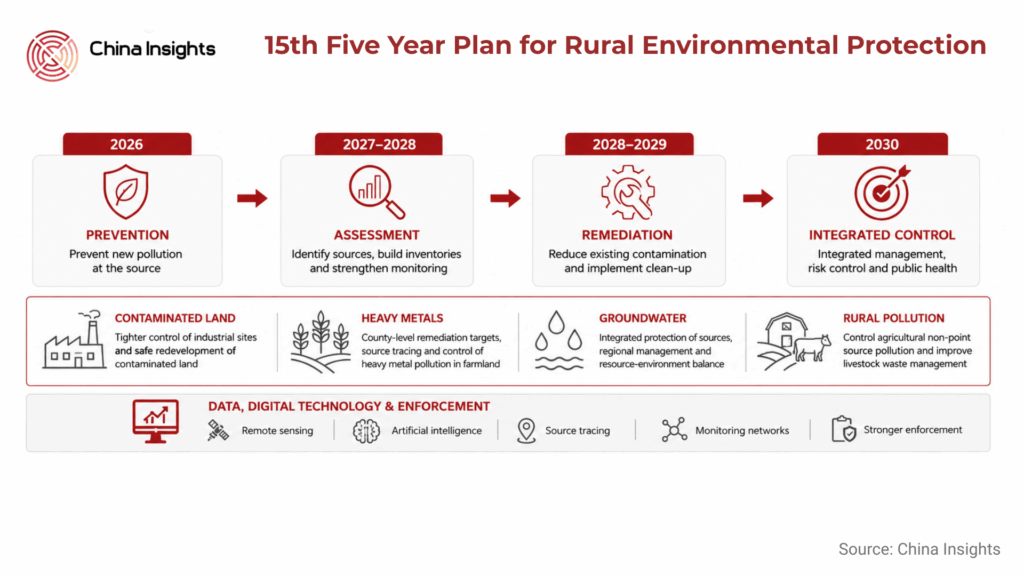
The new Five-Year Plan adopts a comprehensive framework summarized as preventing new pollution, reducing existing contamination, controlling risks, ensuring safety and improving public health. Rather than addressing individual environmental issues separately, the plan integrates land management, pollution prevention, ecological restoration and environmental monitoring.
This integrated approach reflects China’s broader objective of improving environmental quality while supporting sustainable economic development and urbanization.
Stronger Management of Contaminated Construction Land
One of the central elements of the plan is tighter control over contaminated construction land. During the 14th Five-Year Plan, China strengthened land-use approval procedures and ensured the safe redevelopment of approximately 50,000 key land parcels converted into residential or public-use land. The new plan expands these efforts by introducing stricter controls throughout the land redevelopment process. The policy focuses on three priorities.
- Preventing new contamination at its source. Industries such as chemicals and other high-risk manufacturing sectors will face tighter environmental supervision, improved pollution prevention requirements and stronger accountability for soil contamination during normal business operations.
- Reducing risks associated with former industrial sites. Authorities will strengthen contaminated land inventories, improve remediation quality management and prioritize clean-up activities in environmentally sensitive areas, including industrial sites located within one kilometer of major rivers and land previously used for pesticide manufacturing.
- Ensuring the safe redevelopment of contaminated sites. Environmental management requirements will become more closely integrated into land supply and planning procedures. Authorities will encourage phased remediation and controlled redevelopment to balance environmental protection with urban regeneration.
The plan also calls for improvements to environmental legislation, technical standards and enforcement capacity related to contaminated land management.
Heavy Metal Pollution Remains a Key Agricultural Priority
Agricultural land contamination, particularly from heavy metals such as cadmium, remains a major concern because of its implications for food safety.
The Ministry of Ecology and Environment describes the 15th Five-Year Plan period as a critical stage for controlling heavy metal pollution in farmland. Implementation will largely occur at county level through annual remediation targets. Local governments will be required to identify pollution sources, conduct field investigations and maintain dynamic inventories of both current and historical contamination sources. The policy emphasizes source tracing rather than only treating contaminated farmland. Human-generated pollution sources will receive particular attention through expanded environmental monitoring and greater use of information technology.
The remediation strategy also distinguishes between different pollution pathways. For atmospheric deposition, stricter emission standards for particulate matter and heavy metals will apply in designated priority regions, supported by industrial equipment upgrades. For water-related contamination, local governments are encouraged to remove historical waste deposits and contaminated sediments using practical and low-disturbance remediation technologies. Monitoring systems covering soil quality, atmospheric heavy metal deposition and irrigation water will support continuous evaluation of remediation effectiveness.
Groundwater Protection Becomes More Integrated
Groundwater protection receives greater emphasis under the new plan. According to the Ministry of Ecology and Environment, approximately 75% of China’s nationally monitored groundwater sites currently achieve Grade I-IV water quality standards, reflecting gradual improvements during the previous planning period.
The new strategy introduces three integrated management systems.
- The first strengthens coordination between drinking water sources and surrounding regional environments. Authorities will assess emerging pollutants, including per- and polyfluoroalkyl substances (PFAS) and heavy metals, while designating priority groundwater protection areas.
- The second promotes coordinated management of pollution sources and affected regions. China plans to conduct a nationwide groundwater pollution assessment while establishing pilot zones to develop regional remediation approaches.
- The third integrates groundwater resource management with environmental protection. This includes stronger safeguards for groundwater recharge, spring protection and mining activities to better balance resource development with environmental conservation.
Overall, the policy moves beyond protecting individual water sources toward managing groundwater systems at a regional scale.

Systematic Control of Agricultural Non-Point Source Pollution
Agricultural non-point source pollution remains one of China’s most complex environmental challenges because pollution originates from numerous dispersed sources rather than individual industrial facilities.
The new plan therefore focuses on regions where pollution problems are most severe. Local governments are expected to coordinate agricultural production, rural income growth and environmental protection while improving pollution control performance. Particular attention will be given to livestock waste management near drinking water sources, riverbanks and karst regions where groundwater vulnerability is higher.
The plan also introduces wider application of digital monitoring technologies. Remote sensing, artificial intelligence and analysis of public complaints will support earlier identification of serious livestock pollution incidents without relying solely on traditional inspections. At the source level, local governments may designate concentrated livestock breeding areas and encourage centralized manure collection, composting and agricultural reuse where appropriate. The policy also strengthens guidance for livestock operators while reinforcing their environmental compliance responsibilities.
Greater Reliance on Data and Environmental Monitoring
A notable feature of the new plan is the growing role of environmental data. Across soil, groundwater and agricultural pollution control, authorities intend to expand environmental monitoring networks while increasing the use of digital technologies for pollution detection, source tracing and policy evaluation.
What this means for business
The new Five-Year Plan signals continued tightening of China’s environmental regulatory framework.
Industrial companies operating in high-risk sectors, particularly chemicals, mining, metals and pesticide manufacturing, should expect stricter environmental supervision and greater accountability for preventing soil contamination.
Developers and investors involved in industrial land redevelopment will face more rigorous environmental due diligence and remediation requirements before land can be repurposed for residential or commercial use.
Environmental consulting firms, remediation specialists, environmental monitoring providers and digital technology companies may benefit from increased demand as local governments implement the plan.
Agricultural businesses, livestock producers and food supply chain participants should prepare for stronger monitoring of heavy metal contamination, waste management and environmental compliance throughout agricultural production.
Overall, the policy reinforces China’s long-term direction toward integrated environmental governance, where pollution prevention, digital monitoring and environmental accountability become increasingly embedded within industrial and agricultural development.
Sources
https://www.gov.cn/zhengce/202607/content_7076009.htm
Author
Dr. Richard van Ostende

Related Articles