
China Standardizes Centralized Procurement of Medical Equipment
China is strengthening the governance of public healthcare procurement with the release of new rules on centralized purchasing of medical equipment. On 14 July 2026, the National Health Commission (NHC) published the Notice on Further Improving the Centralized Procurement of Medical Equipment by Public Medical and Health Institutions (《关于进一步做好公立医疗卫生机构医用设备集中采购工作的通知》) together with an official policy interpretation.
The notice establishes a more standardized national framework for procuring medical equipment across public hospitals and healthcare institutions. It expands the use of centralized procurement, introduces clearer responsibilities for national, provincial and municipal authorities, and promotes lifecycle cost management rather than procurement decisions based solely on purchase price.
The policy forms part of China’s broader healthcare reform agenda, which seeks to improve the efficiency of public expenditure, strengthen integrity in public procurement and enhance the quality of healthcare services. For medical device manufacturers and suppliers, the notice signals a more centralized, transparent and competitive procurement environment.
Executive Summary
- All public medical institutions must purchase equipment included in national, provincial or municipal centralized procurement catalogues through departmental centralized procurement mechanisms.
- Procurement responsibilities are divided between national, provincial and municipal health authorities according to equipment categories.
- Provinces must complete one round of centralized procurement for Class B large medical equipment before the end of 2026.
- At least one municipal pilot for broader medical equipment procurement must be completed by 30 June 2027.
- Procurement evaluation will increasingly emphasize lifecycle costs, quality and after-sales service rather than lowest purchase price.
- A national database for high-value medical equipment procurement will support greater price transparency.

Policy Background
China has gradually expanded centralized procurement across pharmaceuticals and medical consumables over the past decade. These reforms have reduced procurement costs, increased transparency and strengthened regulatory oversight.
Medical equipment procurement, however, has remained relatively fragmented due to differences in equipment complexity, procurement procedures and local implementation. Building on national procurement experience for large medical equipment and provincial procurement practices, the National Health Commission has introduced a more comprehensive framework for centralized equipment purchasing.
According to the policy interpretation, the objectives are threefold: improve the efficiency of public financial resources, strengthen integrity in healthcare procurement and promote high-quality development of the healthcare sector.
A Unified Procurement Framework
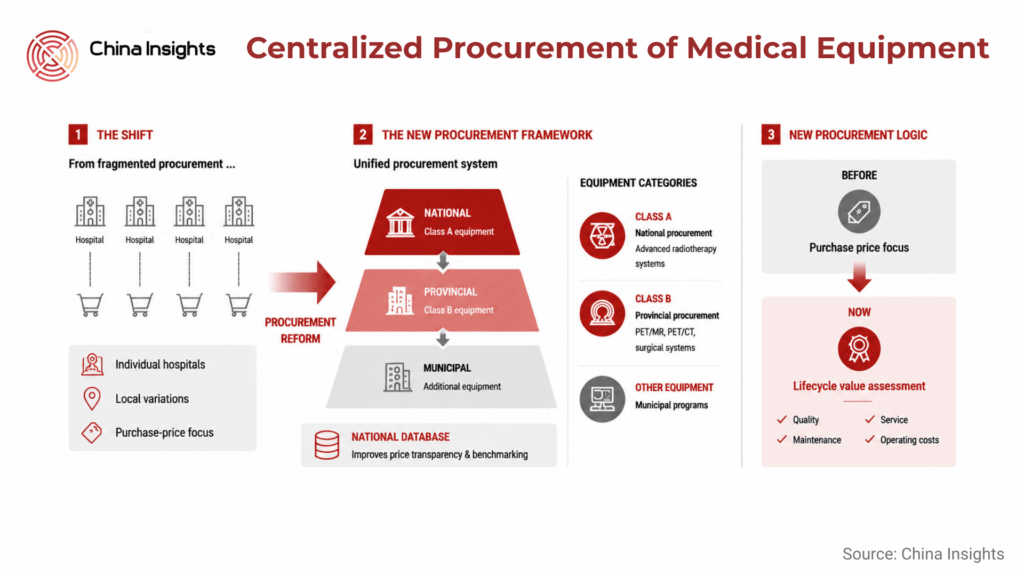
The new policy establishes a hierarchical procurement system covering all public medical and health institutions. Medical equipment included in national, provincial or municipal centralized procurement catalogues must be purchased through departmental centralized procurement. Different levels of government will be responsible for compiling procurement catalogues according to their respective administrative responsibilities. The National Health Commission will establish the national procurement catalogue, provincial health authorities will develop provincial catalogues, and municipal health authorities may establish local procurement catalogues following provincial approval. This structure aims to create greater consistency while allowing local authorities to address regional healthcare needs.
Procurement Responsibilities by Equipment Category
The notice clearly defines procurement responsibilities according to equipment type.
- Class A large medical equipment, primarily consisting of advanced radiotherapy systems, will continue to be procured centrally by the National Health Commission. Certain highly customized systems requiring project-specific infrastructure, such as proton and heavy-ion radiotherapy systems, are excluded because each installation requires individual registration and customized engineering.
- Class B large medical equipment, including PET/MR scanners, PET/CT systems, laparoscopic surgical systems and conventional radiotherapy equipment, will be included within provincial procurement catalogues and purchased through provincial centralized procurement.
Provincial authorities may also gradually include additional high-value medical equipment where procurement expenditure is substantial, and market competition remains limited. Equipment outside national and provincial catalogues may be included within municipal procurement programs as implementation capacity develops. This tiered approach seeks to balance national standardization with local flexibility.
Stronger Procurement Governance
The policy also introduces a more structured implementation framework. The objective is to improve procurement professionalism while reducing administrative duplication across individual healthcare institutions. Each health authority is required to designate a qualified procurement implementation institution with appropriate professional capabilities and internal control systems. Alternatively, existing government procurement organizations may perform this role. Public medical institutions retain responsibility for defining procurement requirements and submitting procurement requests. Procurement implementation agencies will consolidate demand, determine procurement packages and organize tendering procedures directly or through procurement agents.

Mandatory Procurement Timetable
Unlike previous guidance, the new notice establishes clear implementation deadlines, which indicates that implementation will begin immediately rather than being phased in over an extended period.
Provincial governments must complete at least one round of centralized procurement for Class B large medical equipment before the end of 2026. In addition, every province must identify at least one municipality to pilot centralized procurement for broader categories of medical equipment and complete one procurement cycle before 30 June 2027.
From Lowest Price to Best Value
One of the most significant changes introduced by the policy concerns procurement evaluation. The National Health Commission explicitly states that procurement should follow the principle of high quality at a reasonable price rather than pursuing the lowest purchase price alone. Authorities are instructed to adopt a full lifecycle cost management approach when evaluating bids. Procurement decisions should consider not only acquisition costs but also consumables, reagents, maintenance services and other long-term operating expenses throughout the equipment’s useful life. Evaluation criteria should therefore reflect overall value rather than initial purchase price.
The notice also requires stronger scrutiny of abnormally low bids to discourage destructive price competition and prevent procurement outcomes that compromise quality or long-term operating performance. This represents an important evolution in China’s public procurement philosophy, moving beyond cost reduction towards comprehensive value assessment.
Improving Market Transparency
The policy also introduces greater transparency into China’s medical equipment market. Authorities will establish a national filing database for high-value medical equipment procurement, supported by existing government procurement information platforms. The objective is to create a nationwide price transparency mechanism that improves market oversight while promoting open, fair and equitable procurement practices. Greater transparency is expected to reduce information asymmetries, improve price benchmarking and strengthen regulatory supervision across the healthcare procurement system.
What this means for business
The new procurement framework will significantly influence China’s medical device market.
Manufacturers of imaging equipment, surgical systems, radiotherapy equipment and other high-value medical devices should prepare for increasingly centralized procurement processes. Provincial procurement organizations are expected to become more influential purchasing entities, reducing direct negotiations with individual hospitals.
Companies will also need to adjust their commercial strategies. Procurement success will increasingly depend on demonstrating total lifecycle value, including equipment reliability, maintenance costs, service quality and operating efficiency, rather than competing primarily on purchase price.
Suppliers offering integrated service packages, digital maintenance capabilities and strong after-sales support may gain competitive advantages as lifecycle cost evaluation becomes more prominent.
The introduction of national price transparency mechanisms may further intensify competition while improving pricing consistency across regions.
Overall, the notice represents another step in China’s broader healthcare reform program. It seeks to improve procurement efficiency, strengthen governance and maximize the value of public healthcare investment while maintaining high standards of medical equipment quality and patient care.
Source
https://www.gov.cn/zhengce/202607/content_7075361.htm
Author
Dr. Richard van Ostende

Related Articles