
China's 15th Five-Year Plan Prioritizes Employment and Skills
China has released its 15th Five-Year Plan for Human Resources and Social Security Development (2026–2030), providing a roadmap for labor market policy, social security reform and workforce development over the next five years. The plan places employment stability at the center of economic policy while addressing structural labor shortages, population aging and the growing impact of artificial intelligence on China’s labor market.
Issued by the Ministry of Human Resources and Social Security (MOHRSS) on 9 July 2026, the plan introduces quantitative targets across employment, social security, vocational training, talent development and labor governance. It also outlines several new policy initiatives, including an Artificial Intelligence Employment Creation Program and expanded vocational skills training.
For businesses, the plan signals continued government support for labor market stability while accelerating investment in workforce skills, digital public services and talent development.
Executive Summary
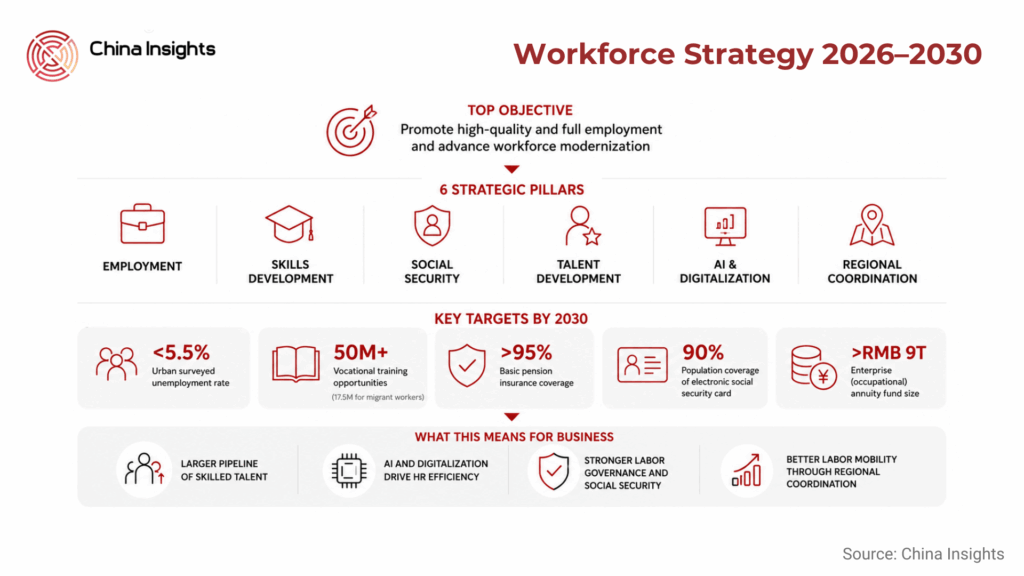
China aims to maintain the surveyed urban unemployment rate below 5.5% throughout the plan period.
More than 50 million subsidized vocational training opportunities will be delivered, including 17.5 million for migrant workers.
Basic pension insurance coverage will remain above 95%, while enterprise annuity assets are expected to exceed RMB 9 trillion.
The plan introduces new initiatives focused on AI-enabled employment creation, digital public services and regional labor market coordination.
Businesses should expect continued policy support for workforce development, digital HR administration and skills upgrading.

Employment Remains the Top Policy Priority
Employment continues to be one of China’s macroeconomic priorities. The plan aims to maintain overall labor market stability while promoting higher-quality employment rather than simply expanding job numbers.
During the 2026–2030 period, China targets large-scale urban job creation, with 25 million unemployed workers expected to return to employment and 6.5 million individuals facing employment difficulties receiving support. The surveyed urban unemployment rate is targeted to remain below 5.5%.
Read more about the upgraded unemployment insurance.
Rather than relying solely on traditional employment policies, the plan places greater emphasis on improving labor market quality. Policy measures focus on employment-friendly economic development, enhanced public employment services, stronger human resource markets and targeted support for key population groups.
One notable addition is the proposed Artificial Intelligence Employment Creation Program, reflecting official recognition that AI will simultaneously reshape labor demand while creating new employment opportunities.
Large-Scale Skills Development Becomes a Strategic Priority
One of the most significant features of the plan is the elevation of vocational skills development into a standalone strategic pillar.
China plans to provide more than 50 million subsidized vocational training opportunities over the next five years, including 17.5 million training opportunities for migrant workers.
The plan links skills development directly to addressing structural labor shortages rather than cyclical unemployment. Priorities include:
expanding lifelong vocational training systems;
improving occupational skills certification;
strengthening technical education institutions;
increasing skills competitions; and
implementing the national “Skills Illuminate the Future” training initiative.
The government also plans to issue 40 million new vocational qualification or occupational skill certificates, including 14 million advanced-level certifications.
For employers, this suggests continued government investment in expanding the skilled labor pool, particularly for advanced manufacturing, digital industries and emerging technologies.
Social Security Reform Continues
The plan continues China’s long-term effort to strengthen and modernize its social security system while addressing demographic pressures.
By 2030, China aims to:
maintain basic pension insurance coverage above 95%;
expand unemployment insurance participation to 255 million people;
increase work injury insurance coverage to 345 million people; and
grow enterprise and occupational annuity assets beyond RMB 9 trillion.
Policy priorities also include strengthening fund supervision, improving investment management and expanding pilot programs for occupational injury protection, particularly for workers in new forms of employment.
Talent Development Expands Beyond Traditional Recruitment
The plan places strong emphasis on building China’s long-term talent base.
Targets include:
14 million new professional qualification certificates;
annual recruitment of 35,000 postdoctoral researchers; and
pilot programs for engineering postdoctoral training.
The government also highlights reforms covering professional talent development, foreign expertise recruitment and public-sector personnel management. While domestic talent cultivation remains the primary focus, the continued emphasis on attracting international expertise indicates that foreign professionals remain part of China’s broader innovation strategy.

AI and Digitalization Shape Human Resources Policy
Beyond employment creation initiatives, the government intends to use AI and digital technologies to improve public human resources and social security services.
Digital transformation priorities include:
standardized digital public services;
smarter administrative systems;
improved digital service platforms; and
broader adoption of electronic social security services.
By the end of the planning period, 90% of the population is expected to have access to electronic social security cards.
Read more about AI in human resources.
Regional Coordination Receives Greater Attention
For the first time, the human resources plan introduces a dedicated chapter on regional coordination.The government aims to strengthen cooperation between regions, improve labor mobility and better align workforce policies with national regional development strategies. This reflects broader national objectives to reduce regional disparities while supporting major economic clusters and strategic development regions.
Legislative and Institutional Reforms Continue
Authorities plan to study revisions to existing legislation, including the Social Insurance Law, while also developing new regulations covering labor rights protection for workers engaged in new forms of employment.
In addition, the plan identifies 11 implementation programs designed to translate strategic objectives into measurable actions. These include initiatives covering employment promotion, vocational training, digital government capability, professional talent development and regional coordination.
What this means for business
China’s latest human resources strategy reinforces that labor market policy will remain closely linked to economic restructuring and industrial upgrading during the 15th Five-Year Plan period.
For employers, the most significant developments are likely to be continued government investment in workforce skills, expanded vocational training, digital HR administration and stronger support for advanced talent development.
Companies operating in manufacturing, technology and other skill-intensive industries may benefit from a larger pipeline of trained workers as government-funded training programs expand.
The prominence of artificial intelligence also signals that policymakers increasingly view workforce transformation as part of China’s broader digital economy strategy. Businesses should expect future labor policies to balance employment protection with technology adoption, while encouraging workforce reskilling.
Finally, the plan suggests continued evolution of China’s labor regulations and social security framework, particularly regarding new forms of employment and digital public services. Companies with long-term operations in China should monitor subsequent implementing regulations, as many of the plan’s strategic objectives will be translated into more detailed policies over the coming years.
Sources
https://www.gov.cn/zhengce/202607/content_7074842.htm
https://www.gov.cn/zhengce/202607/content_7075301.htm
https://www.gov.cn/zhengce/202607/content_7075303.htm
Author
Dr. Richard van Ostende

Related Articles