
China Signals Technology Priorities for the 15th Five-Year Plan
China has provided further insight into its science and technology priorities for the 15th Five-Year Plan (2026–2030). In the policy discussion, Minister of Science and Technology Yin Hejun outlined the government’s assessment of China’s technological progress, the challenges facing the innovation system, and the priorities expected to guide innovation policy over the coming years.
Although no new regulations or policy measures were announced, the discussion offers an authoritative indication of the government’s longer-term direction for science, technology and industrial development. It also provides useful context for understanding how research, innovation and industrial policies are likely to evolve during the next planning cycle.
For businesses operating in or engaging with China, these policy signals highlight the technology areas and strategic objectives expected to receive sustained government attention throughout the 15th Five-Year Plan.
Executive summary
- Science and technology remain central components of China’s economic development strategy during the 15th Five-Year Plan.
- Policymakers continue to pursue greater technological self-reliance while maintaining international scientific cooperation in selected areas.
- Greater emphasis is being placed on commercializing research outcomes and accelerating industrial application.
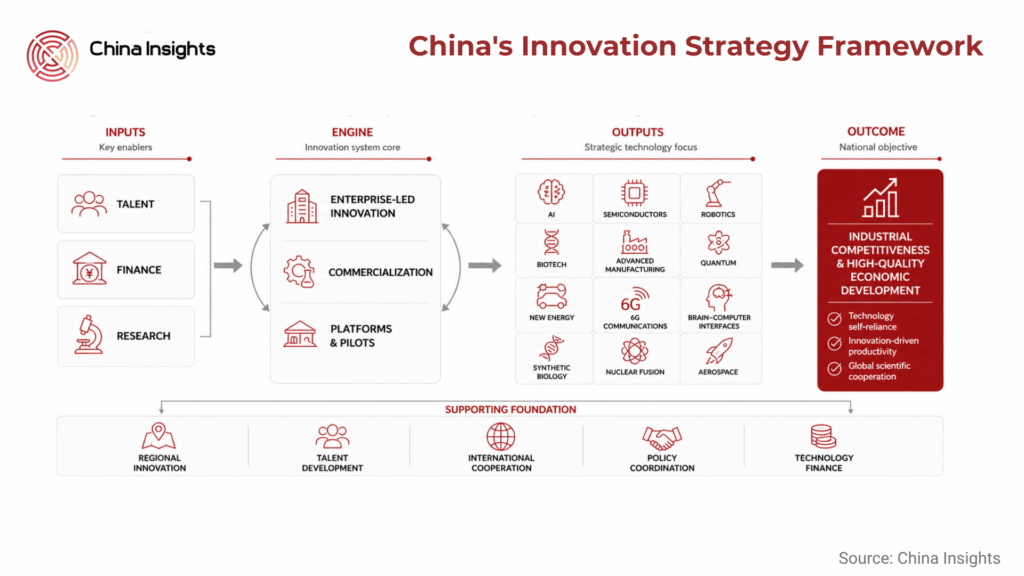
- Artificial intelligence, semiconductors, biotechnology, quantum technology, robotics and advanced manufacturing continue to receive strategic attention.
- Enterprises are expected to play a larger role in research, development and technology commercialization.
- Technology finance, pilot testing facilities and innovation platforms are expected to receive additional policy support.

Technology innovation remains central to economic policy
Science and technology continue to occupy a prominent position in China’s broader economic development strategy. Policymakers view innovation as an important driver of productivity growth, industrial modernization, green transformation and national security.
Looking ahead, the government aims not only to encourage scientific breakthroughs but also to improve the conversion of research into commercially viable products and industrial applications. Innovation is therefore expected to become an even more important contributor to long-term economic competitiveness.
Research capacity continues to expand
Recent data illustrate the continued growth of China’s innovation ecosystem. Research and development expenditure increased from RMB 1.03 trillion in 2012 to RMB 3.93 trillion in 2025, while R&D intensity reached 2.8% of GDP. China also recorded the world’s highest number of international Patent Cooperation Treaty (PCT) applications for the seventh consecutive year.
The country’s research workforce has continued to expand, reaching approximately 7.95 million full-time equivalent R&D personnel in 2025. Young researchers are also assuming more prominent roles in national research programs, particularly within strategically important technology fields.
Alongside efforts to strengthen domestic capabilities, China continues to participate actively in international scientific cooperation. Scientific partnerships now span more than 160 countries and regions, supported by participation in over 200 international scientific organizations and multilateral mechanisms. This reflects an approach that combines greater technological self-reliance with continued engagement in global research networks.
Commercialization becomes a stronger policy focus
One of the clearest themes emerging from China’s technology strategy is the growing emphasis on connecting scientific research with industrial development. Traditional manufacturing industries are expected to continue adopting artificial intelligence, industrial internet technologies, digital solutions and green production methods. Progress in sectors such as steel and cement is highlighted alongside broader advances in intelligent manufacturing. China also points to its expanding role in industrial robotics, accounting for more than 45% of global Lighthouse Factories and deploying more than two million industrial robots across 71 industrial sectors. Taken together, these developments indicate that future innovation policy will increasingly focus on industrial deployment, commercialization and measurable productivity improvements rather than research activity alone.
Strategic Industries Continue to Receive Policy Attention
Several industries are expected to remain at the center of China’s industrial development agenda throughout the current planning period. Electric vehicles, lithium batteries and solar photovoltaics continue to represent China’s established strategic export industries. At the same time, artificial intelligence, robotics and innovative pharmaceuticals are emerging as increasingly important areas for future industrial growth. Artificial intelligence receives particular attention. Policymakers highlight the rapid development of Chinese large language models such as DeepSeek, Qwen, Kimi and GLM, while emphasizing open-source ecosystems and the growing application of AI in scientific research. Looking further ahead, technologies including quantum computing, embodied intelligence, brain-computer interfaces, synthetic biology, sixth-generation communications, hydrogen energy and nuclear fusion are identified as potential drivers of future economic development. These sectors are likely to remain priorities for long-term policy support as commercialization gradually progresses.

Enterprises Assume a Larger Role in Innovation
Businesses are expected to play an increasingly important role within China’s national innovation system. Leading enterprises are encouraged to deepen collaboration with universities and research institutes, establish innovation consortia and participate directly in national technology programs. At the same time, additional investment is expected in proof-of-concept centers, pilot-scale testing facilities and demonstration platforms that help bridge the gap between laboratory research and industrial production. Technology finance also features prominently in future policy considerations. Improving financing mechanisms for early-stage technologies and innovation-driven industries is intended to strengthen commercialization and encourage long-term investment in strategic sectors.
Regional innovation remains an important policy objective
Regional development continues to be an integral part of China’s innovation strategy.
Beijing and the Beijing-Tianjin-Hebei region, the Yangtze River Delta centered on Shanghai, and the Guangdong-Hong Kong-Macao Greater Bay Area are expected to remain China’s leading science and technology innovation hubs. Meanwhile, other regions are encouraged to develop technological capabilities that build on their respective industrial strengths, reinforcing a broader strategy that combines national coordination with regional specialization.
Talent development and international cooperation remain priorities
Human capital remains a critical component of China’s long-term innovation agenda. Policy priorities include strengthening education, cultivating strategic scientific talent, supporting young researchers and reforming research evaluation systems to place greater emphasis on innovation quality rather than publication volume. China also indicates that international scientific cooperation will continue in areas such as artificial intelligence governance, biotechnology, climate change, food security and energy security. These collaborations are expected to continue where they contribute to domestic development priorities and shared global challenges.
What this means for business
While no immediate regulatory changes have been announced, the policy direction outlined provides a useful indication of the priorities likely to shape China’s science, technology and industrial agenda during the 15th Five-Year Plan.
Companies active in advanced manufacturing, semiconductors, artificial intelligence, biotechnology, robotics, aerospace, clean energy and digital infrastructure should continue monitoring policy developments, as these sectors are expected to remain strategic priorities.
The growing emphasis on technology commercialization, industry-research collaboration and innovation finance may also create additional opportunities for companies involved in research partnerships, technology transfer and industrial upgrading.
For foreign businesses, strengthening local technology capabilities and building partnerships with Chinese research institutions are likely to remain important considerations. At the same time, China’s continued commitment to international scientific cooperation suggests that opportunities for cross-border research collaboration will remain available in selected fields.
Overall, the policy direction reinforces that science and technology will continue to underpin China’s long-term industrial competitiveness, with increasing emphasis on commercialization, industrial application and the development of strategically important technologies.
Source
https://www.gov.cn/zhengce/202607/content_7074413.htm
Author
Dr. Richard van Ostende

Related Articles