
China's 15th Five-Year Plan for Beautiful China: Environmental Policy Becomes a Core Driver of Industrial Transformation
China has elevated environmental protection from a sector-specific policy objective to a central pillar of its national development strategy. On 4 July 2026, the State Council released the 15th Five-Year Plan for Beautiful China (《美丽中国建设“十五五”规划》), setting the country’s environmental agenda for the 2026-2030 period. Simultaneously, the Ministry of Ecology and Environment (MEE) published an official question-and-answer briefing explaining the rationale, objectives and implementation approach of the plan.
The document positions environmental quality as a strategic enabler of high-quality economic development rather than a constraint on growth. It also integrates climate policy, industrial upgrading, ecological conservation and environmental governance into a single national framework. For businesses, the plan provides a clear indication of future regulatory priorities, investment directions and compliance expectations during China’s 15th Five-Year Plan period.
Executive Summary
- The 15th Five-Year Plan for Beautiful China aims to achieve a fundamental improvement in China’s ecological environment by 2030.
- Environmental policy is closely linked to industrial upgrading, green development and high-quality economic growth.
- The plan establishes 18 performance indicators, including six mandatory targets.
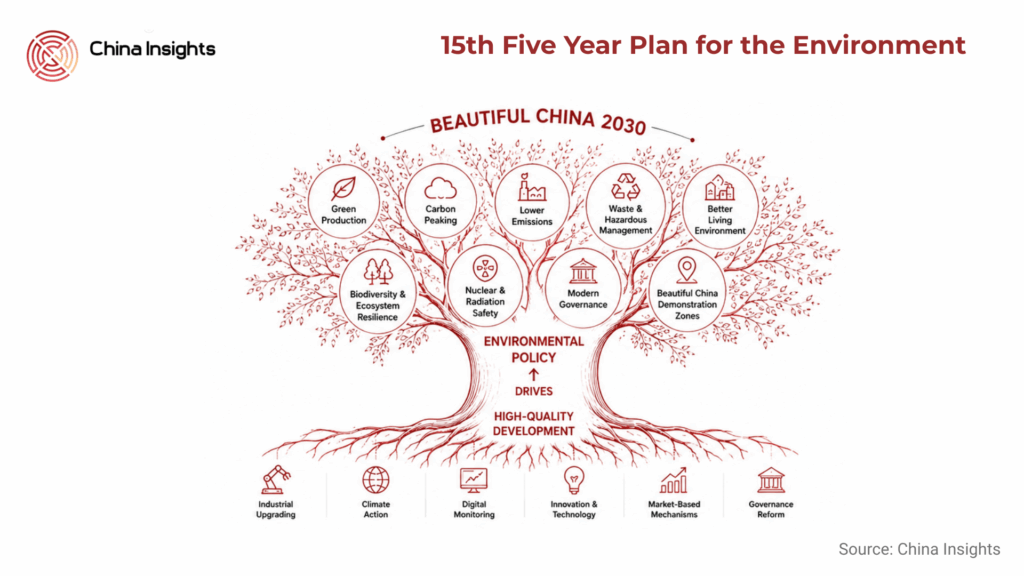
- Seven strategic priority areas cover pollution control, climate action, biodiversity, green production, ecological security and governance reform.
- Twenty major engineering programs will support implementation.
- Stronger environmental standards, digital monitoring and market-based policy instruments are expected during the 2026-2030 period.
Policy Background
The plan builds upon the environmental objectives introduced during the 14th Five-Year Plan while responding to new economic and environmental challenges. According to the Ministry of Ecology and Environment, China has achieved measurable improvements in air quality, water quality and coastal ecosystems during the previous planning period. Average PM2.5 concentrations in prefecture-level cities have fallen by approximately 20%, major sections of the Yangtze and Yellow Rivers have consistently maintained Class II water quality, and public satisfaction with the ecological environment has exceeded 90% for five consecutive years.
Despite these improvements, the Ministry acknowledges that structural environmental pressures remain significant. Pollution sources have become more complex, ecological restoration remains incomplete, and the transition from incremental environmental improvement to systemic environmental recovery has not yet been achieved.
The 15th Five-Year Plan is therefore presented as a critical phase towards achieving the national objective of building a “Beautiful China” by 2035.
Environmental Protection Supports High-Quality Development
One of the most notable features of the plan is its integration of environmental protection with industrial and economic policy. Rather than treating environmental regulation as a separate policy domain, the plan positions ecological quality as a prerequisite for sustainable economic growth. High-quality development, green industrial transformation and environmental governance are presented as mutually reinforcing objectives. The Ministry summarizes this approach through four guiding principles:
- Environmental quality should improve alongside economic development.
- Environmental improvement should focus on comprehensive nationwide progress rather than isolated regional successes.
- Carbon peaking and green industrial transformation should address pollution at its source by reducing fossil fuel dependence and encouraging clean energy deployment.
- Institutional reform, technological innovation and market mechanisms should strengthen modern environmental governance.
This reflects China’s continued shift towards integrating environmental objectives into industrial policy and long-term economic planning.
Targets for 2030
The plan establishes an overall objective of achieving comprehensive environmental improvement by 2030 while supporting China’s broader modernization agenda.
Expected outcomes include:
- Green production and consumption are becoming the dominant development model.
- Achievement of China’s carbon peaking target on schedule.
- Continued reductions in emissions of major pollutants.
- Improved management of solid waste and hazardous materials.
- Better urban and rural living environments.
- Enhanced biodiversity and ecosystem resilience.
- Higher standards for nuclear and radiation safety.
- A more modern environmental governance system.
- Establishment of demonstration zones for Beautiful China development.
To monitor progress, the plan introduces 18 key performance indicators covering the four policy areas of environmental quality, pollution and carbon reduction, ecosystem protection and environmental risk prevention. Six indicators are mandatory targets, while twelve are expected performance targets.
Seven Strategic Priority Areas
The plan identifies seven major policy priorities that will shape environmental regulation during the 2026-2030 period.
The first priority remains the continued fight against air, water and soil pollution. The government aims to further improve air quality, strengthen river and marine protection, and enhance soil and groundwater remediation.
The second priority expands China’s environmental agenda to include comprehensive management of solid waste, hazardous waste, heavy metal pollution and emerging pollutants.
Third, ecosystem conservation will receive greater attention through ecological restoration projects, biodiversity protection and stronger ecological supervision.
Climate policy forms the fourth priority. The government will continue implementing carbon peaking measures, strengthen adaptation to climate change, expand the national carbon market and improve greenhouse gas management systems.
The fifth priority focuses on accelerating green production and consumption. This includes improving environmental performance across key industries, promoting resource efficiency and encouraging low-carbon lifestyles.
The sixth priority addresses environmental security. Nuclear safety, ecological security and emergency environmental management are all strengthened under the new framework.
Finally, the plan calls for comprehensive improvements to China’s environmental governance system through stronger legislation, better monitoring capabilities, expanded scientific research, improved regulatory mechanisms, financial incentives and international cooperation.
Major Engineering Programs
Implementation will be supported through 20 national engineering programs, translating policy objectives into concrete investment projects These projects cover multiple sectors.
Environmental quality projects include air pollution control, river restoration, marine ecosystem rehabilitation and soil remediation. Waste management projects focus on industrial solid waste utilization, hazardous waste treatment capacity, heavy metal pollution control and management of new pollutants. Climate-related projects include industrial energy efficiency improvements, non-carbon dioxide greenhouse gas reduction and digital greenhouse gas monitoring systems. Ecological protection projects support biodiversity conservation and restoration of important ecosystems.
The plan also includes investments in environmental monitoring networks, digital environmental enforcement systems, ecological risk monitoring, nuclear safety technology and smart environmental governance platforms.
Together, these projects indicate continued government support for environmental infrastructure, clean technologies and environmental digitalization.
Implementation Mechanisms
The Ministry of Ecology and Environment outlines three implementation mechanisms, which indicate that environmental policy execution will become increasingly data-driven and performance-oriented.
- Responsibility will be shared across different levels of government through a central coordination model combined with provincial accountability and local implementation.
- Project implementation will be strengthened through detailed project pipelines, public investment and increased participation by private capital. The government also encourages innovative financing models for environmental infrastructure.
- Progress will be monitored through continuous assessment, mid-term evaluations and performance reviews. Environmental monitoring systems will provide ongoing oversight of implementation progress.
Implications for Industry
The plan reinforces several long-term regulatory trends already visible across China’s industrial policy. High-emission industries should expect continued tightening of environmental standards, permitting requirements and emissions management. Manufacturers will likely face greater expectations regarding resource efficiency, waste reduction and carbon management throughout production processes. Companies operating in environmental technologies, renewable energy, environmental monitoring, industrial digitalization and pollution control are likely to benefit from increased public investment and stronger market demand. Financial institutions may also encounter expanding opportunities in green finance as environmental projects increasingly leverage both public and private capital. Meanwhile, companies investing in China should expect environmental compliance to become more integrated into investment approval, industrial planning and supply chain management.
What this means for business
The 15th Five-Year Plan for Beautiful China confirms that environmental policy will remain a central component of China’s economic development strategy during the 2026-2030 period. The plan does not introduce a single major regulatory change. Instead, it establishes a comprehensive policy framework that will shape future regulations, sector-specific standards and investment priorities. Businesses should closely monitor implementation measures issued by central ministries and local governments, particularly in sectors with high energy consumption or environmental impact. Companies that align investments with China’s green transition, including clean technologies, environmental services, resource efficiency and digital environmental management, are likely to find new opportunities as implementation progresses.
Source
https://www.gov.cn/zhengce/202607/content_7074279.htm
Author
Dr. Richard van Ostende

Related Articles