
Emerging Industries, Improved Market Performance, and Trade Upgrading Drive Growth
China’s economic performance continues to demonstrate resilience despite ongoing global uncertainty and domestic structural challenges. During the National Development and Reform Commission (NDRC) monthly press conference on 22 May 2026, officials highlighted three key characteristics of the economy: the rapid expansion of new growth drivers, improving market efficiency, and the continued optimization of foreign trade structures.
This analysis complements our earlier review of China’s economic outlook by examining the emerging industries and market trends underpinning current growth.
Read more about China’s Economic Outlook 2026.
For businesses, the latest data provides insight into the sectors, technologies, and trade segments that are benefiting most from China’s ongoing industrial upgrading and innovation-driven growth strategy.
Executive Summary
- High-tech manufacturing, investment, exports, and profits continued to grow at a strong pace.
- Industrial profitability improved significantly, particularly in advanced manufacturing sectors.
- China’s foreign trade maintained double-digit growth while further diversifying export markets and upgrading export products.
- Consumer and producer prices showed signs of stabilization, reflecting improving supply-demand dynamics.
- The government is accelerating implementation of the “Artificial Intelligence Plus” strategy to support industrial modernization and productivity growth.
- Additional policy measures are being prepared to support employment, business confidence, and economic stability during the early years of the upcoming 15th Five-Year Plan period.
China’s Economic Fundamentals Remain Stable
On 22 May 2026, the National Development and Reform Commission (NDRC) held its monthly press conference to discuss recent economic developments. Li Chao, Deputy Director-General of the NDRC Policy Research Office and spokesperson for the commission, acknowledged that some economic indicators showed fluctuations in April. These developments were attributed to increasing uncertainty in the external environment, rising geopolitical risks, and the continued imbalance between domestic supply and demand.
Despite these challenges, the NDRC emphasized that the overall trajectory of China’s economy remains stable and continues to move toward higher-quality development. According to the commission, three trends stand out: stronger emerging growth drivers, improved market performance, and a more optimized foreign trade structure.
High-Tech Industries Continue to Lead Growth
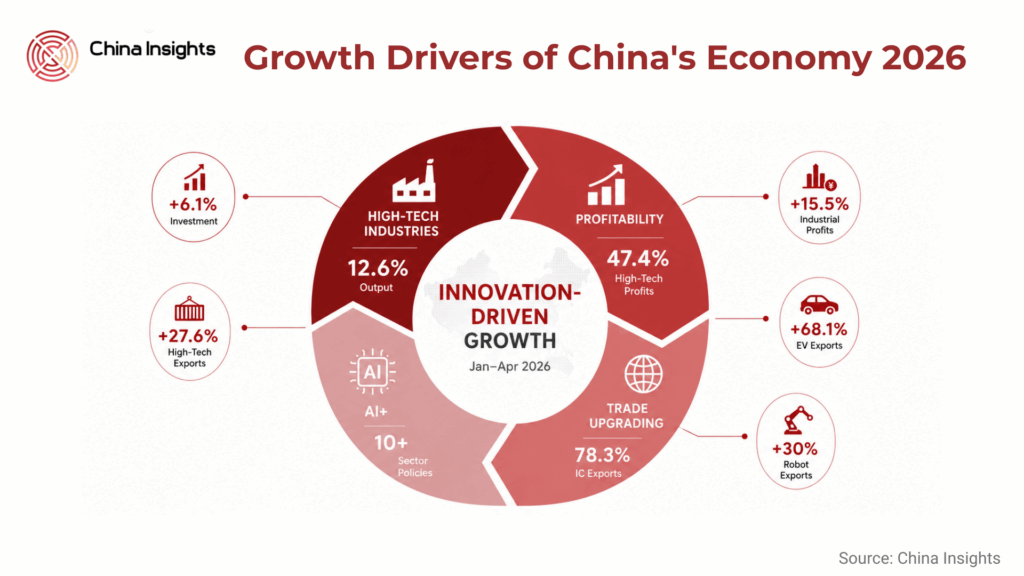
One of the most notable developments is the sustained expansion of China’s high-tech sectors. During the first four months of 2026, value-added output from large-scale high-tech manufacturing enterprises increased by 12.6% year-on-year.
Investment growth also remained robust. Investment in high-tech industries increased by 6.1%, with particularly strong growth recorded in aerospace manufacturing, computer and office equipment manufacturing, and information services. These sectors reported investment increases of 17.9%, 13.9%, and 18.1%, respectively.
The export performance of high-tech products was even more impressive. High-tech exports increased by 27.6% during the January-April period and accounted for 27.9% of China’s total exports. These figures indicate that China’s industrial upgrading strategy continues to gain momentum and that technological innovation is becoming an increasingly important contributor to economic growth.
Market Efficiency and Corporate Profitability Improve
The NDRC also highlighted positive developments in market efficiency. Government efforts to address excessive competition and overcapacity in certain industries have begun to produce measurable results.
As supply-demand relationships gradually improve, prices in several sectors have stabilized or recovered, contributing to stronger corporate earnings and improved market sentiment. In the first quarter of 2026, profits of large-scale industrial enterprises increased by 15.5% compared with the same period last year.
The strongest gains were observed in advanced manufacturing industries. Profits in the high-tech manufacturing sector increased by 47.4%, underscoring the growing contribution of innovation-driven industries to China’s economic performance.
These developments suggest that ongoing industrial restructuring and efforts to address inefficient market practices are beginning to support healthier market conditions and more sustainable growth.
Foreign Trade Structure Continues to Upgrade
China’s foreign trade remained resilient despite a volatile international environment. During the first four months of 2026, total imports and exports increased by 14.9% year-on-year.
Beyond the headline growth figures, the composition of trade continued to improve. China further diversified its trading relationships, with trade volumes with ASEAN, the European Union, and countries participating in the Belt and Road Initiative all recording double-digit growth.
Product upgrading also remained a key feature of export growth. Exports of mechanical and electrical products increased by 17.6%. Particularly strong growth was recorded in electric vehicles and integrated circuits, with exports rising by 68.1% and 78.3%, respectively.
Other advanced industrial products also performed strongly. Exports of wind turbine equipment and components increased by 40.7%, while industrial robot exports grew by 30%. These trends demonstrate China’s increasing competitiveness in technology-intensive and high-value-added manufacturing sectors.
Inflation Trends Send Positive Signals
The NDRC described recent price developments as broadly positive. In April, the Consumer Price Index (CPI) increased by 1.2% year-on-year, marking the third consecutive month in which inflation remained above 1%. Meanwhile, the Producer Price Index (PPI) increased by 2.8%, extending a two-month period of producer price growth.
According to the commission, stronger demand for travel and consumer services during the Qingming Festival, Labour Day holiday, and regional spring holiday periods contributed to higher service-sector prices. At the same time, demand generated by China’s green transition and rapid development of artificial intelligence supported price increases in sectors such as non-ferrous metal processing and information technology equipment manufacturing.
Government efforts to curb excessive competition have also contributed to improving pricing conditions. Prices in photovoltaic and related electrical equipment industries increased, while price declines in conventional and new-energy vehicles moderated compared with the previous year.
Overall, policymakers view recent inflation trends as evidence of improving supply-demand conditions and healthier market dynamics.
Accelerating the “Artificial Intelligence Plus” Strategy
Artificial intelligence remains a major policy priority for China’s economic modernization agenda. According to the NDRC, more than ten sector-specific “Artificial Intelligence Plus” policy documents have been issued since 2025, covering industries including manufacturing, healthcare, and energy.
The government has also established a number of national AI application testing and demonstration bases across sectors such as manufacturing, healthcare, and transportation. These initiatives aim to improve access to computing power, data resources, and real-world application scenarios while shortening commercialization cycles and reducing deployment costs.
In parallel, Chinese authorities continue to strengthen AI governance. Existing regulatory frameworks include the “Measures for Ethical Review and Services of Artificial Intelligence Science and Technology (Trial)” and the “Interim Measures for the Administration of Anthropomorphic Artificial Intelligence Interaction Services.” Policymakers are also conducting further research into comprehensive AI legislation.
Particular attention is being given to embodied AI and robotics. The government aims to accelerate the development of training infrastructure that will allow intelligent robots to move beyond demonstration environments and into factories, commercial facilities, and households.
The NDRC further announced that additional supporting measures for the “Artificial Intelligence Plus” initiative are currently being prepared, including expanded factor support and greater access to high-value application scenarios through state-owned enterprises.
What This Means for Business
China’s latest economic data suggest that the country’s growth model continues to shift toward innovation-driven and technology-intensive industries. While external uncertainties and domestic demand challenges remain, policymakers appear confident that emerging industries, industrial upgrading, and technological innovation can provide important growth support.
For businesses operating in or with China, several implications stand out. First, opportunities continue to expand in advanced manufacturing, artificial intelligence, automation, semiconductors, aerospace, renewable energy, and digital services. Second, ongoing efforts to improve market efficiency and address overcapacity may create a more stable competitive environment in selected industries. Third, the continued diversification of China’s trade relationships may provide new opportunities for exporters, suppliers, and investors targeting both the Chinese market and global value chains connected to China.
The government’s commitment to accelerating AI adoption across industries also signals increasing demand for technologies, expertise, and international partnerships that can support digital transformation. Companies that align their China strategies with these long-term policy priorities may be better positioned to benefit from future growth opportunities.
Source
https://www.gov.cn/zhengce/202605/content_7070002.htm
Author
Dr. Richard van Ostende

Related Articles