
China's Economic Policy Outlook 2026
On 22 May 2026, China’s National Development and Reform Commission (NDRC) held its monthly press conference to discuss recent economic developments and policy priorities. During the briefing, Li Chao, Deputy Director-General of the Policy Research Office and NDRC spokesperson, provided an assessment of China’s economic performance, inflation trends, artificial intelligence development, and infrastructure investment plans.
The remarks offer valuable insight into the Chinese government’s current economic priorities as policymakers seek to maintain growth momentum amid external uncertainties, strengthen emerging industries, and prepare for the implementation of the country’s upcoming Fifteenth Five-Year Plan (2026-2030).
Executive Summary
- The NDRC stated that China’s economy remained stable despite increased external uncertainties and geopolitical risks.
- Growth in high-tech manufacturing, investment, exports, and corporate profits continues to support economic resilience.
- Authorities expect consumer and producer prices to remain within a reasonable range as supply-demand conditions improve.
- The NDRC is preparing supporting policy documents to accelerate implementation of the “Artificial Intelligence Plus” (AI+) strategy.
- New initiatives will focus on embodied AI and robotics applications across industrial, commercial, and household settings.
- China plans significant investments in six strategic infrastructure networks, including power grids, computing networks, communications, logistics, water systems, and underground utility networks.
- During the Fifteenth Five-Year Plan period, investment in the power grid and underground utility networks is each expected to exceed RMB 5 trillion.
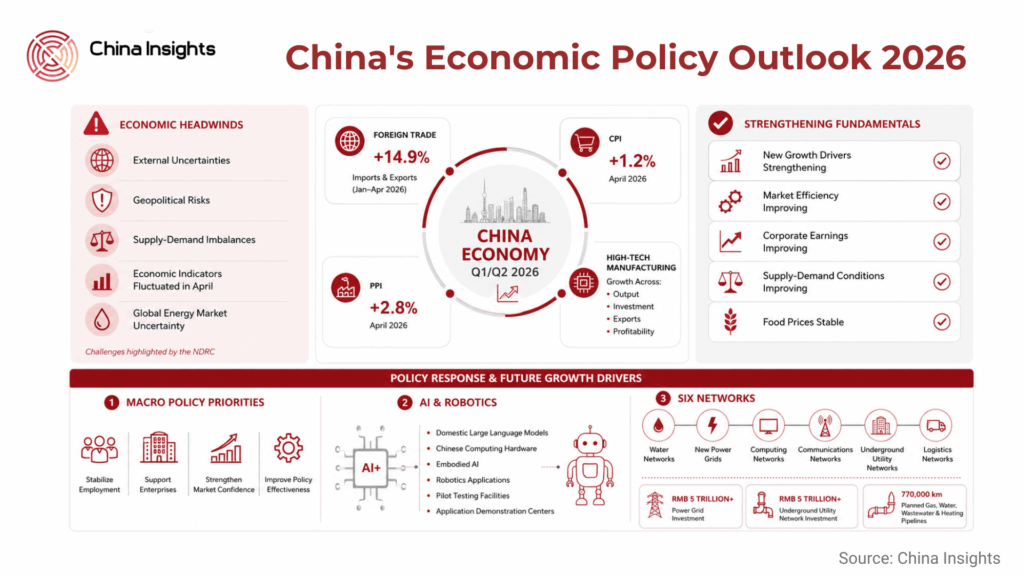
China’s Economy Remains Resilient
According to the NDRC, some economic indicators experienced fluctuations during April 2026. Officials attributed these developments to growing international uncertainties, rising geopolitical risks, and persistent imbalances between domestic supply and demand.
Nevertheless, the Commission emphasized that the overall trajectory of China’s economy remains positive. Three key characteristics were highlighted.
- New growth drivers continue to strengthen. High-tech manufacturing maintained rapid growth across industrial output, investment, exports, and profitability. This reflects Beijing’s ongoing efforts to move the economy up the value chain and reduce reliance on traditional growth sectors.
- Market efficiency has improved. Government measures aimed at addressing excessive competition and industrial overcapacity have reportedly begun to produce results. In several sectors, supply-demand conditions are gradually improving, supporting price stabilization and stronger corporate earnings.
- Foreign trade has demonstrated resilience. During the first four months of 2026, China’s total imports and exports increased by 14.9 percent year-on-year. Authorities also noted continued optimization of the trade structure, suggesting ongoing progress toward higher-value exports.
The NDRC reiterated its commitment to implementing the economic priorities outlined during the Central Political Bureau meeting of 28 April 2026. Particular emphasis will be placed on stabilizing employment, supporting enterprises, strengthening market confidence, and ensuring policy effectiveness.
Inflation Pressures Remain Manageable
Inflation trends were another key topic during the briefing. China’s Consumer Price Index (CPI) increased by 1.2 percent year-on-year in April 2026, representing a modest acceleration compared to the previous month. Meanwhile, the Producer Price Index (PPI) rose by 2.8 percent year-on-year.
According to the NDRC, government efforts to address so-called “involution-style competition”
have contributed to improving pricing conditions in several industries. For example, prices within the photovoltaic and electrical machinery sectors increased by 3.6 percent compared to the previous year.
Price declines in both conventional fuel vehicles and new energy vehicles also narrowed relative to 2025 levels, suggesting that competitive pressures within China’s automotive market may be easing.
Food prices remained broadly stable during the first four months of the year, contributing to overall price stability.
Looking ahead, the NDRC expects inflation to remain within a reasonable range. While global energy markets continue to present uncertainties, officials argued that China’s strong production capacity and ample supply of goods and services provide a solid foundation for maintaining price stability.
Accelerating the “Artificial Intelligence Plus” Strategy
One of the most notable announcements from the press conference concerns China’s continued focus on artificial intelligence.
The NDRC confirmed that supporting policy documents are currently being prepared to accelerate implementation of the national “Artificial Intelligence Plus” (人工智能+) strategy. The initiative aims to deepen AI integration across economic and social sectors while ensuring technological self-reliance and security.
According to Li Chao, policymakers are working to strengthen factor support mechanisms and encourage broader adoption of domestic large language models and AI systems that operate on Chinese-developed computing hardware.
The government also intends to expand access to high-value application scenarios through state-owned enterprises and other major institutions. This approach is designed to accelerate commercialization while creating benchmark projects that can be replicated across industries and regions.
The announcement aligns with broader national objectives to position China as a global leader in artificial intelligence while reducing dependence on foreign technologies.
Embodied AI and Robotics Receive Increased Attention
In addition to general AI development, the NDRC highlighted embodied intelligence as a strategic priority.
Embodied AI refers to artificial intelligence systems integrated with physical machines such as robots. Chinese policymakers view the technology as a key enabler of future productivity gains across manufacturing, logistics, retail, healthcare, and consumer services.
The Commission announced plans to accelerate construction of training infrastructure that can improve the adaptability of embodied AI systems across multiple operating environments.
Officials also intend to establish additional pilot testing facilities and application demonstration centers. These initiatives aim to strengthen collaboration between software developers, hardware manufacturers, and infrastructure providers, helping accelerate commercialization of robotics technologies.
The long-term objective is to move robots beyond laboratory demonstrations and sporting competitions into practical deployment across factories, shopping centers, and households.
Massive Infrastructure Investments Planned Through 2030
Infrastructure development remains a central pillar of China’s economic strategy.
The NDRC outlined its vision for coordinated development of six major infrastructure networks, collectively referred to as the “Six Networks” (6张网):
- Water networks
- New power grids
- Computing networks
- Next-generation communications networks
- Urban underground utility networks
- Logistics networks
Authorities emphasized that these networks should not be viewed as isolated systems. Instead, greater integration and coordination between infrastructure categories is expected to improve efficiency and support long-term economic modernization.
Particularly noteworthy are the investment figures announced for the Fifteenth Five-Year Plan period.
Investment in China’s new power grid infrastructure is expected to exceed RMB 5 trillion. Planned projects include new transmission corridors, interprovincial electricity exchange projects, urban distribution network upgrades, rural grid modernization, and reliability improvements.
Similarly, underground utility infrastructure investment is projected to reach approximately RMB 5 trillion. Planned construction and renovation activities will cover around 770,000 kilometers of gas, water supply, wastewater, and heating pipelines.
To support implementation, the NDRC plans to issue dedicated planning documents and implementation measures while strengthening project pipelines and financing mechanisms. Policymakers also intend to leverage both government funding and policy-based financial instruments while encouraging greater private-sector participation.
What This Means for Business
The NDRC’s latest policy briefing reinforces several important themes for domestic and international businesses operating in China.
- Policymakers remain committed to maintaining economic stability through targeted macroeconomic support measures. Companies can therefore expect continued policy interventions aimed at supporting growth, employment, and market confidence.
- Artificial intelligence is rapidly moving from a technology priority to an implementation priority. Businesses active in AI software, computing infrastructure, semiconductors, automation, and digital transformation should monitor forthcoming AI+ policy documents closely for new opportunities.
- Embodied AI and robotics are emerging as strategic growth sectors. Companies involved in industrial automation, robotics, sensors, software platforms, and smart manufacturing may benefit from future government support and pilot projects.The planned multi-trillion-renminbi infrastructure investments signal substantial opportunities across power systems, utilities, communications, logistics, engineering, construction, and related supply chains throughout the 2026-2030 planning period.
For foreign companies, understanding how these priorities align with local industrial policies will remain essential for identifying market opportunities and positioning within China’s evolving economic landscape.
Sources
https://www.ndrc.gov.cn/xwdt/xwfb/202605/t20260522_1389052.html
https://www.news.cn/politics/20260522/xxxxxxxx.htm
Author
Dr. Richard van Ostende

Related Articles