
China’s 15th Five-Year Plan Repositions Coal as a Flexible and Technology-Driven Part of the Energy System
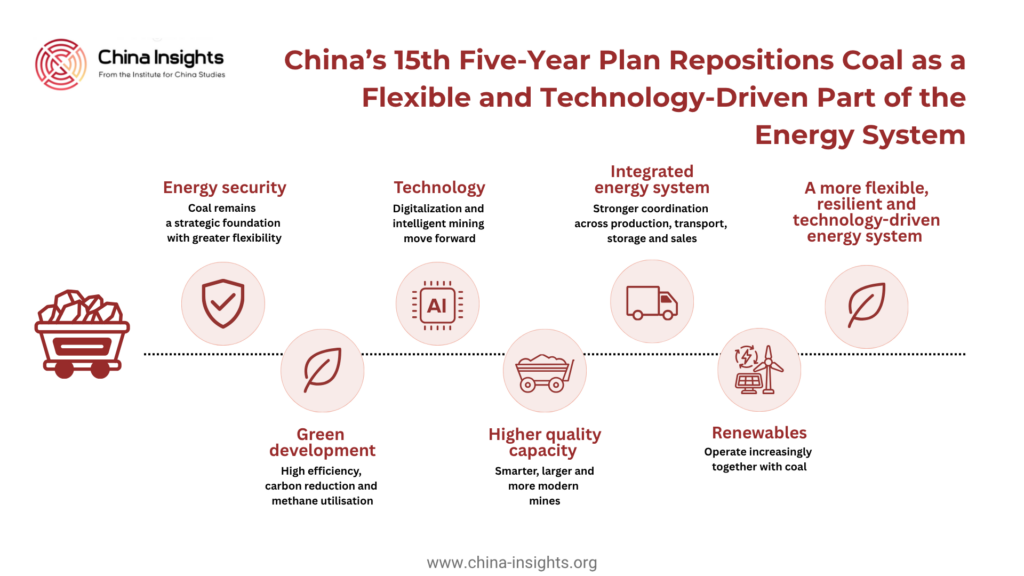
China’s 15th Five-Year Plan (2026–2030) for the coal industry marks a shift from managing coal primarily around supply security toward building a more flexible, efficient and technologically advanced industry. Coal remains a foundational energy source, but its role is being recalibrated as consumption approaches a peak and China accelerates the development of a new energy system.
The National Development and Reform Commission (NDRC) and National Energy Administration (NEA) issued the “15th Five-Year Plan for the Development of the Coal Industry” (《煤炭工业发展“十五五”规划》) under document NDRC Energy [2026] No. 979. The plan was dated 6 July 2026 and published on 10 August 2026.
Executive summary
- Coal remains a strategic component of China’s energy security framework, but its role is shifting as coal consumption approaches its peak.
- The policy places greater emphasis on high-quality and advanced production capacity, rather than simply expanding output.
- Large modern coal mines are expected to account for a higher share of national capacity by 2030.
- Mine digitalization and AI applications are moving from pilot deployment toward deeper operational integration.
- Green mining, methane utilization, energy efficiency and coal–renewable integration are becoming core industry requirements.
- Coal companies face increasing pressure to combine security of supply, operational efficiency and lower carbon intensity.
From production growth to capacity quality
The most important change is the industry’s development model. During the 14th Five-Year Plan, policy focused strongly on stabilizing production and supply while improving the industry’s structural efficiency. Coal production reached 4.85 billion tons, while the number of coal mines fell to around 4,000 and large mines accounted for 85% of national capacity.
The 15th Five-Year Plan now puts greater emphasis on advanced production capacity and the optimization of the mining structure. By 2030, the share of large modern coal mines in national capacity is targeted to rise to 87%. The direction is therefore toward fewer, larger and more technologically capable producers.
For businesses, this implies a more demanding investment environment. Scale alone will be less important than resource quality, mine efficiency, safety performance, technology deployment and the ability to operate within tighter environmental requirements.
Supply security remains the underlying constraint
The shift toward cleaner energy does not eliminate coal’s strategic role. The plan continues to treat coal as a fundamental source of energy security and system flexibility. It calls for stronger coordination across production, transportation, storage and sales, alongside increased reserve capacity.
This represents an important distinction from a simple coal-reduction strategy. China intends to reduce the growth of coal consumption while retaining sufficient capacity to respond to fluctuations in the wider energy system. Coal supply resilience therefore remains a policy priority even as the sector moves toward its consumption peak.
For mining companies, logistics providers and equipment suppliers, this should sustain demand for efficient production, transport and reserve-capacity systems.
Intelligent mining moves into the next phase
The new plan significantly raises the technology ambition for the sector. Intelligent mine construction is moving toward deeper and more systematic deployment, with AI applications to be expanded into specific mining scenarios. By 2030, intelligent coal-mine capacity is targeted to account for 75% of the national total.
This is a shift from digitalization as an efficiency project toward digitalization as part of the operating model. Automation, intelligent monitoring, data systems and AI-supported decision-making are expected to contribute directly to productivity and safety.
The commercial implications extend beyond mining companies. Demand should increase for automation systems, sensors, industrial software, communications infrastructure, robotics and intelligent equipment capable of operating in complex underground environments.
Green mining becomes a full-cycle requirement
The plan also strengthens the environmental dimension of coal production. Authorities are calling for higher levels of green resource extraction, greater energy efficiency and carbon reduction across the mining process, as well as expanded utilization of coal-mine methane.
The direction is broader than reducing emissions from coal-fired power generation. It covers the mining and processing stages themselves. Existing progress provides a baseline: during the 14th Five-Year Plan, the comprehensive utilization rates for coal gangue and mine water reached 75% and 74.7%, respectively.
For businesses, environmental performance will increasingly become part of operational competitiveness. Equipment and technologies that reduce energy consumption, improve resource recovery and utilize mine waste or methane should gain greater relevance.
Coal and renewables will increasingly operate together
The plan explicitly promotes greater integration between coal and renewable energy. This reflects the changing function of coal within China’s electricity system. As renewable generation expands, coal-fired power and coal supply systems will increasingly need to provide flexibility and system support rather than simply maximize baseload generation.
The same logic is visible in the plan’s emphasis on clean and efficient coal utilization. Authorities are promoting higher-quality coal products, coal-power transformation and upgrading, and the controlled expansion of coal as an industrial feedstock.
This creates a more differentiated market for coal. Companies positioned around efficient, flexible and higher-value applications may be better aligned with the industry’s future direction than businesses dependent on volume growth alone.
Technology investment becomes more strategic
The plan gives greater weight to technological innovation. Priorities include applied basic research, advanced technologies and equipment, and stronger mechanisms connecting research with industrial deployment.
This creates opportunities for suppliers of advanced mining equipment and technology providers. It also increases the importance of cooperation between coal enterprises, equipment manufacturers, research institutions and technology companies.
The direction suggests that the next phase of industry consolidation will not be based solely on mine ownership and production capacity. Technology capability is becoming an increasingly important competitive factor.
Safety and governance remain central
Safety remains a core requirement. The plan calls for stronger foundations for mine safety, deeper prevention of major mining hazards and improved occupational health protection. At the same time, authorities intend to strengthen the modern coal market system and improve industry governance.
This creates a more regulated operating environment. Companies will face simultaneous expectations around production reliability, safety, environmental performance, technology and market discipline.
For international suppliers, this makes regulatory and technical compliance particularly important. Market opportunities will increasingly depend on the ability to meet China’s evolving technical, safety and environmental requirements.
What this means for business
- Prioritize advanced capacity: Investment opportunities are likely to favor efficient, large-scale and technologically advanced mines.
- Expect continued technology demand: AI, automation, sensing, robotics and industrial software will become increasingly important.
- Position for green mining: Energy efficiency, methane utilization and resource recovery are becoming core operational requirements.
- Look beyond coal volumes: Growth opportunities will increasingly come from productivity, technology and higher-value utilization rather than simply higher output.
- Monitor coal–renewable integration: Coal’s role is evolving toward greater flexibility within the broader energy system.
- Prepare for tighter operating requirements: Safety, environmental performance and governance will increasingly influence competitiveness and investment decisions.
Sources
- https://www.gov.cn/zhengce/202608/content_7077824.htm
- https://www.ndrc.gov.cn/xxgk/zcfb/tz/202608/t20260810_1406952_ext.html
- https://www.ndrc.gov.cn/xxgk/jd/jd/202608/t20260810_1406951.html
Author
Dr. Richard van Ostende

Related Articles