
China Accelerates “Six Networks” Infrastructure Build-Out Under the 15th Five-Year Plan
China is moving from planning to implementation on a new generation of infrastructure networks. The approach brings together water infrastructure, the new power system, computing infrastructure, next-generation communications, urban underground networks and logistics. The policy direction is significant because these networks are no longer being treated as separate infrastructure programs. Their integration is becoming a central feature of China’s infrastructure investment strategy under the 15th Five-Year Plan (2026–2030).
The National Development and Reform Commission (NDRC) confirmed in July 2026 that construction of the six networks is accelerating. The announcement followed the State Council Executive Meeting of 9 May 2026, which called for stronger planning and construction of the six networks, and the Politburo meeting of 28 April 2026, which identified the networks as a priority for infrastructure development.
Executive summary
- China is shifting the “Six Networks” agenda from strategic planning toward project implementation and investment delivery.
- The six networks combine traditional infrastructure with digital and energy infrastructure.
- The policy emphasis is moving from individual projects toward cross-network integration and interoperability.
- NDRC is coordinating dedicated plans and implementation measures for each network.
- Computing, power and communications infrastructure are emerging as a particularly integrated investment area.
- Private-sector participation is being encouraged, particularly where projects offer clearer commercial returns.
- Companies supplying equipment, digital systems, engineering services and infrastructure technologies should expect greater demand for integrated solutions, rather than standalone products.
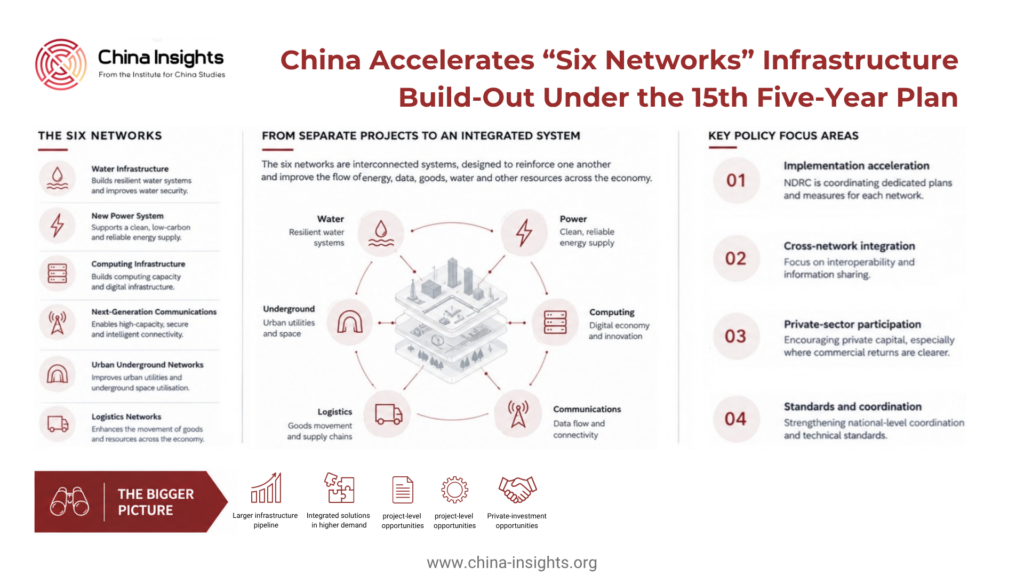
From individual infrastructure projects to an integrated system
The key change is conceptual. The six networks are not being developed as six independent investment programs. NDRC describes them as interconnected systems that should reinforce one another. The objective is to improve the movement of energy, data, goods, water and other resources across the economy.
This represents a broader shift in China’s infrastructure model. Traditional infrastructure remains important, but investment is increasingly being linked to digitalization, energy transition, industrial upgrading and supply-chain efficiency. For companies, this increases the relevance of technologies that can operate across infrastructure systems.
Implementation is moving faster
The immediate change is the pace of project execution. NDRC stated in July that a large number of projects had already started construction, while additional projects were being prepared for implementation. The commission is working with other government departments and local governments to develop dedicated plans and implementation measures for each network.
The focus is therefore shifting from announcing infrastructure priorities to generating physical investment and operating capacity. This creates a more visible project pipeline for companies involved in engineering, construction, equipment, digital infrastructure and infrastructure-related services.
The implementation model also places greater emphasis on selecting projects according to actual demand and local conditions. This reduces the policy case for indiscriminate infrastructure expansion and increases the importance of project quality and utilization.
Computing, power and communications become more closely linked
The integration of the computing network, new power system and next-generation communications network is one of the clearest examples of the new approach. NDRC has highlighted the need to coordinate computing capacity with electricity supply and communications infrastructure.
This has direct implications for the digital economy. Computing infrastructure requires reliable and increasingly low-carbon electricity. At the same time, distributed computing resources require high-capacity communications and effective data connectivity. Infrastructure planning is therefore moving toward a model in which power, computing and communications capacity are considered together.
For technology companies, this creates opportunities beyond conventional data-centre construction. Demand is likely to extend to power-management systems, energy storage, network equipment, computing infrastructure, software and integrated digital-management platforms.
Interoperability becomes a policy priority
The infrastructure agenda is also becoming more focused on the “soft” side of network development. NDRC has identified interoperability, standards, information sharing and market-access arrangements as areas requiring improvement.
This matters because infrastructure capacity alone does not guarantee efficiency. Different regions and systems must be able to exchange data, coordinate operations and use common technical standards. The policy therefore creates potential demand for technologies and services that support system integration, monitoring and intelligent management.
For foreign companies, standards and interoperability will become important market-entry considerations. Technical capability will need to be combined with an understanding of China’s regulatory and infrastructure standards.
A larger role for private investment
The six-network strategy is also creating space for greater private-sector involvement. NDRC has indicated that projects with relatively stable commercial returns will be identified to attract private capital. The approach is intended to move beyond infrastructure financed and operated solely through government investment.
This is relevant for companies assessing China’s infrastructure market because commercial participation will depend increasingly on the economic structure of individual projects. The strongest opportunities are likely to be found where infrastructure investment produces identifiable operating revenues or measurable efficiency gains.
The policy therefore does not simply increase the volume of infrastructure investment. It is also intended to improve the conditions under which infrastructure assets can support commercial activity.
Investment priorities extend across old and new infrastructure
The six networks combine new infrastructure with the upgrading of existing infrastructure. Water networks and urban underground pipelines address physical infrastructure gaps. New power systems, computing networks and communications infrastructure support China’s digital and energy transition. Logistics networks focus on improving the movement of goods and resources.
This combination broadens the addressable market. Infrastructure opportunities are not limited to large technology projects. They also include equipment replacement, network upgrades, monitoring systems, energy efficiency, maintenance and digital transformation of existing assets.
For suppliers, the distinction between infrastructure construction and infrastructure technology is therefore becoming less relevant. Integrated capabilities are likely to become more valuable.
Stronger coordination at national level
Implementation is increasingly supported by formal coordination mechanisms. In August, NDRC established a coordination mechanism involving the major power-grid companies, telecommunications operators and computing-related enterprises for the computing, power and communications networks.
This is an important operational development. It indicates that cross-network coordination is moving from a policy objective toward an institutionalized implementation process. It should also improve the alignment of investment plans among major infrastructure operators.
For businesses, this increases the importance of understanding not only individual projects but also the wider network architecture and the companies responsible for implementation.
What this means for business
- Expect a larger infrastructure pipeline: The transition from planning to implementation should create opportunities across engineering, equipment, technology and services.
- Prioritized integrated solutions: Demand is shifting toward technologies that connect power, computing, communications, logistics and physical infrastructure.
- Monitor project-level opportunities: National priorities will increasingly translate into provincial and local projects with different commercial models.
- Assess standards early: Interoperability, data exchange and technical standards will become important market-access considerations.
- Look beyond construction: Operations, maintenance, digital management and infrastructure optimization should become increasingly important markets.
- Track private-investment opportunities: Projects with predictable revenues and measurable efficiency gains are likely to receive greater attention as China seeks broader participation in infrastructure investment.
Primary source
https://www.gov.cn/zhengce/202607/content_7077300.htm
https://www.ndrc.gov.cn/fzggw/jgsj/tzs/sjdt/202608/t20260820_1407103.html
https://www.ndrc.gov.cn/xwdt/wszb/7yxwfbh/wzsl/202607/t20260731_1406818.html
https://www.sic.gov.cn/sic/81/455/0630/20260630152023378835147_pc.html
Author
Dr. Richard van Ostende

Related Articles