
China’s 15th Five-Year Plan Positions Tourism as a Strategic Growth Industry Through Digitalization, Consumption Expansion and Internationalization
China’s Ministry of Culture and Tourism issued the “Tourism Powerhouse Construction 15th Five-Year Plan” as part of the implementation of the 15th Five-Year Plan for National Economic and Social Development. The plan outlines China’s strategy to accelerate tourism sector development from 2026 to 2030, positioning tourism as an emerging strategic pillar industry and a key driver of domestic consumption, employment, cultural development, and international exchange.
For businesses operating in tourism, consumer services, technology, transportation, hospitality, and cultural industries, the policy direction creates new investment and market opportunities while increasing expectations around service quality, innovation and compliance.
Executive Summary
By 2030, China targets 8.3 billion domestic trips and domestic tourism spending of RMB 7.7 trillion, while seeking to expand inbound tourism to 190 million visits with total spending exceeding USD 150 billion.
The development model will increasingly focus on smart tourism, green transformation, cultural integration and diversified tourism products.
Digital technologies, artificial intelligence, data platforms and intelligent services will become important drivers of tourism sector upgrading.
International tourism development will focus on improving inbound tourism convenience, expanding international routes, enhancing payment and service accessibility, and strengthening China’s global tourism brand.
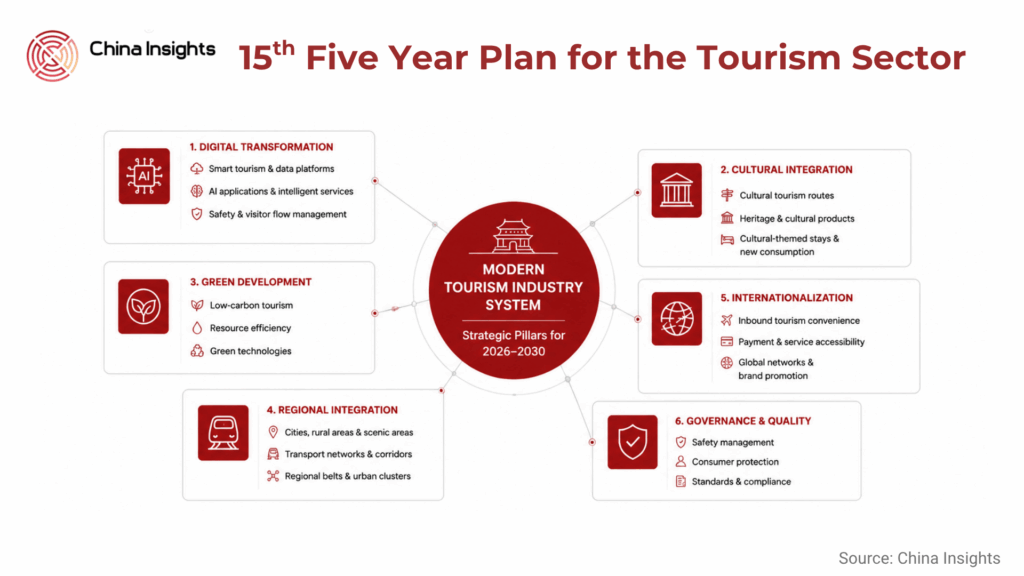
Tourism Elevated as a Strategic Industry
The 15th Five-Year Plan defines tourism as an industry with increasing strategic importance for China’s economic and social development. The policy framework emphasizes tourism’s role in supporting domestic demand, employment creation, cultural development, and international exchange.
Rather than focusing only on increasing tourism volume, the plan prioritizes the construction of a modern tourism industry system. The government aims to improve the quality of tourism supply, strengthen public services, and develop products that better match changing consumer demand.
By 2030, the plan expects tourism’s contribution to the economy to continue increasing, supported by stronger domestic consumption and expanded international tourism activity. Domestic tourism is expected to reach 8.3 billion trips, with domestic tourism expenditure reaching RMB 7.7 trillion. Inbound tourism is targeted to reach 190 million visits, generating more than USD 150 billion in spending.
Regional Tourism Development Creates New Market Opportunities
A major focus of the plan is improving tourism coordination across regions and creating stronger links between cities, rural areas, and transportation networks.
The government plans to strengthen tourism development around major cultural and geographic corridors, including national cultural parks, high-speed rail networks, and regional tourism belts. The strategy aims to create interconnected tourism systems rather than isolated destinations. Especially, major urban clusters such as the Yangtze River Delta, Guangdong-Hong Kong-Macao Greater Bay Area, Beijing-Tianjin-Hebei region and Chengdu-Chongqing region will continue to develop integrated tourism offerings.
Read more on the initiative for the vehicle rental sector.
Digital Transformation Becomes a Core Development Direction
Digitalization is one of the central themes and identifies smart tourism as a key pathway for improving service efficiency, operational management, and visitor experience. Especially, promotion of the application of digital technologies and data resources across tourism scenarios, including travel planning, digital guides, immersive experiences, visitor flow management, and safety supervision.
Moreover, the development of tourism data infrastructure and the application of large-scale models in tourism services will extend to areas such as immersive experience equipment, cruise and yacht services, low-altitude tourism equipment, and safety monitoring platforms.
Cultural Integration and New Tourism Consumption Models
Authorities aim to develop tourism products that combine cultural resources, historical heritage, and modern consumption experiences. The strategy includes expanding cultural tourism routes, improving heritage-based tourism products, developing cultural-themed hotels and home-stays, and creating new cultural consumption scenarios.
Green Development Becomes a Requirement for Tourism Growth
Environmental sustainability is identified as a key principle throughout tourism planning, development, and operation via improved environmental management, ecological restoration in tourism areas, low-carbon tourism products, and greater use of green technologies.
Tourism operators are encouraged to reduce emissions, improve energy and water efficiency, promote waste reduction and support low-carbon travel behavior. Hospitality companies, destination developers, and tourism infrastructure providers will face stronger expectations regarding environmental performance.
Expanding International Tourism and Improving Foreign Visitor Services
An increase in China’s international tourism attractiveness is aimed for with improvements on inbound tourism convenience through better visa policies, international transportation connections, payment services, accommodation services, and multilingual support.
The development of international tourism networks, cooperation with global tourism organizations and stronger overseas promotion of China’s tourism brand arises by improving foreign visitor experience. This will require coordination across transportation, hospitality, retail, digital payment, translation services, and destination management.
Stronger Market Governance and Service Quality Requirements
Alongside expansion, the plan highlights stronger governance standards. Authorities will improve tourism market supervision, strengthen safety management, and promote service quality improvements.
The plan calls for stronger monitoring systems, digital supervision tools, improved complaint handling mechanisms, and stricter enforcement against market irregularities.
Tourism businesses will therefore need to focus not only on growth but also on compliance, operational standards, consumer protection, and service quality management.
What this means for business
China’s 15th Five-Year Plan for tourism development indicates that the sector is entering a new phase focused on quality, technology, and integration rather than simply expanding visitor numbers.
For businesses, the main opportunities are concentrated in five areas:
First, smart tourism solutions will become increasingly important as destinations adopt digital platforms, AI-enabled services, and data-driven management.
Second, experience-based consumption will create opportunities for companies developing cultural, wellness, sports, entertainment and specialized tourism products.
Third, green transformation will become a competitive requirement for tourism operators, infrastructure providers, and hospitality companies.
Fourth, inbound tourism recovery and internationalization will create demand for services improving foreign visitor convenience and experience.
Fifth, regional tourism integration will create opportunities linked to transportation networks, destination development and cross-sector partnerships.
Overall, the policy direction suggests that China’s tourism market will continue expanding, but future growth will increasingly favor companies that provide higher-quality experiences, digital capabilities, sustainable solutions and integrated services.
Source
https://zwgk.mct.gov.cn/zfxxgkml/ghjh/202607/t20260707_966446.html
Author
Dr. Richard van Ostende

Related Articles