
China Approves Education Development Plan for the 15th Five-Year Plan Period
China has formally approved its next five-year blueprint for educational development, reinforcing the sector’s strategic importance within the country’s long-term modernization agenda. On 11 June 2026, the State Council Executive Meeting reviewed and approved the Education Development 15th Five-Year Plan (《教育发展“十五五”规划》), establishing the framework that will guide education policy from 2026 to 2030.
The approval comes at a pivotal moment. China has already established what authorities describe as the world’s largest education system and has made significant progress in expanding access to education at all levels. However, demographic shifts, technological transformation, industrial upgrading, and changing labor market demands are creating new challenges and opportunities for policymakers.
The newly approved plan seeks to address these developments by strengthening educational quality, improving resource allocation, and enhancing the contribution of education to innovation-driven economic growth.
Executive Summary
China has taken another step toward its long-term objective of becoming a leading education nation with the approval of the Education Development 15th Five-Year Plan (2026–2030).
Key takeaways include:
- The State Council Executive Meeting reviewed and approved the Education Development 15th Five-Year Plan on 11 June 2026.
- The plan positions education as a strategic pillar supporting national development, technological innovation, and talent cultivation.
- Key priorities include improving educational quality, promoting educational equity, optimizing resource allocation, strengthening teacher development, and expanding international educational cooperation.
- Authorities will seek to better align education resources with demographic changes and evolving labor market requirements.
- The plan emphasizes the role of education in supporting scientific and technological innovation and the development of high-level talent.
- Education reform is expected to play a critical role in supporting China’s broader economic modernization and industrial upgrading agenda during the 15th Five-Year Plan period.
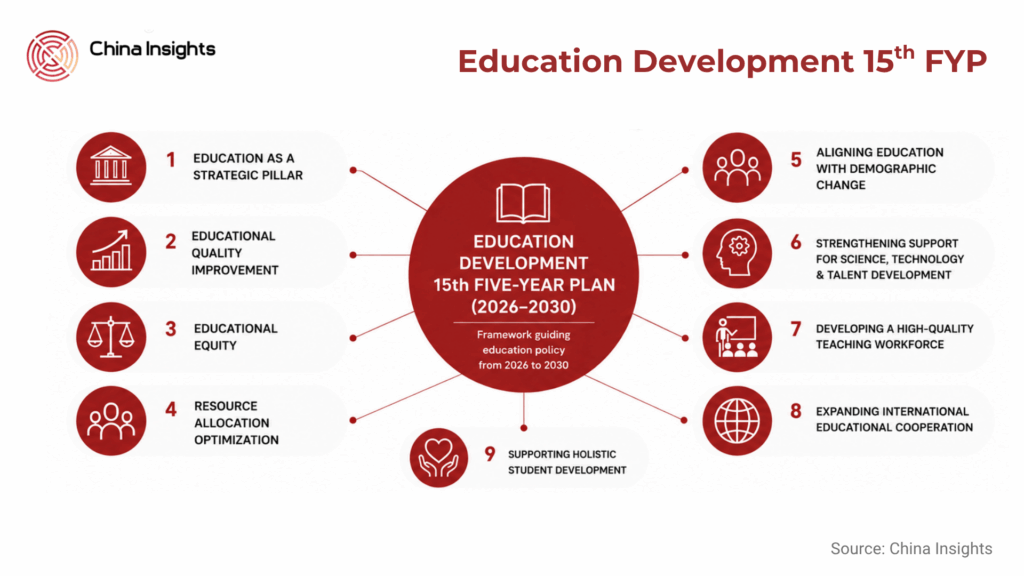
Education as a National Strategic Priority
The State Council meeting reaffirmed that education remains a fundamental pillar of national development. Chinese policymakers increasingly view educational advancement not only as a social objective but also as a critical component of economic competitiveness, technological innovation, and national rejuvenation.
During the 14th Five-Year Plan period, China expanded educational access and improved educational outcomes across multiple levels of the system. The government now intends to build upon these achievements by further strengthening educational quality and ensuring that educational development aligns with broader national priorities.
The approval of the new plan signals continued policy support and investment in the education sector, reflecting its importance within China’s long-term development strategy.
Entering a Critical Phase of Education Reform
Experts cited in official reporting describe the 15th Five-Year Plan period as a critical stage in China’s transition toward becoming a “strong education nation”.
While previous reforms focused heavily on expanding access and infrastructure, future efforts are expected to place greater emphasis on quality, effectiveness, and adaptability. The new planning period will likely focus on ensuring that educational outcomes better support economic modernization and societal needs.
The State Council highlighted the need for continued reform and innovation throughout the education system, indicating that structural adjustments will remain an important feature of future policy development.
This reflects a broader trend in China’s policymaking approach, where qualitative improvements are increasingly prioritized alongside quantitative expansion.
Promoting Educational Equity
A major theme of the approved plan is the promotion of educational fairness and equal access to quality educational resources.
Authorities emphasized the importance of improving public education services and ensuring that educational opportunities remain broadly accessible across different regions and demographic groups. Educational equity has long been a central objective of China’s education reforms, particularly as disparities between urban and rural areas have narrowed but not disappeared.
The government appears committed to further reducing inequalities in educational access while improving overall educational quality. This objective aligns with broader efforts to promote balanced regional development and inclusive social progress.
Educational equity is expected to remain a key benchmark for evaluating the success of reforms during the 15th Five-Year Plan period.
Aligning Education with Demographic Change
One of the most significant challenges facing China’s education system is the country’s changing demographic structure.
Declining birth rates and shifts in school-age population distribution are creating new requirements for educational planning and resource allocation. The State Council specifically called for improvements to mechanisms that allocate educational resources based on changes in the school-age population.
This suggests that authorities will increasingly focus on optimizing educational infrastructure, teacher distribution, and institutional planning to reflect evolving demographic realities.
More efficient resource allocation could help improve educational outcomes while ensuring the sustainability of public investment in the sector.
The emphasis on demographic adaptation demonstrates that educational planning is becoming increasingly integrated with broader social and economic policy considerations.
Strengthening Support for Science, Technology and Talent Development
A particularly important aspect of the plan is its focus on strengthening the role of education in supporting scientific and technological development.
The State Council emphasized that education should better support both technological innovation and talent cultivation. This reflects China’s broader objective of enhancing indigenous innovation capabilities and building a workforce capable of supporting advanced manufacturing, digital transformation, artificial intelligence, green technologies, and other strategic sectors.
Universities, vocational institutions, and research organizations are likely to play increasingly important roles in cultivating the highly skilled talent needed to support industrial upgrading.
The linkage between education and innovation policy has become increasingly prominent in recent years, and the new plan further reinforces this strategic connection.
Developing a High-Quality Teaching Workforce
Teacher development remains another major policy priority.
The State Council specifically highlighted the importance of cultivating high-level teaching personnel, recognizing that educational quality depends heavily on the quality of educators themselves.
Efforts to strengthen teacher training, professional development, and recruitment are expected to continue throughout the planning period. Improving teaching quality is viewed as essential for enhancing educational outcomes and supporting broader educational reform objectives.
Investment in human capital within the education system is likely to remain an important component of future policy implementation.
Expanding International Educational Cooperation
The approved plan also calls for expanding high-level international educational openness.
China has increasingly pursued international cooperation in higher education, academic research, talent exchange, and joint educational programs. The continuation of this policy direction suggests that international engagement will remain an important component of China’s educational development strategy.
Greater openness may create opportunities for cooperation between Chinese educational institutions and foreign universities, research centers, and training organizations.
International collaboration can also support talent development, research excellence, and knowledge exchange in strategically important fields.
Supporting Holistic Student Development
In addition to academic achievement, the State Council emphasized the importance of student health and comprehensive development.
Authorities called for the continued implementation of quality-oriented education and measures that promote healthy growth among students. This reflects an ongoing effort to balance academic performance with broader developmental objectives.
The emphasis on student well-being aligns with recent education reforms that have sought to reduce excessive academic pressure while improving the overall quality of education.
The government’s approach suggests a growing recognition that educational success should be measured by a broader set of outcomes than examination performance alone.
Education and Economic Development
The approval of the Education Development 15th Five-Year Plan highlights the increasingly close relationship between education policy and economic development strategy.
China’s leadership views education as a critical enabler of productivity growth, innovation capacity, and industrial competitiveness. As the economy becomes more technology-intensive, demand for highly skilled workers is expected to continue rising.
Educational reform therefore serves not only social objectives but also broader economic goals related to technological self-reliance, industrial modernization, and long-term competitiveness.
The plan’s focus on talent cultivation and innovation support reflects this strategic perspective.
What This Means for Business
The approval of the Education Development 15th Five-Year Plan provides valuable insight into China’s long-term talent and innovation priorities.
For businesses operating in China, particularly those in technology, advanced manufacturing, research and development, education services, and professional training, the policy signals continued government support for talent development and skills upgrading.
Companies may benefit from a growing pool of highly educated and technically skilled graduates as educational reforms increasingly align with industrial and technological priorities.
Organizations engaged in vocational training, executive education, research collaboration, and workforce development may also find new opportunities arising from the implementation of the plan.
Foreign universities, educational institutions, and training providers should closely monitor future implementation measures related to international educational cooperation, as these may create opportunities for partnerships with Chinese institutions.
More broadly, the plan demonstrates that education will remain a central pillar of China’s modernization strategy, serving as a key mechanism for supporting innovation, productivity growth, and long-term economic development.
Sources
Author
Dr. Richard van Ostende

Related Articles