
China's Revised Civil Aviation Law
On December 27, 2025, the 19th Session of the Standing Committee of the 14th National People’s Congress adopted a comprehensively revised Civil Aviation Law of the People’s Republic of China. The revised law, comprising 16 chapters and 262 articles, replaces the framework established in 1995 and represents the most systematic overhaul of Chinese civil aviation legislation in three decades. It takes effect on July 1, 2026.
The revision is not an update. It responds to structural changes in the industry: China’s commercial airports have more than doubled since 1995, annual passenger volumes have grown from roughly 51 million to approximately 770 million trips, and entirely new industries, commercial drones, urban air mobility, and the broader low-altitude economy, have emerged without any dedicated legal foundation. The revised law addresses all of these gaps simultaneously.
Executive Summary
The revised Civil Aviation Law takes effect July 1, 2026, and is the first comprehensive overhaul since the law’s enactment in 1995.
Drone and UAV operators must now obtain airworthiness certification from the Civil Aviation Administration of China (CAAC); manufacturers must assign unique product identification codes to each unit.
Low-altitude economy receives its first dedicated legal recognition, with a new article (Article 225) and an updated airspace division principle that formally accounts for low-altitude economic activity.
A new dedicated section on passenger rights has been added to the public air transport chapter, covering flight delay obligations, complaint handling, and data protection.
Aviation safety rules have been significantly expanded, with a detailed list of prohibited conduct on board and at airports, including the use of lasers near navigation aids.
Airport governance has been restructured, with transport airports and general aviation airports now governed under separate, dedicated sections.
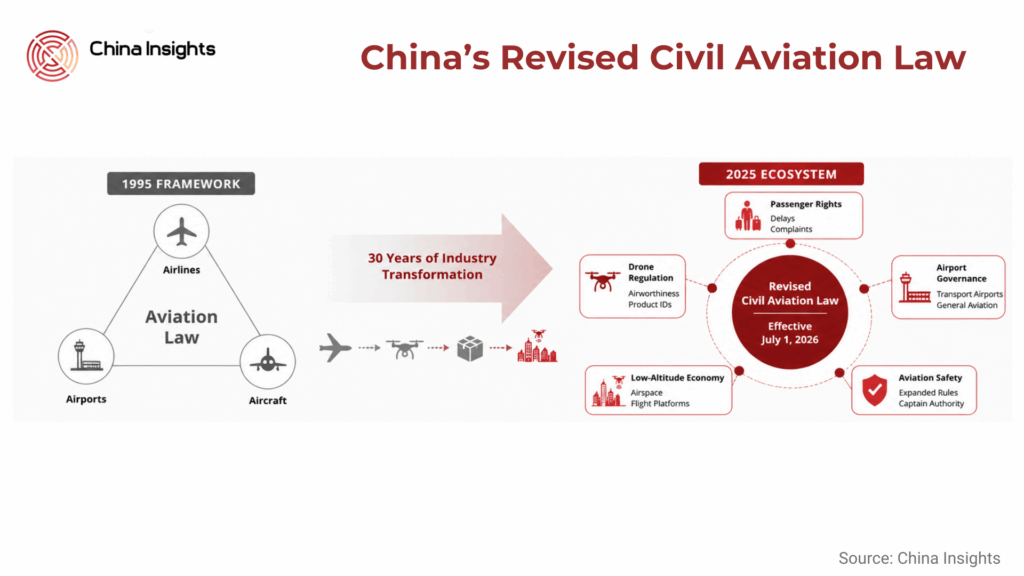
Towards an Legal Aviation Ecosystem
The original Civil Aviation Law was enacted in 1995, at a time when China had roughly 130 commercial airports and 51 million annual passengers. Between 1995 and 2025, the law underwent six partial revisions, mostly technical adjustments, none of which addressed the structural transformation of the industry. Drones did not exist as a regulated category. The low-altitude economy was not a policy concept. Passenger rights protections were minimal. The 2025 revision corrects all of this in a single legislative instrument.
The amendment process began in February 2025 with a first legislative review, followed by a second review in June 2025 and a third and final review in December 2025, at which the law was adopted. The Civil Aviation Administration of China (CAAC) and the Ministry of Transport were the primary drafting authorities.
Drone Regulation
The most significant structural addition to the revised law is a formal regulatory framework for civil unmanned aerial vehicles. The 1995 law contained no provisions for drones. The revised law closes that gap entirely.
Under the new framework, any entity engaged in the design, production, import, maintenance, or operation of civil drones is now required to obtain airworthiness certification from the CAAC, unless specifically exempted under national regulations. In addition, drone manufacturers are required to assign a unique product identification code to every unit produced, a traceability requirement with direct implications for production processes and record-keeping.
The practical scope of this change is significant. It directly affects major manufacturers as well as passenger drone producers and the growing ecosystem of logistics operators using drones for last-mile delivery. Airports are also now explicitly required to have counter-UAV capabilities, including detection and countermeasure equipment.
Low-Altitude Economy
China has been developing its low-altitude economy as a national strategic priority since at least 2021, when it was first included in the National Comprehensive Three-dimensional Transport Network Planning Outline. The revised Civil Aviation Law now gives this policy direction its first foundation in national legislation.
Notable are the principles governing airspace division to explicitly include the development needs of the low-altitude economy alongside civil aviation, national defense, and public interest as statutory factors. These principles establish a legal basis for allocating airspace in ways that accommodate commercial drone corridors, urban air mobility routes, and other low-altitude uses that previously had no standing in airspace planning decisions.
Moreover, new requirements of the state aim to optimize low-altitude airspace resource allocation, promote the establishment of regulatory and service platforms for civil low-altitude flight, and develop airworthiness certification and flight management standards suited to low-altitude economic activity. Both central government departments and provincial-level governments are tasked with formulating development plans and supportive policy measures for the sector.
Read more about the standardization of the low-altitude economy.
Passenger Rights
Prior to this revision, passenger protections were embedded within the broader public air transport chapter with limited specificity. The revised law introduces a standalone section on passenger rights within Chapter 6, marking a shift in legislative intent toward treating passengers as a protected category rather than simply parties to a transport contract.
The new provisions place explicit obligations on both airlines and airport operators. In the event of a flight delay or cancellation, carriers are required to issue timely and accurate information notices, explain the cause and flight status to passengers, and carry out ticketing changes and accommodation arrangements in accordance with regulations and contract terms. When large-scale delays occur, airport operators are specifically required to coordinate the orderly dispersal of passengers.
The revised law also introduces data protection obligations for airlines, ticketing agents, online sales platforms, and aviation information companies, requiring all parties to comply with personal data protection legislation. A new complaints handling obligation requires airlines, airports, and online platforms to publish complaint channels and respond to complaints within prescribed timeframes.
Aviation Safety
The revised law substantially expands the list of behaviors that are explicitly prohibited in and around civil aircraft and airports. It enumerates twelve categories of prohibited conduct, several of which are new additions compared to prior legislation.
Notable inclusions are the prohibition on using lasers or lights that affect the use of airport visual navigation aids. The article also explicitly bans spreading rumors about civil aviation safety, unauthorized opening of emergency exits, and the use of electronic cigarettes on board. The captain’s authority to take necessary control measures against disruptive passengers is reinforced, and passengers or crew who assist the captain in doing so are given explicit legal cover.
These changes reflect a broader trend: aviation safety legislation increasingly addresses human behavior on board as a distinct regulatory domain, rather than treating it solely as a matter of contract or criminal law.
Airport Governance
The prior law treated civil airports largely as a unified category. The revised law introduces a cleaner structural distinction between transport airports (those serving scheduled commercial air transport) and general aviation airports, dedicating separate legislative sections to each with distinct planning, construction, approval, and operational requirements.
For transport airports, planning authority is anchored at the national level, with provincial governments required to incorporate airport plans into their territorial spatial planning. For general aviation airports, provinces and municipalities take the lead in planning and construction, with a filing or permit requirement depending on whether the airport is open to the public. This tiered governance model reflects the scale of general aviation expansion anticipated under the low-altitude economy agenda.
What This Means for Business
Drone manufacturers and operators face the most immediate compliance burden.
The airworthiness certification requirement for UAV design, production, import, maintenance, and operation is new law, not existing practice extended.
Companies operating in China’s drone sector whether in manufacturing, logistics, agriculture, or inspection services need to assess their certification status against the new framework immediately.
The unique product identification code requirement adds a production-level traceability obligation that may require process and system changes.
Low-altitude economy investors and operators gain legal certainty they previously lacked.
The explicit inclusion of low-altitude economic needs in airspace division principles and the mandate for dedicated regulatory platforms give investors a statutory foundation for commercial planning.
The implementing regulations required under Article 225 have not yet been issued, and the practical airspace allocation changes will depend heavily on how those regulations are drafted.
Monitoring CAAC rulemaking activity closely is essential.
Airlines and airport operators need to review their passenger rights compliance frameworks against the new dedicated section.
The obligations around delay notifications, complaint handling timelines, data protection, and family assistance plans for accidents are now statutory requirements with penalty exposure, not just service commitments.
Foreign carriers operating in China are equally subject to these requirements and are additionally required to publish Chinese-language general conditions of carriage and designate Chinese-language complaint handling capacity (Article 205).
General aviation enterprises benefit from an expanded scope of permitted activities, including the ability to engage in certain scheduled transport services.
This creates new business model options but also brings those operations within the compliance requirements applicable to public air transport enterprises.
In aggregate, the revised Civil Aviation Law shifts China’s aviation regulatory environment from a framework built for a 1990s industry toward one designed for the realities of 2025 and beyond. The law is now in effect as of July 1, 2026. Businesses operating in China’s civil aviation sector should treat compliance as an immediate operational priority.
Sources
http://lawdb.cncourt.org/show.php?fid=158209
http://www.caac.gov.cn/English/News/202503/t20250306_226881.html
http://en.moj.gov.cn/2025-12/30/c_1151392.htm
http://en.npc.gov.cn.cdurl.cn/2025-12/29/c_1151037.htm
Author
Dr. Richard van Ostende

Related Articles