
China Establishes Policy Framework to Expand Low-Altitude Insurance Market
On 12 February 2026, the National Development and Reform Commission, National Financial Regulatory Administration, and Civil Aviation Administration of China released the “Implementation Opinions on Promoting High-Quality Development of Low-Altitude Insurance” (Document No. Development and Reform Low Aviation [2026] No. 123).
The policy defines low-altitude insurance as risk protection covering low-altitude flight activities, including low-altitude aircraft manufacturing and operations, infrastructure construction, and related professional services. It positions insurance as a supporting mechanism for establishing a safer and more sustainable low-altitude economy.
China’s evolving low-altitude policy framework signals a transition toward greater regulatory formalization, with insurance expected to become a key component of operational compliance and industry development. International companies should monitor upcoming implementation measures and assess opportunities arising from new market requirements.
Executive Summary
China has introduced a policy framework to develop a dedicated low-altitude insurance system supporting the growth of the low-altitude economy.
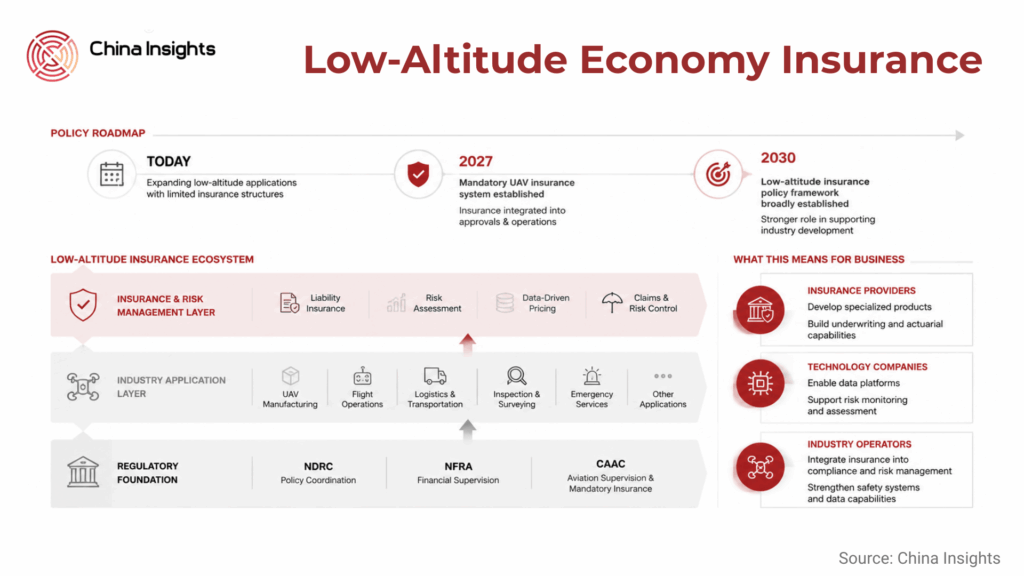
The document sets a target to establish a preliminary mandatory insurance system for unmanned aerial vehicle (UAV) liability insurance by 2027 and a broader low-altitude insurance policy framework by 2030.
The policy encourages insurers to develop products covering aircraft manufacturing, operations, infrastructure, data security, safety management, and sector-specific applications.
The new framework is expected to create new market opportunities for insurers, UAV manufacturers, operators, technology providers, and risk management service companies.

Establishment of Mandatory UAV Insurance System
The policy requires relevant departments to strengthen full-chain management of UAV insurance. For aircraft subject to mandatory insurance requirements, insurance verification will become part of flight activity approvals and operational supervision. Authorities will also develop implementation measures defining liability scope, minimum coverage requirements, and related procedures.
The timeline indicates that China expects the mandatory UAV insurance system to be initially established by 2027. By 2030, policymakers aim to have a more comprehensive low-altitude insurance policy framework supporting industry development.
Expansion of Insurance Product Coverage
The policy encourages insurance companies to expand coverage across the entire low-altitude industry value chain. This includes research and development, aircraft manufacturing, flight operations, infrastructure support, and related services.
The authorities identify several emerging risk areas for insurance innovation, including flight safety, technical security, network and data security, environmental risks, facility safety, and human operation risks. Insurers are encouraged to develop products tailored to different application scenarios rather than relying on standard aviation insurance models.
The policy also highlights the need to improve insurance solutions for medium and large unmanned aircraft while continuing to strengthen protection for traditional manned aviation activities. Export credit insurance, product liability insurance, and reinsurance services are identified as tools to support international expansion of low-altitude industries.
Scenario-Based Insurance Development
China’s approach emphasizes application-specific insurance solutions. The policy identifies multiple low-altitude use cases requiring targeted protection, including agricultural and forestry operations, inspection services, surveying and mapping, logistics, transportation, urban governance, emergency response, medical rescue, tourism, and aviation sports.
This approach reflects the diverse risk profiles within the low-altitude economy. For example, logistics operators may require coverage related to operational interruption and third-party liability, while infrastructure inspection providers may require protection against equipment failure and service disruption.
Insurance providers will need stronger industry knowledge and data capabilities to price risks accurately across different operational environments.
Data Infrastructure and Risk Management Development
The policy places significant emphasis on data infrastructure as a foundation for insurance market development. Authorities call for the construction of low-altitude insurance information platforms and improved data standards to support actuarial pricing and risk monitoring.
The policy encourages integration between insurance information systems and low-altitude intelligent connected systems. Relevant data may include insurance records, flight operations, enterprise credit information, illegal flight records, geographic information, weather conditions, and electromagnetic risk factors.

Regulatory Coordination and Market Supervision
The policy establishes a coordinated regulatory structure involving the NDRC, NFRA, and CAAC. The NDRC will coordinate implementation and policy alignment. The CAAC will oversee aviation-related insurance supervision and lead the establishment of mandatory UAV liability insurance requirements. The NFRA will supervise insurance business operations and market conduct.
The authorities also emphasize commercial sustainability and risk control. Insurance companies are expected to strengthen internal controls, assess business risks carefully, and expand low-altitude insurance activities in an orderly manner.
This indicates that regulators intend to encourage market growth while preventing excessive risk accumulation during the early development stage of the sector.
Implications for Industry Participants
The development of a formal low-altitude insurance framework will influence multiple parts of the emerging low-altitude economy ecosystem.
For insurance companies, the policy creates a new business segment requiring specialized underwriting capabilities, actuarial models, and technical expertise. Partnerships with UAV manufacturers, operators, and technology providers are likely to become increasingly important.
For UAV manufacturers and operators, insurance will become a more important element of compliance, operational risk management, and commercial credibility. Companies with stronger safety management systems and better operational data may gain advantages in insurance access and pricing.
For technology providers, opportunities may emerge in areas such as flight data platforms, risk monitoring systems, artificial intelligence-based assessment tools, and digital insurance services.
What this means for business
China’s low-altitude insurance policy marks an important step toward formalizing risk management in the country’s emerging low-altitude economy.
Businesses involved in UAV manufacturing, aviation services, logistics, infrastructure, and insurance should prepare for a more structured regulatory environment. Companies should assess future insurance obligations, strengthen operational data capabilities, and explore partnerships with insurers and technology providers.
The market is likely to move from fragmented insurance offerings toward a broader ecosystem combining insurance, aviation regulation, operational data, and safety management. Businesses that build capabilities in risk assessment and compliance management will be better positioned as China’s low-altitude economy expands.
Sources
https://www.caac.gov.cn/XXGK/XXGK/ZCJD/202602/t20260212_230053.html
https://www.caac.gov.cn/XXGK/XXGK/ZCFB/202602/t20260212_230056.html
Author
Dr. Richard van Ostende

Related Articles