
China Proposes Mandatory National Safety Standard for L3 and L4 Autonomous Driving Systems
China is moving another step towards the commercialization of autonomous driving. In February 2026, , the Ministry of Industry and Information Technology (MIIT) published the Mandatory National Standard “Safety Requirements for Automated Driving Systems” (Draft for Public Consultation). The draft establishes China’s first comprehensive mandatory safety framework for Level 3 (L3) and Level 4 (L4) automated driving systems (ADS).
Rather than introducing a single technical requirement, the draft creates a comprehensive regulatory framework covering vehicle manufacturers, automated driving system performance, testing procedures and safety management throughout the vehicle lifecycle. The proposal also aligns China’s domestic regulatory framework with the ongoing development of the United Nations Automated Driving System Global Technical Regulation (ADS GTR).
Executive Summary
China proposes its first mandatory national safety standard covering both L3 and L4 automated driving systems.
The draft introduces requirements covering manufacturers, automated driving systems, testing, safety documentation and lifecycle safety management.
Vehicle manufacturers will be required to establish comprehensive Safety Management Systems (SMS) and demonstrate compliance through simulation, closed-course and public road testing.
The framework is designed to support large-scale commercialization while improving road safety and regulatory consistency.
The proposal further aligns China’s autonomous driving regulations with international standards under the UN ADS GTR.
Supporting the Commercialization of Autonomous Driving
China has steadily expanded pilot programs for intelligent connected vehicles in recent years. Authorities have already approved selected L3 autonomous vehicles for market access under pilot programs, signaling a gradual transition from technology demonstration towards commercial deployment.
The proposed mandatory standard represents the next stage of this process. Rather than regulating individual pilot projects, it establishes a unified national safety framework that manufacturers will ultimately need to satisfy before bringing L3 and L4 automated driving systems to market.
A Comprehensive Safety Framework
Unlike earlier guidance documents that focused primarily on technical functionality, the draft addresses autonomous driving from both an organizational and product perspective.
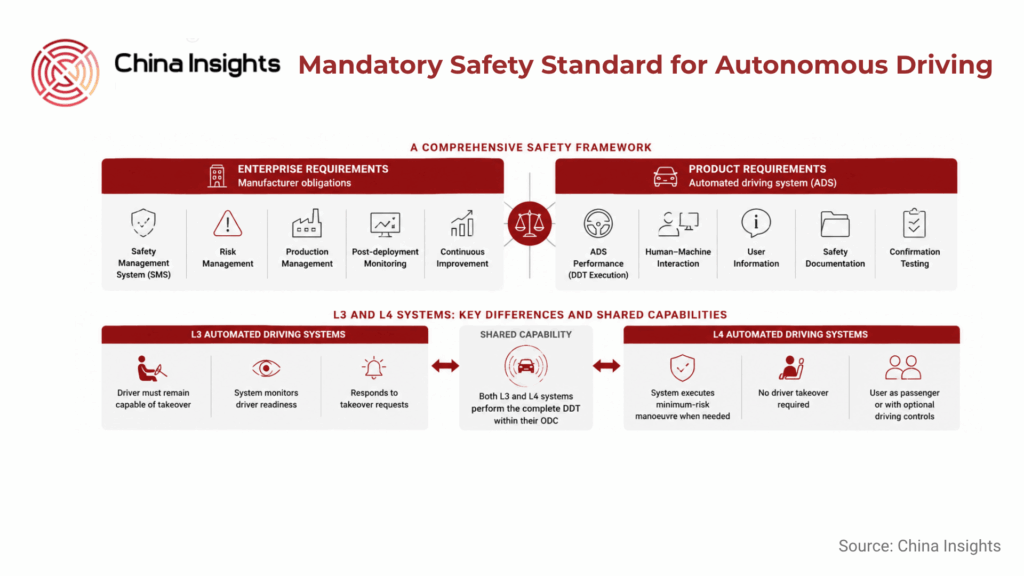
At the enterprise level, manufacturers are expected to establish comprehensive Safety Management Systems (SMS), covering risk management, safety governance, production management, post-deployment monitoring and continuous improvement throughout the vehicle lifecycle.
At the product level, the draft specifies requirements for automated driving system performance, human-machine interaction, user information, safety documentation, and confirmation testing. Compliance will be assessed through a structured inspection framework that includes documentation reviews together with simulation, closed-course, and public road testing.
Clear Safety Expectations for L3 and L4 Systems
The draft also clarifies the expected capabilities of different levels of vehicle automation.
For L3 automated driving systems, drivers must remain capable of taking back control whenever the system issues a takeover request. Consequently, manufacturers must incorporate continuous monitoring of driver readiness and appropriate human-machine interaction strategies.
For L4 systems, the automated driving system assumes greater responsibility. Where necessary, the system must automatically execute a minimum-risk maneuver without requiring driver intervention. Depending on vehicle design, users may either retain manual driving controls or act solely as passengers.
Despite these differences, both L3 and L4 systems must be capable of continuously performing the complete Dynamic Driving Task (DDT) while operating within their Operational Design Conditions (ODC).
Raising the Bar for Safety Verification
A notable feature of the proposal is its emphasis on evidence-based safety verification. Manufacturers will need to demonstrate not only that automated driving systems perform safely under normal operating conditions but also that they can respond appropriately to hazardous situations, system failures, and scenarios outside the vehicle’s operational design conditions.
The standard therefore combines technical performance requirements with extensive documentation, safety evidence, and multiple forms of testing.
What this means for business
The draft mandatory standard marks China’s transition from pilot programs to a comprehensive regulatory framework for autonomous driving. Rather than focusing solely on vehicle performance, the proposal introduces lifecycle safety management requirements that extend across product development, manufacturing, testing and post-deployment monitoring.
For vehicle manufacturers, compliance will increasingly depend on demonstrating robust organizational governance alongside technical capability. Companies developing L3 and L4 automated driving systems should prepare for more comprehensive documentation, stronger safety management processes, and expanded verification requirements.
More broadly, the draft provides greater regulatory certainty for the automotive industry. Although still subject to public consultation, it offers a clear indication of the direction of China’s autonomous driving policy and the compliance expectations likely to accompany future commercial deployment.
Source
https://wap.miit.gov.cn/zwgk/zcjd/art/2026/art_c1f44b5caef44d9ca3fadd6bd3844f88.html
Author
Dr. Richard van Ostende

Related Articles