
China Establishes Infrastructure Framework to Support Low-Altitude Economy Development
China is strengthening the foundation to develop its low-altitude economy by improving the information and communication infrastructure required for large-scale low-altitude operations. On February 3, 2026, the General Office of the Ministry of Industry and Information Technology (MIIT)issued the “Implementation Opinions on Strengthening Capacity Building in the Information and Communication Industry to Support the Development of Low-Altitude Infrastructure” (MIIT Joint Communication [2026] No. 4).
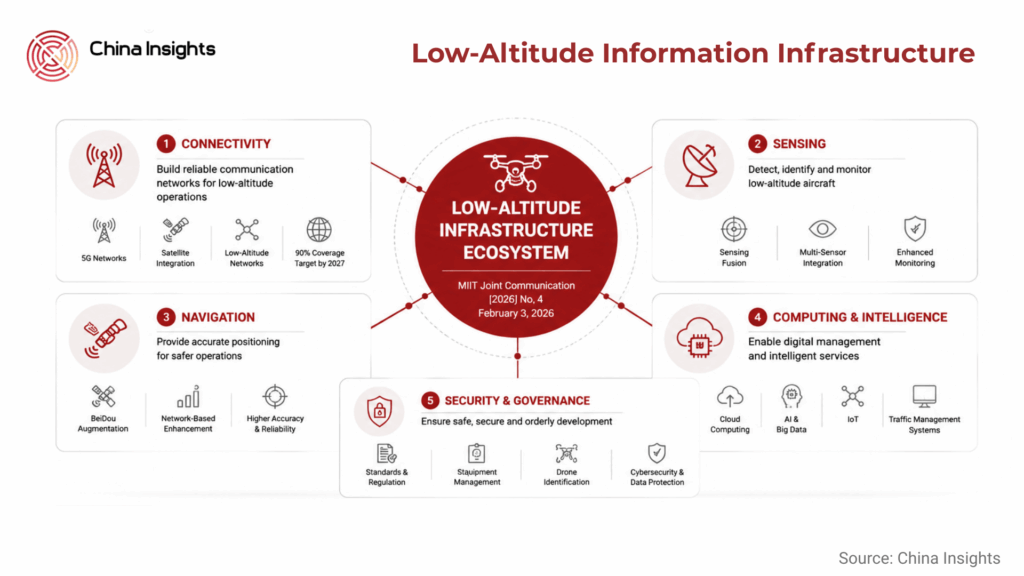
The policy identifies information and communication infrastructure as a critical foundation for low-altitude economic development. It sets priorities for communication networks, sensing capabilities, navigation services, intelligent connected systems, industrial supply capacity, standardization, and security management.
Executive Summary
China is establishing an information infrastructure framework to support the expansion of low-altitude applications.
The policy prioritizes communication networks, sensing systems, navigation capabilities, and intelligent connected platforms.
Existing 5G infrastructure will be leveraged, while dedicated low-altitude networks and satellite communication integration will be explored.
China aims to achieve at least 90% ground mobile communication network coverage for national low-altitude public air routes by 2027.
Standardization, cybersecurity, data protection, and regulatory systems will become key components of future low-altitude infrastructure development.

Communication Infrastructure Becomes a Core Development Priority
Reliable connectivity is becoming a fundamental requirement for low-altitude operations. Low-altitude air routes below 300 meters, including Class G and W airspace, are identified as priority areas for network capability enhancement.
Existing public mobile communication infrastructure, particularly 5G networks, will provide the foundation for low-altitude applications. Telecommunications operators are expected to upgrade network capabilities and expand coverage based on operational requirements.
Where additional capabilities are required, dedicated low-altitude networks may be developed. Satellite communication will complement terrestrial networks to support operations in higher-altitude areas and remote regions.
By 2027, China aims to achieve no less than 90% ground mobile communication network coverage across national low-altitude public air routes. This target demonstrates that network availability is being treated as a prerequisite for broader low-altitude deployment.
Communication, Sensing and Navigation Form the Technical Foundation
Low-altitude operations require reliable identification, monitoring, and positioning capabilities. China is therefore developing infrastructure that combines communication networks with sensing and navigation technologies.
For key areas such as large event venues, military facilities, and critical infrastructure, sensing fusion technologies will be explored to improve detection and recognition of low-altitude aircraft. These capabilities will integrate technologies including radar, electro-optical sensing systems, and other recognition solutions.
Navigation accuracy will be improved through greater use of the BeiDou ground-based augmentation system and public service platform. Positioning enhancement information will be transmitted through 5G and other mobile communication networks to improve aircraft positioning speed and accuracy.
The combination of connectivity, sensing, and navigation capabilities provides the foundation for safer and more coordinated low-altitude operations.
Intelligent Systems Expand the Digital Infrastructure Layer
China’s low-altitude infrastructure strategy also includes the development of intelligent connected systems supported by digital technologies.
Artificial intelligence, cloud computing, big data, and the Internet of Things will support low-altitude management and operational services. Telecommunications companies are expected to strengthen cooperation with air traffic management authorities and other stakeholders to develop digital systems related to low-altitude traffic management.
Computing infrastructure will also become an important supporting capability. Improving public computing power interconnection will provide flexible computing resources for low-altitude management services and digital applications.

Industrial Development Focuses on Technology Integration
Strengthening industrial supply capacity is a key priority. Development areas include 5G-A technology, sensing integration, and equipment innovation.
Closer cooperation between low-altitude equipment manufacturers and information and communication companies is expected to accelerate technology integration. Areas of focus include compatibility testing between 5G and 5G RedCap modules and low-altitude aircraft.
The development of integrated communication, navigation, and surveillance modules will support greater technology maturity and improve the industrial foundation for low-altitude applications.
Standards and Security Will Shape Market Participation
Standardization will become an important foundation for China’s low-altitude technology ecosystem. Future standards will cover key technologies, testing procedures, and construction specifications.
Regulatory development will also focus on telecom service access, equipment management, service supervision, inter connectivity, emergency communication, and data security.
Drone identification capabilities are expected to improve through mechanisms such as “one machine, one code, one number,” supporting more refined management of drone communication resources.
Cybersecurity and data protection requirements will remain central. Priorities include network protection, data classification, security monitoring, risk assessment, and emergency response capabilities.
Technology Validation Supports Market Development
China is supporting experimental validation to accelerate the development and application of low-altitude infrastructure solutions.
Testing activities will focus on network coordination, equipment integration, sensing capabilities, and related technologies. Through initiatives such as the “Bloom Cup” competition and case collection activities, the government aims to identify and promote practical examples of information infrastructure development.
What this means for business
China’s latest low-altitude infrastructure framework signals that future growth will depend on more than aircraft development. The market will require a supporting digital foundation built around connectivity, sensing, navigation, computing, and security systems.
The emerging ecosystem creates opportunities for companies providing communication infrastructure, network equipment, sensing technologies, navigation solutions, intelligent platforms, and security capabilities.
Simultaneously, participation will increasingly depend on compliance with Chinese technical standards, regulatory requirements, and ecosystem integration.
For international companies, the key consideration is that China’s low-altitude economy is being developed as an integrated infrastructure market. Competitive positioning will depend not only on individual technologies but also on the ability to connect with the broader ecosystem.
Source
https://wap.miit.gov.cn/zwgk/zcwj/wjfb/yj/art/2026/art_d1cb1667897e4c999a303d110b6691dc.html
Author
Dr. Richard van Ostende

Related Articles