
China Extends Zero-Tariff Access to All 53 African Partners
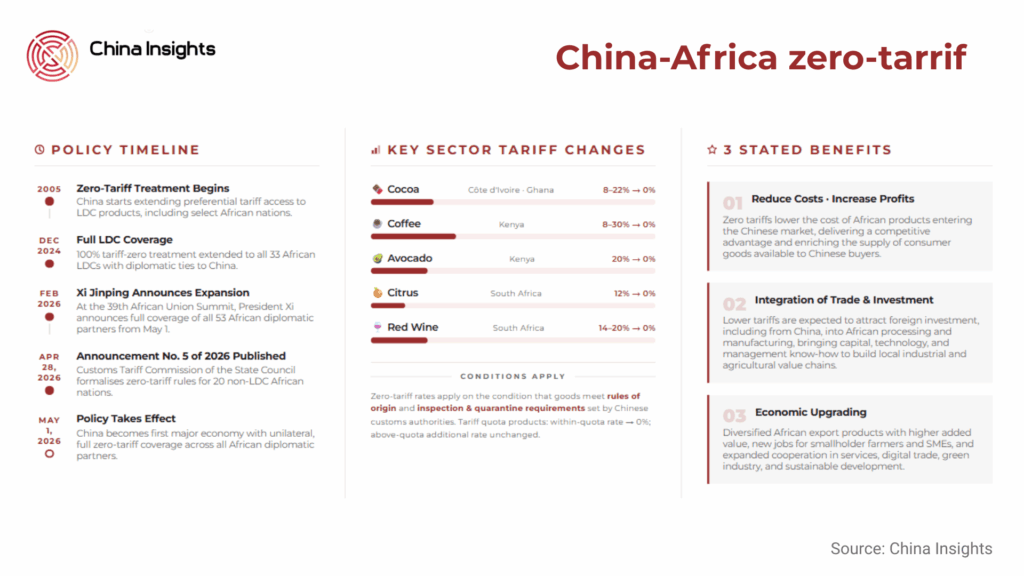
On April 28, 2026, the Customs Tariff Commission of the State Council of the People’s Republic of China issued Announcement No. 5 of 2026, formally extending zero-tariff treatment to 20 African countries not classified as Least Developed Countries (LDCs). Combined with zero-tariff access already granted to 33 African LDCs from December 1, 2024, the measure brings China’s full-coverage zero-tariff policy to all 53 African nations with which it holds diplomatic relations, effective May 1, 2026.
The extension of zero-tariff treatment to all African partner countries marks a notable shift in the operating environment for Africa-China trade. For businesses involved in sourcing, manufacturing, logistics, market-entry, or Africa-based processing operations, the policy expands duty-free access to the Chinese market and may improve the economics of cross-border trade and investment. However, with the arrangement currently scheduled to expire in April 2028, companies should assess both the immediate commercial opportunities and the regulatory uncertainties associated with its two-year timeframe.
Executive Summary
The Customs Tariff Commission of the State Council published Announcement No. 5 of 2026 on April 28, 2026, extending zero tariffs to 20 non-LDC African countries from May 1, 2026 to April 30, 2028.
The 20 newly covered non-LDC countries include Algeria, Botswana, Cape Verde, Cameroon, Congo (Brazzaville), Côte d’Ivoire, Egypt, Equatorial Guinea, Gabon, Ghana, Kenya, Libya, Mauritius, Morocco, Namibia, Nigeria, Seychelles, South Africa, Tunisia, and Zimbabwe.
Tariff quota products receive zero tariffs within-quota only. Additional tariff rates remain unchanged.
The current zero-tariff arrangement is valid for two years and contingent on progress toward bilateral Economic Partnership Agreements for Common Development.
Sectoral beneficiaries include cocoa, coffee, avocado, citrus, and wine, with previous tariffs ranging from 8% to 30% now eliminated.
The policy aligns with commitments announced at the Forum on China-Africa Cooperation (FOCAC) and President Xi Jinping’s February 14, 2026 address to the 39th African Union Summit.
A Policy Two Decades in the Making
China’s preferential tariff engagement with Africa did not emerge overnight. Since 2005, China has progressively extended zero-tariff treatment to products from the world’s least developed countries, with product coverage widening through each successive round of trade opening. The most significant prior step came on December 1, 2024, when China granted 100% tariff-zero treatment to all 33 African LDCs with which it maintains diplomatic relations. The May 2026 measure closes the remaining gap by incorporating the 20 non-LDC African economies, completing what Chinese authorities describe as a full-coverage, unilateral commitment.
The policy carries explicit political backing at the highest level. On February 14, 2026, President Xi Jinping referenced the upcoming zero-tariff expansion in his congratulatory message to the 39th African Union Summit, framing it as part of a broader agenda to build what Beijing terms an “all-weather China-Africa community with a shared future.” The Ministry of Commerce and the Customs Tariff Commission subsequently moved quickly to publish the implementing regulations, underscoring the political priority attached to the initiative.
Scope, Duration, and Limitations
The announcement issued by the Customs Tariff Commission sets the operative parameters. The zero-tariff regime for the 20 non-LDC African nations runs within a two-year window. China’s World Trade Department at the Ministry of Commerce confirmed that this interim period serves a specific purpose: to give relevant African countries sufficient runway to complete negotiations toward bilateral Economic Partnership Agreements for Common Development, which would establish long-term, institutionalized tariff certainty under WTO-compliant frameworks.
For products subject to tariff rate quotas, only the within-quota tariff rate drops to zero. Additional tariff rates on above-quota volumes remain unchanged. This distinction matters particularly for commodities such as sugar, cotton, and certain grains where quota regimes apply. Importers and exporters will need to verify product-specific classifications against the country-by-country tariff rate tables published in the Annex to the Announcement on the Ministry of Finance website.
Immediate Beneficiaries Across Key Commodities
The Ministry of Commerce provided specific examples of the tariff reductions that take effect from May 1. Cocoa from Côte d’Ivoire and Ghana previously attracted tariffs between 8% and 22%. Coffee and avocado from Kenya faced import duties of 8% to 30% and 20% respectively. South African citrus carried a 12% tariff, while South African red wine faced rates between 14% and 20%. All of these product categories now enter the Chinese market tariff-free, provided they meet applicable rules of origin and inspection and quarantine requirements.
Beyond agricultural commodities, Chinese authorities highlight the potential for the policy to catalyze investment flows into African processing and manufacturing capacity. When zero tariffs apply to finished or semi-processed goods, they create an incentive for businesses, including Chinese firms, to locate production inside Africa and export to China rather than exporting raw materials for processing elsewhere. This dynamic, if it materializes at scale, could support the development of African industrial value chains rather than simply amplifying commodity exports.
Positioning in a Shifting Global Trade Environment
The timing of this measure is deliberate. Chinese authorities have been explicit that the policy responds to a global environment characterized by rising unilateralism and protectionism. In this context, Beijing positions itself as a counterweight. China aims to offer expanded market access at a moment when other major economies face internal pressures to restrict trade.
The African Union’s own strategic interests intersect with this agenda. At the 9th China–African Union Strategic Dialogue held in Addis Ababa in January this year, AU Commission Chairperson Mahmoud Ali Youssouf and Chinese Foreign Minister Wang Yi discussed alignment between China’s 15th Five-Year Plan and the AU’s Second Ten-Year Implementation Plan of Agenda 2063. The African Continental Free Trade Area (AfCFTA) also featured prominently in discussions, suggesting that both sides see the zero-tariff arrangement as one component of a broader framework for deepening institutional cooperation. The year 2026 also marks the 70th anniversary of the establishment of China-Africa diplomatic relations, lending additional symbolic weight to the rollout.
Conditions for Long-Term Certainty
The two-year time horizon built into the announcement makes clear that the current arrangement is transitory. For zero-tariff access to become permanent and institutionalized, individual African countries will need to complete negotiations on Economic Partnership Agreements for Common Development with China. These agreements, according to the Ministry of Commerce, would address not only tariff schedules but also non-tariff barriers, trade facilitation standards, and investment provisions. Countries that progress most quickly through negotiations stand to gain the greatest long-term predictability.
For African governments, the implication is that securing durable access to the Chinese market requires substantive engagement in the bilateral agreement process. For businesses operating across multiple African jurisdictions, this creates a differentiated regulatory landscape that will evolve country by country over the next two years.
What This Means for Business
The extension of zero-tariff treatment to all 53 African countries reshapes the cost structure of Africa-China trade, but how much of that potential translates into commercial reality will depend on how businesses navigate a set of structural conditions.
African exporters of previously tariffed goods enter the Chinese market on more favorable terms than competing origin countries that still face tariffs, though only where rules of origin and inspection and quarantine requirements are met. Zero-tariff access is conditional, not automatic.
The case for Africa-based processing and manufacturing strengthens when finished goods enter China duty-free. This opens opportunities in agri-processing, logistics, and light manufacturing. For quota-regulated products, however, only within-quota volumes benefit; above-quota rates remain unchanged.
The two-year time horizon is the central planning challenge. The arrangement runs until April 30, 2028, with continuity contingent on bilateral Economic Partnership Agreement negotiations whose timelines differ country by country. Therefore, creating an uneven regulatory landscape that is too uncertain for major capital commitments, but significant enough to warrant serious strategic preparation.
Sources
https://gss.mof.gov.cn/gzdt/zhengcejiedu/202604/t20260428_3988618.htm
https://www.fmprc.gov.cn/eng/wjbzhd/202601/t20260112_11811302.html
https://english.www.gov.cn/news/202604/28/content_WS69f0a1d7c6d00ca5f9a0aad0.html
Author
Dr. Richard van Ostende

Related Articles