
China Implements New Approval Rules for Government Investment Projects
Mid April, 2026, China’s State Council published the Opinion on Deepening the Reform of the Investment Approval System (国务院办公厅关于深化投资审批制度改革的意见, Document No. 国办发〔2026〕13号, dated April 8, 2026). The document sets out how going forward investment projects, both government-funded and enterprise-led, are reviewed, approved, and monitored.
Executive Summary
- Government investment projects now face stricter, mandatory review steps that cannot be skipped or worked around. Furthermore, decision-makers on public projects can be held personally liable.
- The list of enterprise projects requiring state approval will be updated more regularly, and regulators gain new powers to temporarily freeze approvals in overheated industries. Moreover, projects banned by the state will be cut off from land, energy, water, environmental permits, and financing all at once.
- A unified online platform will handle more approvals in one place, with better data sharing across agencies.
- Supervision is clarified: whoever approves a project is responsible for overseeing it. A new evaluation framework will track project performance across its full lifespan.
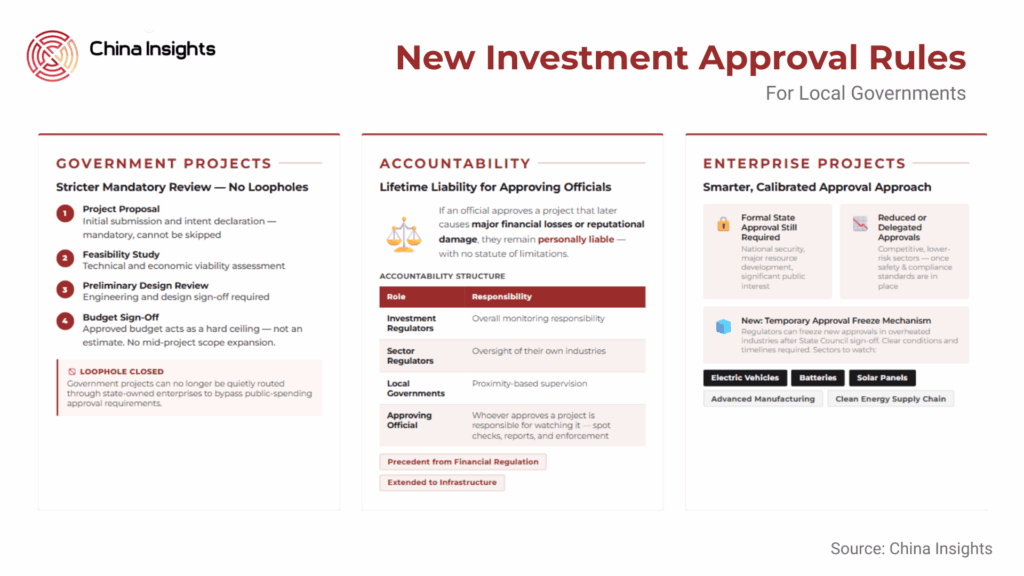
Government Projects Get Stricter Rules
Beijing is closing a loophole that has been widely used at the local level. In the past, some government-funded projects were quietly routed through state-owned enterprises and filed as corporate investments, herewith skipping the more rigorous approval process that applies to public spending. That is now explicitly banned.
Going forward, all government investment projects must obtain approval for the project proposal, the feasibility study, the preliminary design review, and budget. Once a budget is approved, it acts as a hard ceiling, not an estimate.
The most significant new measure is a lifetime accountability rule. If an official approves a project that later causes major financial losses or reputational damage, the official remains personally liable. This kind of rule already exists in financial regulation in China, and by extending it to infrastructure investment, a clear signal is given that China wants to discourage prestige projects with weak economic foundations.
A Smarter Approach to Enterprise Project Approvals
For businesses, the changes are more nuanced. Projects touching national security, major resource development, or significant public interests still require formal state approval.
What is new is the calibration around other sectors. Industries that are competitive and of lower risk should see approval requirements reduced or delegated, but only once clear standards for safety, technical compliance, and industrial policy are in place first.
There is also a new emergency tool. Regulators can now temporarily freeze new project approvals in sectors experiencing severe overcapacity after obtaining State Council sign-off. The conditions and timelines must be clearly defined. Industries like electric vehicles, batteries, and solar panels, where overcapacity has been a recurring concern, will likely watch this mechanism closely.
Moreover, if a project is prohibited by the state, land rights, energy quotas, water allocations, environmental approvals, and financing will be denied everything at once. Previously, projects in grey zones could sometimes secure individual permits even when the overall project was questionable. That gap is now closed.
One Platform, Less Paperwork
The approval process itself is more streamlined via a single online platform that handles land use, marine use, forestry, grassland, and cultural heritage reviews together, rather than sending applicants to multiple agencies in sequence.
Parallel reviews within the same agency will be be merged into a single approval item. Local governments must fix the circular dependencies that have long frustrated project developers, where approval A requires approval B, which in turn requires approval A.
On the technical side, no new standalone IT systems for investment management will be allowed. Every system in use must plug into the existing national platform. A universal project code will link approval records, construction updates, and payment information across agencies, making it easier to track a project’s full history in one place.
Clearer Lines of Accountability
The Opinion clarify responsibility. Investment regulators carry overall monitoring responsibility. Sector regulators oversee their own industries, and local governments handle proximity-based supervision.
The guiding principle is simple: whoever approves a project is responsible for watching it. Regulators will conduct spot checks, publish supervision reports, and pursue cases of illegal approvals or construction that deviates from approved plans. Monitoring data will be shared across agencies to reduce the duplication of inspections, which has historically added an unnecessary burden for developers.
Performance Tracking and New Financing Options
Two forward-looking elements round out the directive.
- A new evaluation framework will assess investment projects against economic, social, environmental, and safety outcomes across the full project lifecycle, not just at completion. Results from post-project reviews will feed back into future planning and investment decisions.
- The opinion opens up financing options for commercial infrastructure. It encourages equity-based funding channels and specifically endorses Real Estate Investment Trusts (REITs) as a way to recycle capital from completed assets. A national investment and financing service platform is also planned, designed to connect project developers with funding sources more efficiently.
What This Means for Business
The stricter controls on government projects may make some public procurement decisions slower in the short term, since officials will act more cautious due to personal liability. For contractors already working on public projects, tighter budget rules should mean fewer mid-project scope expansions and cost surprises.
The temporary approval freeze mechanism is worth monitoring. Especially in sectors already flagged for overcapacity, such as clean energy supply chain, advanced manufacturing, there might be a need for contingency time for possible approval suspension.
The integrated resource denial policy removes the regulatory grey zone that some projects previously exploited. A project that is not approved will now be blocked at every resource stage simultaneously.
The single-window platform and merged review processes should cut the administrative workload for businesses going through approvals. For foreign investors in particular, the clearer accountability structure and standardized procedures reduce one of the most common friction points: not knowing who is actually responsible for a decision.
Finally, the REIT endorsement and the planned financing platform are important. For companies with operational infrastructure assets, the conditions for monetizing those assets and recycling capital look set to improve.
Source https://www.gov.cn/zhengce/content/2026-04/15/content_7026028.htm
Author
Dr. Richard van Ostende

Related Articles