
China’s High-Tech Sector Attracts Strong Foreign Investment Growth in Early 2026
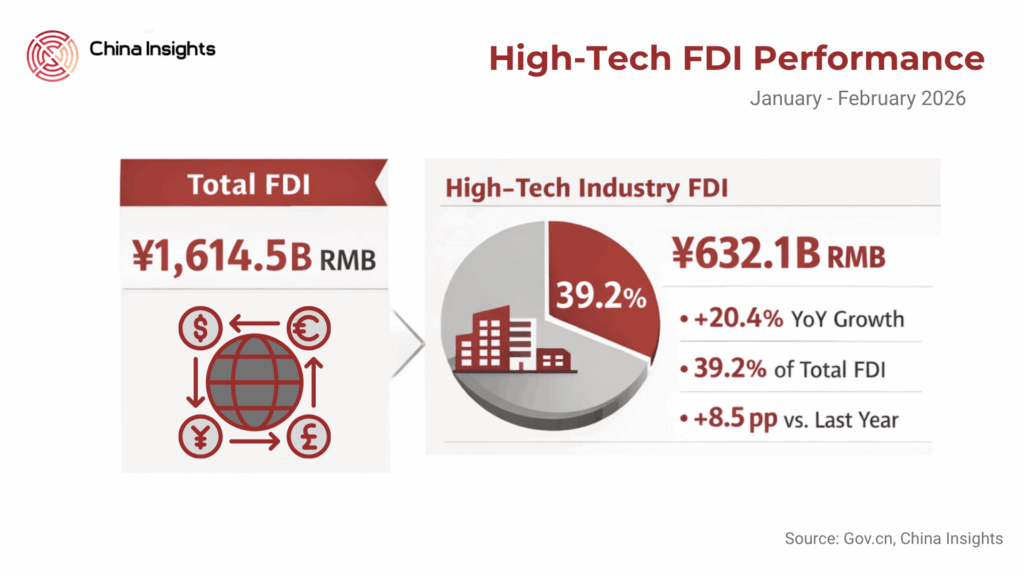
China’s foreign direct investment (FDI) landscape is showing renewed momentum in high-value sectors. According to a recent update published on the Chinese government portal, the country’s high-technology industries recorded a 20.4% year-on-year increase in actual use of foreign investment during the first two months of 2026. This development highlights a continued structural shift in China’s investment profile, from traditional manufacturing toward innovation-driven and technology-intensive industries. The data reflects both the impact of targeted policy support and the strategic recalibration of foreign investors seeking exposure to China’s advanced industrial ecosystem.
Executive Summary
- China’s high-tech industries saw a 20.4% year-on-year increase in actual FDI in the first two months of 2026.
- Growth reflects policy prioritization of advanced manufacturing, digital economy, and green technologies.
- The Ministry of Commerce (MOFCOM) continues to play a central role in shaping the foreign investment environment.
- The “Catalogue of Encouraged Industries for Foreign Investment (2022 Edition)” (NDRC & MOFCOM, October 26, 2022) remains a key policy driver.
- Structural shifts in FDI indicate declining reliance on low-cost manufacturing and increasing focus on innovation.
- Regional diversification and sector-specific incentives are influencing investment patterns.
For international businesses operating in China, the 20.4% growth in high-tech FDI signals a clear shift : Opportunities are increasingly concentrated in advanced manufacturing, green technology, and digital services, where policy alignment and technological differentiation will separate the successful from the rest.
Policy Framework Supporting High-Tech FDI
China’s policy environment has been instrumental in attracting foreign investment into high-technology sectors. A central policy document is the “Catalogue of Encouraged Industries for Foreign Investment (2022 Edition),” jointly issued by the National Development and Reform Commission (NDRC) and the Ministry of Commerce (MOFCOM) on October 26, 2022. This catalogue outlines sectors where foreign investment is actively encouraged, including advanced manufacturing, information technology, and green energy.
In parallel, the “Special Administrative Measures (Negative List) for Foreign Investment Access (2021 Edition),” issued by NDRC and MOFCOM on December 27, 2021, continues to reduce restrictions in key sectors. Together, these frameworks signal a clear policy direction: channeling foreign capital into areas aligned with China’s long-term industrial strategy.
Sectoral Breakdown of Investment Growth
The reported 20.4% increase in FDI is concentrated in high-technology industries, particularly in areas such as electronics manufacturing, medical equipment, and digital services. These sectors benefit from strong domestic demand, well-developed supply chains, and increasing integration into global innovation networks.
High-tech services, including research and development (R&D) and technology commercialization, are also attracting growing interest from foreign investors. This reflects a broader trend in which multinational companies are expanding their presence in China beyond production, moving into higher-value activities such as design, engineering, and innovation.
Role of the Ministry of Commerce and Regulatory Environment
The Ministry of Commerce (MOFCOM) plays a central role in monitoring and guiding foreign investment trends. Through regular data releases and policy adjustments, MOFCOM provides both transparency and strategic direction to the market.
Recent policy emphasis has been placed on improving the business environment for foreign enterprises. This includes streamlining administrative procedures, enhancing intellectual property protection, and promoting fair competition between domestic and foreign firms. These measures aim to sustain investor confidence amid an increasingly complex global economic environment.
Regional Dynamics and Investment Distribution
China’s high-tech FDI growth is not evenly distributed across regions. Coastal provinces and major metropolitan areas—such as the Yangtze River Delta and the Greater Bay Area—continue to attract the majority of high-tech investment due to their advanced infrastructure and innovation ecosystems.
However, there is a growing policy push to encourage investment in central and western regions. Incentives outlined in the encouraged industries catalogue specifically target these areas, promoting industrial upgrading and regional economic balance. As a result, some inland cities are beginning to emerge as new hubs for high-tech manufacturing and R&D.
Structural Shift in China’s FDI Profile
The latest data underscores a broader structural transformation in China’s FDI profile. Traditional labor-intensive manufacturing is gradually giving way to capital-intensive and technology-driven industries. This shift aligns with national strategies such as “Made in China 2025” and broader innovation-led development goals.
Foreign companies are increasingly aligning their China strategies with these priorities. Investments are being directed toward sectors where China offers competitive advantages, including scale, talent availability, and a rapidly evolving digital infrastructure.
External Factors Influencing Investment Trends
Global economic conditions and geopolitical dynamics continue to influence foreign investment decisions. While some multinational companies are diversifying supply chains, many continue to view China as a critical market for growth and innovation.
The resilience of high-tech FDI growth suggests that, despite external uncertainties, China remains an attractive destination for investment in advanced industries. Policy stability and market potential are key factors underpinning this confidence.
Outlook for 2026 and Beyond
Looking ahead, China is expected to maintain its focus on attracting high-quality foreign investment. Policy measures are likely to further emphasize innovation, sustainability, and digital transformation.
At the same time, regulatory scrutiny may increase in sensitive sectors, particularly those related to data security and critical technologies. Companies will need to navigate a more complex regulatory landscape while identifying opportunities in prioritized industries.
What this means for business
The 20.4% growth in high-tech FDI in early 2026 signals a clear direction for foreign investors in China. For businesses, several implications stand out.
- Opportunities are increasingly concentrated in high-value sectors. Companies seeking to expand in China should prioritize investments in areas aligned with national policy objectives, such as advanced manufacturing, green technology, and digital services.
- Policy alignment is becoming more critical. Understanding and leveraging instruments such as the encouraged industries catalogue can provide tangible advantages, including preferential treatment and access to incentives.
- Regional strategies matter. While established hubs remain attractive, emerging inland markets may offer new opportunities, particularly in sectors supported by targeted policies.
- Competition is intensifying. Both domestic and foreign players are moving up the value chain, making differentiation and innovation key to long-term success in China’s evolving investment landscape.
Sources
- China Government Portal: http://www.gov.cn/xinwen/2026-xx/xx/content_xxxxx.htm
- “Catalogue of Encouraged Industries for Foreign Investment (2022 Edition)” (NDRC & MOFCOM, October 26, 2022): https://www.ndrc.gov.cn/xxgk/zcfb/fzggwl/202210/t20221028_1349413.html
- “Special Administrative Measures (Negative List) for Foreign Investment Access (2021 Edition)” (NDRC & MOFCOM, December 27, 2021): https://www.ndrc.gov.cn/xxgk/zcfb/fzggwl/202112/t20211227_1309339.html
Author
Dr. Richard van Ostende

Related Articles