
China Repositions Central SOEs as Strategic Infrastructure and AI Platforms
China is giving its centrally administered state-owned enterprises (central SOEs) a more explicit role in implementing the 15th Five-Year Plan. At a State Council Information Office press conference on 28 September 2026, the State-owned Assets Supervision and Administration Commission (SASAC) outlined how central SOEs will support national priorities through investment, industrial restructuring, technological innovation and artificial intelligence.
The emphasis is shifting from enterprise-level growth toward a stronger strategic role. Central SOEs are expected to support national infrastructure networks, strengthen critical industrial capabilities and accelerate the application of AI in the real economy. The approach gives them a larger role as infrastructure operators, technology platforms and industrial coordinators.
Executive summary
- Central SOE planning is becoming more tightly linked to national strategic priorities and industrial policy.
- The “six networks” are emerging as a major investment channel, with approximately RMB 2 trillion of planned annual investment.
- SASAC is seeking stronger integration between computing, electricity and communications infrastructure.
- Central SOEs are being positioned as major users, providers and organizers of AI technology.
- AI policy is moving from pilot applications toward deployment in core production processes.
- Private and foreign companies may gain opportunities through infrastructure supply chains, technology partnerships and ecosystem participation.
From corporate planning to strategic execution
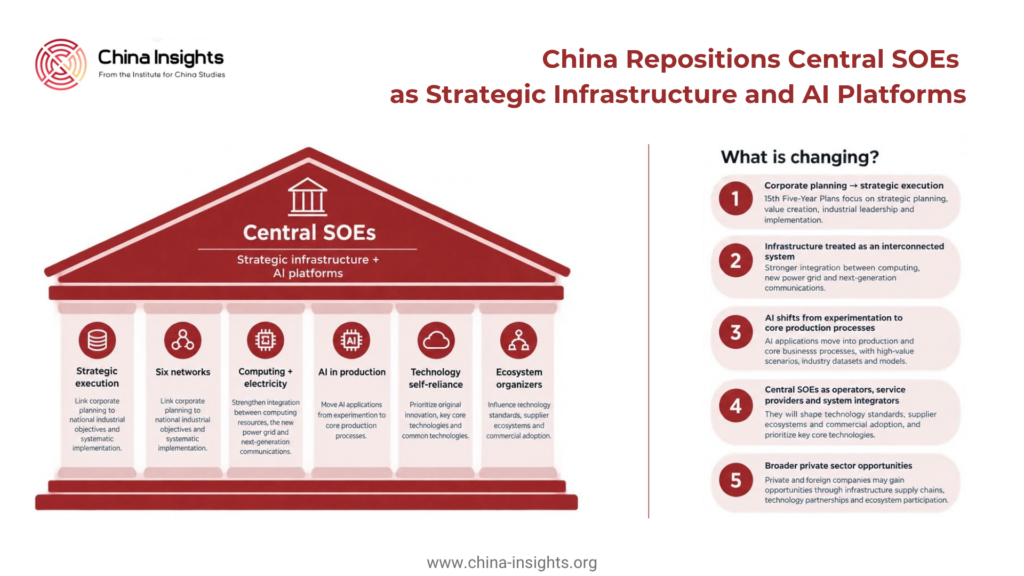
A key change is the greater rigidity of central SOE planning. SASAC stated that the 15th Five-Year Plans of central SOEs will focus on systematic planning, value creation, industrial leadership and implementation. The planning process includes 106 industrial development actions and links planning with annual plans, projects and evaluation.
This creates a more direct connection between corporate investment decisions and national industrial objectives. Central SOEs will therefore increasingly be assessed not only on financial performance but also on their contribution to strategic industries, infrastructure and technological capabilities.
The direction is consistent with SASAC’s broader objective of optimizing the structure of the state-owned economy and concentrating resources in areas linked to national security, economic stability and emerging industries.
Six infrastructure networks become a major investment channel
The six networks, water, electricity, computing, communications, urban underground infrastructure and logistics, have become a major implementation mechanism for the opening phase of the 15th Five-Year Plan. Central SOEs have planned approximately RMB 2 trillion of related investment for 2026.
The important change is that these networks are increasingly being treated as an interconnected infrastructure system. SASAC specifically called for stronger integration between the computing network, new power grid and next-generation communications network. Digitalization of logistics and underground urban infrastructure is also being prioritized.
This creates a broader infrastructure market. Projects are less likely to be assessed as isolated assets and more as components of integrated national systems.
Computing and electricity move closer together
The policy direction places greater emphasis on computing-power and electricity coordination. SASAC intends to expand computing-network investment while promoting more efficient and environmentally compatible intelligent computing centers. It also supports greater integration between computing resources and power infrastructure, including green electricity supply.
This is commercially relevant because AI infrastructure is increasingly constrained by energy availability, grid capacity and operating costs. The closer integration of computing and electricity planning could influence where new data centers and AI infrastructure are developed.
It also expands potential demand for power-management systems, energy storage, cooling, network infrastructure and technologies that improve computing efficiency.
AI moves from experimentation to industrial deployment
Central SOE AI policy is also entering a new phase. SASAC reported that the existing “AI+” special initiative has produced progress in applications, data, computing power, models and industrial ecosystems. The next stage will focus more heavily on applying AI in production and core business processes.
The emphasis is therefore shifting from demonstrating AI capabilities to achieving measurable operational impact. Central SOEs are expected to develop high-value application scenarios, strengthen industry datasets and expand the use of industry-specific models and intelligent agents.
This could accelerate demand for industrial AI, data infrastructure, model development, cybersecurity and systems integration. It also creates a large potential test market for technologies that can demonstrate reliability in industrial environments.
Central SOEs become ecosystem organizers
SASAC is positioning central SOEs not only as users of technology but also as operators, service providers and system integrators. The stated objective is to encourage other companies to participate in infrastructure development and share the resulting opportunities.
This model could create opportunities beyond direct procurement. Central SOEs control extensive industrial assets and supply chains. Their participation can therefore influence technology standards, supplier ecosystems and commercial adoption across entire sectors.
For smaller technology companies and foreign suppliers, access to these ecosystems may become more important than competing for individual projects.
Technology self-reliance remains a parallel priority
The stronger role assigned to central SOEs is also linked to technological self-reliance. SASAC has called on them to increase support for original innovation, key core technologies and common technologies, while strengthening their role as national strategic technology forces.
This creates a mixed competitive environment. China continues to encourage cooperation and participation by different types of enterprises, but strategic technology capabilities will remain subject to strong domestic policy priorities. Companies operating in critical infrastructure and technology supply chains therefore need to distinguish between commercially open markets and strategically sensitive areas.
What this means for business
- Infrastructure suppliers: The six-network program creates opportunities across energy, computing, communications, logistics, water and urban infrastructure.
- AI companies: Industrial AI and production-level applications are likely to receive greater attention than standalone consumer applications.
- Technology providers: Partnerships with central SOEs may provide access to large industrial ecosystems and deployment environments.
- Energy and data-center businesses: Computing-power and electricity coordination will increasingly influence infrastructure investment decisions.
- Foreign companies: Market opportunities remain, but participation will depend increasingly on alignment with national technology and infrastructure priorities.
- Investors: Central SOE investment plans provide an important indicator of where China expects infrastructure and industrial demand to develop during the 15th Five-Year Plan.
Sources
https://www.gov.cn/zhengce/202609/content_7082329.htm
Author
Dr. Richard van Ostende
Related Articles