
China Sets a Broader Agenda for Expanding and Upgrading Goods Consumption
China is broadening its approach to stimulating domestic consumption. On 13 August 2026, the Ministry of Commerce (MOFCOM), together with six other ministries and agencies, issued the Implementation Opinions on Promoting the Expansion and Upgrading of Goods Consumption. MOFCOM published its official policy interpretation on 31 August 2026.
The measures go beyond subsidies and replacement programs. They target the full consumption chain, from product supply and standards to distribution, financing, after-sales services and recycling. The objective is to expand demand while changing what consumers buy and how goods are supplied to the market.
Executive summary
- China is shifting from primarily stimulating consumption toward expanding and upgrading the overall goods-consumption market.
- Policy support is being extended across automobiles, home appliances, home furnishings, food, clothing and consumer products.
- Green, smart and health-related products are identified as priority growth areas.
- Product standards, branding, financing, recycling and distribution infrastructure are becoming more important policy levers.
- Companies will face stronger incentives to improve product quality, technology content and consumer services rather than compete mainly on price.
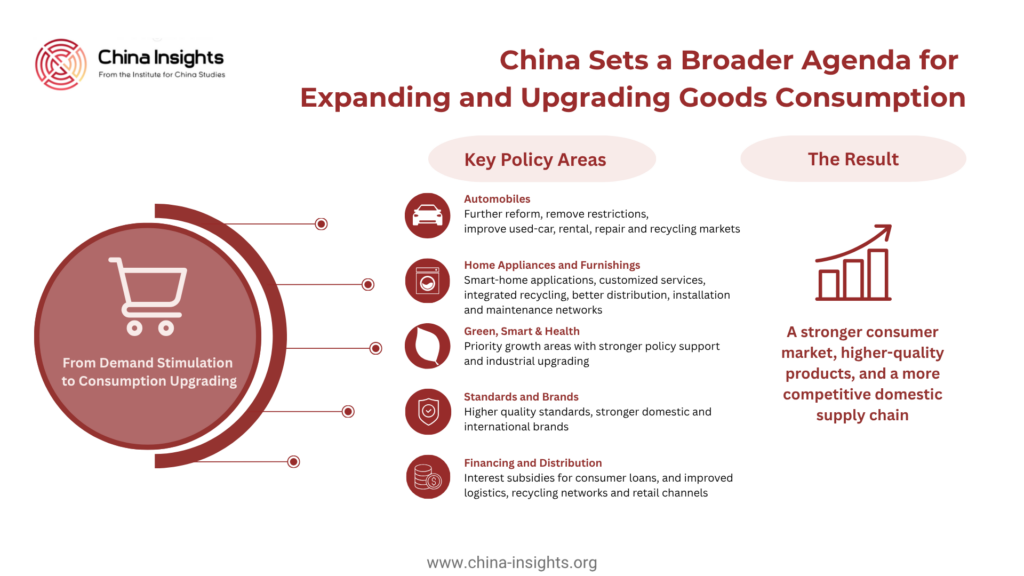
From demand stimulation to consumption upgrading
The new measures form part of the consumption agenda under the 15th Five-Year Plan. The central government is seeking to combine stronger consumer demand with improvements in the quality and structure of domestic supply. MOFCOM stated that the policy is designed to promote both the expansion of consumption and its structural upgrading.
This represents an evolution from the recent emphasis on consumer-goods trade-ins. Replacement programs remain relevant, but the new framework is broader. It addresses the entire consumption ecosystem and seeks to create sustained demand for higher-quality products and new consumption categories.
Durable goods receive a full-chain policy approach
Automobiles, home furnishings and household appliances receive particular attention. The policy calls for further reform of automobile circulation and consumption, removal of unreasonable restrictions and improvements in the used-car, rental, repair and recycling markets.
For home appliances and furnishings, the emphasis is increasingly on smart-home applications, customized services and integrated recycling. The policy also calls for better distribution, installation, maintenance and collection networks. This moves support away from the point of purchase and toward the complete product lifecycle.
Green, smart and health consumption become growth priorities
A significant change is the explicit prioritization of green, smart and health-related consumption. These categories are positioned as new areas of consumption growth rather than simply as niche segments.
The approach creates a stronger policy connection between consumer demand and industrial upgrading. Companies developing products with higher technology content, energy efficiency, health functions or smart capabilities are likely to operate in segments receiving greater policy attention. MOFCOM has also highlighted technology development, improved standards and stronger brands as key elements of the approach.
Standards and brands become competitive factors
The policy places greater emphasis on upgrading consumption standards and strengthening domestic and international brands. It calls for improvements to the consumer-goods standards system and supports brand development across both domestic and international markets.
This matters because standards increasingly influence market access and product competitiveness. Companies will need to compete not only through pricing and distribution but also through product quality, certification, technology and brand positioning. The policy also supports the development of Chinese brands and encourages domestic and foreign brands to expand within China.
Financing and distribution are being strengthened
The new framework also expands the policy focus to consumer finance. It calls for the use of interest subsidies for personal consumer loans and encourages financial institutions to develop products supporting automobile, appliance, digital-product and smart-home consumption.
At the same time, China is seeking to improve the physical and commercial infrastructure supporting consumption. This includes urban and rural consumption facilities, logistics, recycling networks and retail channels. The objective is to reduce friction between consumer demand and product availability.
Market rules and transaction costs
The policy also addresses the institutional side of domestic consumption. The seven departments call for wider use of domestic trade transaction guidelines and greater consistency in market transaction rules. Enforcement against counterfeit goods, misleading marketing and intellectual-property violations is also emphasized.
This is relevant for companies operating across multiple Chinese markets. Greater consistency in commercial rules could reduce transaction costs and improve market access. At the same time, stronger enforcement increases the importance of compliance in marketing, product quality and intellectual-property protection.
What this means for business
- Product strategy: Green, smart and health-related product features are becoming increasingly aligned with national consumption priorities.
- Beyond subsidies: Companies should assess the complete consumer journey, including financing, distribution, installation, maintenance and recycling.
- Technology and standards: Product development will need to keep pace with evolving standards and stronger expectations for quality and functionality.
- Brand positioning: Brand strength and differentiated product value are becoming more important as China seeks to move consumption toward higher-quality products.
- Market access: More consistent domestic trade rules could reduce regional barriers, while stronger enforcement will increase compliance requirements.
- Local market strategy: Companies should align product and channel strategies with changing consumption patterns among different consumer groups and regions.
Sources
https://www.gov.cn/zhengce/202608/content_7079711.htm
Author
Dr. Richard van Ostende

Related Articles