
China's 15th Five-Year Plan for a New Energy System
On 25 June 2026, the National Development and Reform Commission (NDRC) and National Energy Administration (NEA) released the 15th Five-Year Plan for the Construction of a New Energy System. The plan outlines China’s energy priorities for 2026–2030 and marks a shift from expanding renewable capacity toward building an integrated energy system that combines energy security, digitalisation, market reform and industrial competitiveness. For businesses, the policy highlights where investment and regulatory support are expected to concentrate over the next five years.
Executive Summary
China aims to establish a clean, low-carbon, secure, and efficient new energy system by 2030.
Total energy production capacity is targeted to reach 5.8 billion tons of standard coal equivalent.
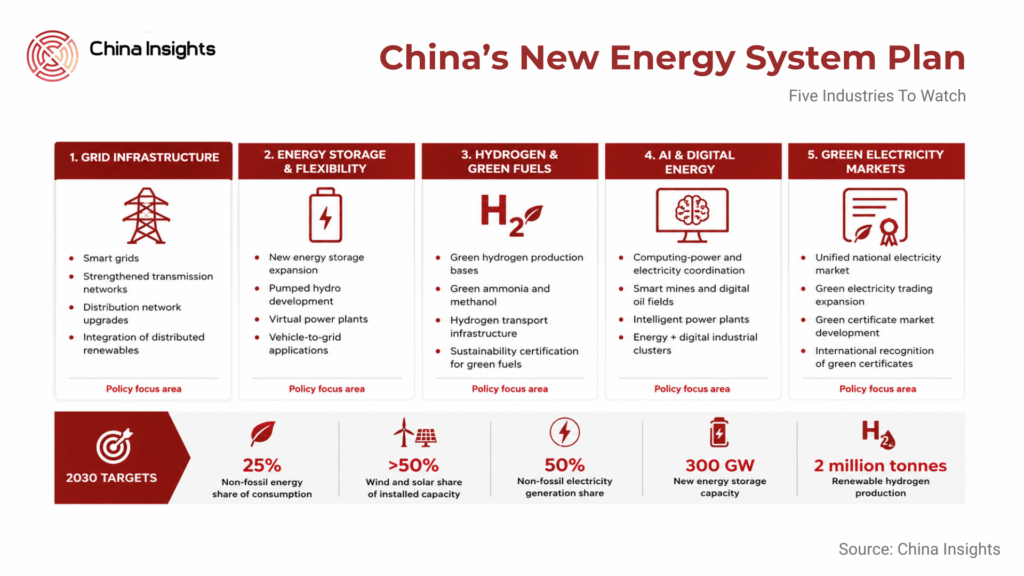
Non-fossil fuels should account for 25% of total energy consumption by 2030.
Wind and solar power are expected to account for more than 50% of installed electricity generation capacity.
Non-fossil electricity generation should reach 50% of total power generation.
New energy storage capacity is targeted to reach 300 GW and pumped hydro capacity around 160 GW.
Virtual power plants should provide more than 50 GW of flexible demand response capacity.
China plans to accelerate hydrogen development, green fuels, and artificial intelligence applications in the energy sector.
The plan further advances electricity market reforms and the expansion of green electricity and green certificate markets.

Energy Security Remains the Foundation
In China, energy transition and energy security are considered inseparable. China’s policymakers describe the current period as one characterized by overlapping security risks, accelerating the low-carbon transition, technological disruption and changing international energy relations. The country aims to increase its comprehensive energy production capacity from 5.13 billion tons of standard coal equivalent in 2025 to 5.8 billion tons by 2030.
Further priorities are diversification of energy imports, expansion of strategic oil and gas reserves, and the strengthening of domestic energy production capabilities.
Renewable Energy Becomes the Main Source of Installed Capacity
The target of the plan is further expansion of renewable energy. The key measures by 2030 are set:
Non-fossil energy should account for 25% of total energy consumption.
Wind and solar power should exceed 50% of installed generation capacity.
Non-fossil electricity generation should account for 50% of total power output.
Renewable electricity generation should account for approximately 30% of total generation.
Beyond capacity expansion, the plan supports desert renewable bases, offshore wind, geothermal energy, hydrogen and green fuels while expanding renewable energy applications beyond electricity generation.
Read more about China’s Decarbonazation Plans.
Building a New Power System
The rapid expansion of renewable generation requires significant changes to China’s electricity system. Therefore priorities lie with the construction of a new power system capable of accommodating a high share of intermittent renewable energy. By 2030:
Total installed power generation capacity should reach 5.4 billion kilowatts.
Distribution networks should be capable of integrating 900 GW of distributed renewable energy.
Additional west-to-east electricity transmission capacity should exceed 80 GW.
Furthermore, China aims to accelerate smart grid development, strengthen inter regional power transmission and improve nationwide grid resilience.
Storage and Flexibility Become Strategic Priorities
Moreover, China plans to expand energy storage technologies rapidly and demand-side management solutions.
By 2030, they set their key measures:
Pumped hydro storage capacity should reach approximately 160 GW.
New energy storage capacity should reach around 300 GW.
Electricity demand response capability should exceed 5% of peak demand.
Vehicle-to-grid charging resources should reach around 50 GW.
Virtual power plants should provide more than 50 GW of demand response capacity.
The plan also supports smart micro grids, direct green electricity supply projects and integrated energy systems. These measures are designed to improve renewable energy integration and reduce curtailment risks.

Hydrogen and Green Fuels Move into the Mainstream
Hydrogen moves from pilot projects to a strategic industry under the new plan. China intends to expand green hydrogen, ammonia and methanol production, transportation infrastructure and certification systems, targeting around two million tons of renewable hydrogen production by 2030.
Hydrogen and green fuels are expected to play an increasing role in transportation, industrial processes, energy storage, chemicals and metallurgy. Additionally, the plan introduces the establishment of sustainability certification systems for green fuels, suggesting that China intends to develop internationally recognized standards in this field.
Artificial Intelligence and Computing Infrastructure Enter Energy Planning
For the first time, artificial intelligence and computing infrastructure are deeply integrated into China’s long-term energy strategy.
The plan promotes “computing-power and electricity coordination”, encouraging the joint development of data centers, renewable energy, electricity infrastructure and digital energy applications. Moreover, the government plans to build “energy + digital” industrial clusters, develop smart mines, digital oil fields and intelligent power plants and promote the integration of artificial intelligence throughout the energy value chain. The policy recognizes AI-driven electricity demand as a new driver of energy system development.
Market Reform Continues
Beyond infrastructure development, the plan continues electricity market reforms through a unified national market, greater market-based pricing, expanded green electricity and green certificate trading. The government also aims to encourage greater private sector participation in energy infrastructure, reflecting a broader effort to mobilize capital for the energy transition.
The emphasis on increasing the international recognition of China’s green certificates further suggests that energy policy is becoming more closely linked with trade competitiveness, carbon accounting and global sustainability standards.
What This Means for Business
The 15th Five-Year Plan provides a clear signal where policy support, infrastructure investment and industrial development are likely to concentrate through 2030. Five opportunity areas stand out.
Grid infrastructure will remain a major investment theme as China expands transmission networks, smart grids and distributed renewable integration, creating demand for grid equipment, power electronics, digital grid solutions and engineering services.
Energy storage and system flexibility are becoming central to China’s power system. Ambitious targets for battery storage, pumped hydro, virtual power plants and vehicle-to-grid applications are expected to drive demand for storage technologies, energy management software and demand-response solutions.
Hydrogen and green fuels are moving from pilot projects to strategic industries. Expanded support for green hydrogen, ammonia, methanol, transport infrastructure, and certification systems is expected to accelerate investment across the emerging hydrogen value chain.
The integration of artificial intelligence into the energy sector creates a new growth area. The plan’s emphasis on computing-power and electricity coordination is likely to increase demand for green data centers, intelligent power systems, industrial digitalization and energy management technologies.
Electricity market reform will further increase the strategic importance of renewable electricity procurement and carbon management. As green electricity and green certificate markets expand, companies, particularly manufacturers and exporters, are likely to face growing demand for transparent carbon accounting and renewable energy sourcing.
The policy focus is no longer limited to deploying renewable generation capacity. Instead, it is shifting toward the construction of an integrated energy ecosystem encompassing infrastructure, digital technologies, green fuels and market mechanisms. Companies aligned with these priorities are likely to benefit most from policy support and investment through 2030.
Sources
https://www.gov.cn/zhengce/202606/content_7073347.htm
https://www.ndrc.gov.cn/xxgk/zcfb/tz/202606/t20260625_1406079.html
Author
Dr. Richard van Ostende

Related Articles